
Raising alpacas allows a Buxton family to keep a historic farm in agriculture and allows a mother with two children to work at home.
“It’s a nice way to farm and raise your children on the farm,” said Marcia MacDonald on Monday.
MacDonald and her husband, Desmond Williams, own Long Plains Alpacas. They sell products made from alpaca wool at a store on their farm at 301 Long Plains Road in Buxton. They’ve been on the farm five years. They have a daughter, Kaya, 10, and a son, Desi, 4. Kaya attends the Hanson School.
A former 100-acre dairy farm once owned by the Knight family, it was originally built by William Leavitt. The couple is restoring the 1793 farmhouse that features timbers hewed by hand. “I love the house,” MacDonald said.
Now a 10-acre farm, they wanted to utilize the large barn, too. “We felt like we had to use the barn,” she said.
Raising alpacas seemed like a logical choice. MacDonald said alpacas, which originated in the harsh mountainous areas of South America, are “efficient grazers” and work well on a small farm. An acre of pasture can handle up to 10 alpacas. “Alpacas appeal to those who don’t have a lot of acreage,” she said.
Alpacas adapt well to the Maine climate and enjoy being outside. “They do fine in the cold weather,” she said. “Maine is a great place for them. The climate is just right.”
In the summer, MacDonald keeps their alpacas cool, spraying them with a garden hose. She also places “kiddie pools” in their pens so the alpacas can cool off on hot days.
A member of the camel family, alpacas graze on pasture during the summer months. But in winter, they chow on hay supplemented with grain, which the couple has to buy. She said the cost of feeding an alpaca is about the same as a large dog.
She said alpacas have good personalities and like children. “They are very pleasant animals, nice to be around,” she said.
The Buxton family is one of 60 farms in Maine raising alpacas. MacDonald grew up in Ogunquit and didn’t have any farm experience. But as a child, she loved llamas. After marrying, she “dragged” her husband to the Common Ground Fair in Maine.
Williams is from the island of St. Kitt in the Caribbean and has a background in agriculture. He had a flock of sheep as a youngster.
MacDonald and Williams started with six female alpacas and their flock has grown to 30, including 10 adult females. “I would like to have 30 to 40 breeding age females,” she said.
They are steadily increasing the size of the flock. “It allows me to be home,” she said.
Alpacas are expensive. MacDonald said the low-end value of a bred female would be $15,000. Young males sell for between $1,000 and $1,500. They have sold some to “fiber artists” or as pets.
But some have endeared themselves to the family. “I have a few I’ll never sell,” MacDonald said
The family’s alpaca wool is custom processed at a mini-mill in Otisfield. Alpaca wool is known for its softness, strength and warmth. “Their wool is a luxury fiber,” she said.
The couple converted a former milk store, which had fallen in, into a shop on the farm where they sell products made from their alpaca wool. The products include knitted caps, sweaters, scarves, blankets and yarn. They design their products and make some of the items. Their store is open by appointment.
They have open houses periodically throughout the year and they also participate in Maine Farm Days. “We’re right out straight all day,” she said about showing visitors the farm and the alpacas.
MacDonald takes young alpacas to the bedsides of elderly in nursing homes. “I cried,” MacDonald said when she saw the expression of a patient looking at an alpaca. “They’re great therapy animals.”
The Buxton farm also has two adult llamas as pets. But they double as guard animals, protecting the alpacas and ducks, geese and chickens. She said coyotes do visit the farm. The llamas are so protective that she once had to rescue a wild rabbit that had strayed into the alpaca pen.
A border collie, Cody, who they acquired with the farm, is also protective and she said he possesses herding instincts. “Cody is really smart,” she said.
Alpacas are native to Peru, Chile and Bolivia. They were raised by the Incas in South America.
Alpacas grow to about 36 inches at their shoulders and an adult weighs between 100 and 200 pounds. They live up to 20 years old.
Long Plains Alpacas can be reached at 727-3148 or Longplainsalpacas.com or [email protected]
 Marsha MacDonald carries a young alpaca at Long Plains Alpacas in Buxton.
 A curious alpaca i Buxton.
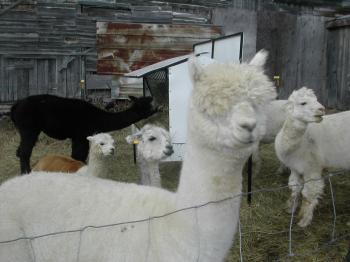 Alpacas are helping preserve a heritage of farming in Buxton.
 Alpacas, native of South America, are flourishing at a Buxton farm.
 (alpacas (Desi) – Desi, four-year-old son of Marsha MacDonald and Desmond Williams, shows one of the many ribbons earned in shows by Long Plains Alpacas in Buxton.
Comments are no longer available on this story