
Scarborough resident Ancilla Parent and her husband, Lorne, have called St. Maximilian Kolbe their home parish for 13 years. Parent attends services about three times during the week, in addition to a weekend Mass.
Now St. Maximilian will be offering fewer weekend Masses, and fewer weekday Masses will be led by priests because of a shortage of priests in the Catholic Church. Representatives from the Diocese will meet with parishioners to talk about the changes at 1 p.m. Sunday at St. Maximilian.
Despite the changes, however, Parent said she’s not worried about the future of her church. “Your faith is not shaken because of fewer Masses,” she said.
The changes, which are part of a proposed reorganization plan announced last April, will affect Catholic churches in Scarborough, Cape Elizabeth and South Portland. The good news for local parishioners is that the diocese doesn’t plan to close any of the churches.
The reorganization dictated that independent churches would be grouped into “clusters” and many of those clusters would lose a priest, including Cluster 22, composed of St. Bartholomew’s in Cape Elizabeth, St. Maximilian Kolbe in Scarborough, St. John the Evangelist and Holy Cross in South Portland. The reorganization will be completed by 2010.
There are already clusters in Maine where two or three parishes share a priest.
With one less priest, the four parishes will be forced to reduce the number of priest-led services offered both during the week and on weekends. Clergy anticipate the change in weekend Masses will affect more people, but some parishioners devoted to their weekday Masses would prefer to attend priest led services.
At St. Bartholomew’s in Cape Elizabeth, about 25 to 30 parishioners attend Mass daily, said Rev. Michael Henchal. He expects that a layperson will lead services in the absence of a priest.
“Those people would still have a place to come,” he said.
Both St. Bart’s in Cape and St. Max’s in Scarborough offer four weekly Masses with priests. That number will be reduced, but by how much remains unclear, said Henchal. It has been recommended that one daily priest-led Mass be offered for the cluster.
The four parishes now offer 12 weekend services. Once a priest is removed, that number will drop to eight and most weekday services will likely be run by laypeople rather than an ordained priest.
Masses better with priest
Scarborough residents Grace and Steve Curran attend services daily at St. Maximilian’s. They’ve been members since before its opening in 1988. Both said they would prefer to have a priest perform a Mass.
In the Catholic religion, only an ordained priest can transform bread and wine into the body of Christ. When a layperson delivers a service, the bread and wine is consecrated by the priest in advance of the service.
“It’s better to have Mass with a priest,” said Steve Curran.
The Currans said traveling to another parish for a priest-led service isn’t out of the question, but attending a layperson’s service would also be all right. This increase in laity participation is part of the Roman Catholic Diocese’s plan to shift clergy responsibility over to the laity.
Parent said, although she recognizes it might not be an ordained priest administering it, it’s important for her to know that Mass will still be offered regularly during the week. She’ll be content, she said, “as long as the Mass is still there.”
Henchal said, although there will be one less priest and fewer services, because of the anticipated increase in lay leadership, there will be fewer administrative duties and more time for parishioners.
Henchal expects that lay people will fill in the gaps where clergy used to be. More lay leaders will be charged with conducting services, performing administrative duties and dealing with finances. Henchal said that as a priest he spends a lot of time on non-worship based duties such as ensuring “the roof is repaired, the grass is cut and the snow is removed.”
Though there will be fewer priests, their time will be spent more in prayer and educational activities of children and adults, he said. Lay people will be hired to deal with administrative duties.
Churches to stay open
Each cluster was charged with making recommendations to the diocese about how best to “cluster” their parishes. Four options were given for clustering parishes. Each option includes one pastor and a centralized team and council to run the cluster. The parishes could join or remain separate. In addition the cluster could choose to build a single church, which would be funded by the sale of the other churches. The final model is a combination of all the models, according to the proposal.
Committee Chairman of the Cluster Planning Committee Scott Ewing said, although the model hasn’t been chosen, none of the churches will close. “A lot of people think churches are going to shut down,” he said.
However, Ewing said the committee found it was financially viable to maintain all four parishes.
In a prepared statement explaining the restructuring of the Roman Catholic Church, Bishop Richard Malone said the number of priests are declining in Maine. He projected that by 2010 there would be 61 priests for all the Roman Catholic Churches in Maine.
Parishes will look to combine services in adult and youth programming, marriage preparation, and other areas of church life. Services that were offered in every parish prior to reorganization may only be offered in one parish.
Henchal expects resistance from parishioners accustomed to their routines. “Everybody wants to get better, but nobody wants to change.”
However, he plans to work a little bit harder “to encourage people to cross those lines.”
 St. Maximilian Kolbe Church on Black Point Road in Scarborough will host an informational meeting for parishioners from its own parish, St. Bartholomew’s in Cape Elizabeth and St. John the Evangelist and Holy Cross in South Portland this Sunday at 1 p.m. The topic will be the Roman Catholic Diocese reorganization announced last April.
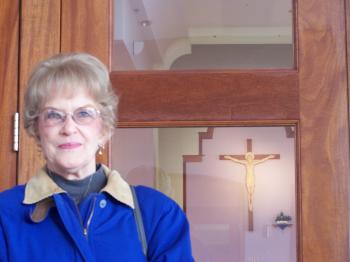 Scarborough resident Ancilla Parent attended Tuesday’s 8 a.m. weekday mass at St. Maximilian Kolbe Church on Black Point Road in Scarborough. Ancilla attends mass three times during the week. By 2010 most of the weekday masses will be lead by laypeople.
Comments are no longer available on this story