
A Westbrook man who pleaded guilty to defrauding investors out of nearly $80,000 is awaiting sentencing in the custody of U.S. marshals after being accused of further fraud while out on bail.
Todd Denson, 46, faces up to 20 years in prison and as much as $250,000 in fines for wire fraud, which he committed after losing his own money to another apparent scam.
He is now awaiting sentencing in jail after telling a judge in a bail revocation hearing Feb. 7 that he believed he was still in the midst of a legitimate business transaction and needed to send more money to be able to get his investors’ money back. The judge refused his request to remain out on bail and has yet to set a sentencing date, which should come some time after April 19, according to the U.S. District Court clerk’s office.
“Since August of this year, my main intent and objective was nothing more than proving my innocence, proving that what is going on here is, in fact, real, even though everybody is telling me that it’s not,” Denson told the court, according to a court transcription of the hearing. “I should know. I’m the one that’s been involved in it for the past year and a half.”
Denson was indicted in federal court in October on seven counts of fraud after losing $60,000 of his own money in an apparent Internet scam, and then scamming others for additional money.
Denson told investigators that he received an e-mail requesting money to pay taxes on an inheritance in Ghana, which would entitle him to the inheritance – an estimated $9 million.
According to Westbrook Police Chief Paul McCarthy, scams such as these are fairly common, particularly from overseas perpetrators. McCarthy said he has personally received four e-mails that were scams this year, with one last week saying he had won a London-based lottery. He said police receive reports of these scams, although the frequency of the reports is declining because they are so common. Yet, some people still fall prey to them, he said.
According to Mike Magalski, head of the Secret Service branch in Portland, some of the scams are sophisticated enough to dupe anyone. He said 99 percent of people scammed say they knew it was a scam when they first saw it, but were convinced it was real after responding to the e-mail. Magalski said the most important thing to remember is not to respond, because a person is then in contact with a con artist.
Magalski said the most common form of the scam is based on false checks, which can take up to two or three months to identify as false. By that time, the damage is done.
As he explained it, a person will begin correspondence with a con artist, who will offer to send a check for $100,000 if the person agrees to send $50,000 of the money to another account. The person will receive the check, and the bank will credit his or her account. The person will then send a check for $50,000 to another account. When the bank realizes the original check was false, it requests the $50,000 back for the second check.
In most cases, U.S. law enforcement can’t help someone who was conned because the base operations of the scammer is almost always located in a country that does not cooperate with the United States, such as Nigeria. However, the con artist will work through a second country, such as England or Canada, so as not to tip off the person being scammed, who might have heard of a Nigerian scam. The money will undergo several wire transfers to reach the con artist.
“On the face of things, you’re not seeing the big picture,” said Magalski.
That appears to be the case with Denson. After running out of his own money, Denson conceived a scheme to get money from others, authorities say.
According to court documents, Denson placed a classified advertisement in a local paper advertising a $20,000 return on a $40,000 investment within 48 hours.
In one scam, Denson told investors that he had made millions of dollars in sales of heavy machinery. In a second scam, he told investors he had made an excess of $9 million from inventing and patenting window-washing equipment. After receiving responses to his advertisement, he told investors he needed to pay a fee to release the money from overseas banks.
After pleading guilty to two counts of mail fraud and five counts of wire fraud involving communications via Internet and money transfers to Ghana and Scotland in October, Denson was released on bail, whereupon he began a third scam to raise more money.
Magalski said Denson rented a Westbrook residence to at least three people, acquiring money from them, and then sending the money overseas.
“He keeps sending it, and everyone keeps telling him it’s a scam,” said Magalski.
The Westbrook police contacted the Secret Service after receiving complaints that Denson had rented his McKinley Avenue residence to multiple parties, according to an affidavit written by Secret Service Special Agent Martin Conley. Magalski said the Secret Service became involved in the case because the fraud involved the use of computers.
According to the affidavit, Denson collected more than $2,000 in deposits and first month’s rent from two people in January after showing them the home and providing them a lease agreement. Meanwhile, he had already rented the apartment in December to a third party.
At the Feb. 7 bail revocation, hearing Judge David Cohen refused bail, stating he believed Denson would commit further crimes to raise more money for his overseas venture.
“Frankly, your statement to the court was not in your best interest because it suggests that you are essentially a desperate man doing anything that you have to to continue to raise funds to secure this inheritance,” Cohen told Denson at the hearing.
While Denson understands now that he will go to jail for his crimes, he apparently still believes he will receive the $9 million if he continues to send more money.
“If I don’t get this done within these next four or five days, these people will indeed lose their money,” he said. “If I go to prison, it won’t get to happen. That’s why I’ve been very determined to get this done.”
Calls to Denson’s Portland lawyer, Joel Vincent, were not returned.
 Westbrook man awaiting jail, $9M payday
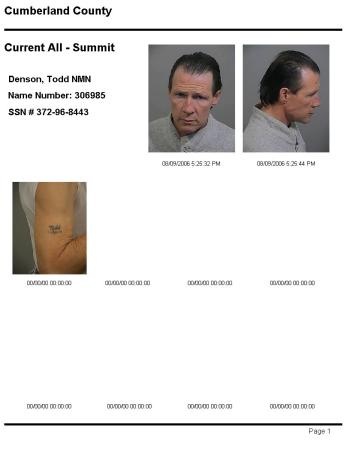
 Todd Denson, the Westbrook man awaiting sentencing on fraud charges, is shown in this photo from the Cumberland County Jail.
Comments are no longer available on this story