
For the first time in nearly three decades, the Snell Family Farm in Buxton won’t be producing maple syrup this year and won’t be a host farm for this weekend’s traditional Maine Maple Sunday.
With energy costs and other demands in their farming operation increasing, Ramona and John Snell made the decision to stop boiling down maple sap.
“It was marginally profitable in a good year,” Ramona Snell, a former English teacher in Cape Elizabeth, said Tuesday.
During Maine Maple Sunday in the past, Snell Family Farm has served up to 2,000 people in two days in a cafa. The structure is now used full time as a greenhouse.
She said the turnouts were tremendous and had grown from a small beginning.
“It snowballed over the years,” she said.
“They’re disappointed,” Snell said about their customers, but added most understood the business decision.
The farm began production of maple syrup in 1980, and in recent years produced about 100 gallons of syrup annually. It was boiled down from 4,000 gallons of sap gathered from 300 taps on maple trees.
Several neighbors allowed the Snells to tap and collect sap from their trees. Pails of sap were picked up using a diesel truck equipped with a tank to hold the sap.
It was then hauled to their sugar shack, where the sap was boiled in an evaporator fired by wood.
Last year’s price of diesel fuel contributed to the decision to halt their maple syrup production. In another energy-saving measure, the farm diverted use of the firewood from the sugar to a greenhouse.
“It’s a long-term look at the energy problem,” Snell said of the changes, citing what she called the governor’s warning not to get lulled into complacency now that prices have fallen.
Hired hands helped collect sap. On Maine Maple Sunday, cooks and a wait staff served the public.
Maple syrup kicked off the season at the farm.
“It was a great connection to the community,” she said. “We were high profile, but we were small,” she said about maple syrup production.
They sold the maple syrup equipment.
Time was another factor in halting the maple syrup production, as more greenhouses were added and became more labor intensive.
In the former cafa, covered in clear plastic, tomato seeds were planted on Feb. 28 and other vegetables, including onions, and flower seeds are being sown.
“Greenhouses take careful management,” she said.
Their daughter, Carolyn Snell, and son-in-law, Victor Amarilla, work with them at the farm. They sell their produce at the farm and at farmers markets in Portland and Saco.
The farm plants about 20 acres, including five acres of apple trees, 1.5 acres of potatoes and a half acre of raspberries. During the peak of the growing season, the farm employs 20, including both part-time and full-time seasonal workers.
The farm has been in the Snell family since 1926, when her husband’s grandfather bought it. Over the years, an apple orchard provided an abundance – enough to sell in Boston as well as locally. Apples and eggs were also marketed and the farm kept a couple of cows for milk and butter.
But the maple syrup business made a lot of memories for the Snells. After 29 years, thoughts often are about the time-honored Maine maple syrup ritual.
“This would be a good sap day,” she said, citing an often-used family expression at this time of year.
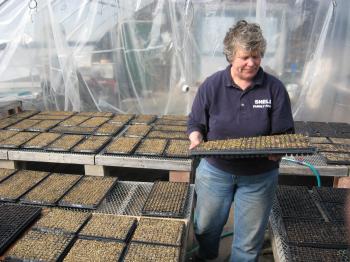 cutline (Snell Farm 1) – Ramona Snell carries a tray of seedlings Tuesday in a green house that was once a cafe where pancakes and maple syrup were served on Maine Maple Sunday. The farm no longer produces maple syrup.
Comments are no longer available on this story