
Maine Education Commissioner Susan Gendron came to Old Orchard Beach High School Monday night for a frank give-and-take on the state’s budget troubles. And there was plenty of giving and taking.
Gendron headlined an informational forum to explain the dilemma facing school districts, from a $38 million curtailment this year to expected cuts in the next two years, and offer a few suggestions, including collaboration between districts on special education, salary freezes and state support for any district willing to “look outside the box.”
More than 100 school board members, administrators, teachers and the public were interested in Gendron’s point of view, but they were also more than willing to offer their own, oftentimes skeptical, opinions.
John Bird of Old Orchard Beach was perhaps the most skeptical, reacting strongly when Gendron said Gov. John Baldacci was not willing to raise taxes in order to address state budget shortfalls. Bird said passing the burden down to cities and towns amounted to a tax increase, a different kind of unfunded mandate where the state requires a quality education for students but is not willing to pay for it.
“Why on earth should anybody in local municipalities have any faith in state government?” asked Bird. “We will not have the same quality of education we are trying to provide now.”
Gendron said Maine has the lowest class sizes in the county, nine students for each teacher. She admits many classrooms have more students but asked, “Can we afford to afford having the lowest in the country?”
The education commissioner heard calls for less testing, which she supports, and dread over decisions whether to cut salaries or raise taxes. Gendron said there are ways to avoid big local tax increases but pointed out how state workers have taken salary freezes and furlough days to keep their jobs. While she does not favor furlough days for school districts, she does see salary freezes as a way to avoid major layoffs.
Connie Bandendries of Saco, a retired Biddeford special education teacher, urged the public to get involved in this discussion.
“It can’t just be a few people making the decision,” said Bandendries, who added some superintendents “need to crack some whips” to shape up their districts.
Streamlining reporting requirements to the state and a simpler formula for essential program and services funding was suggested. Gendron said the biggest problem with Maine’s education funding formula for many districts in southern Maine is their high property valuations.
Along with the $38 million curtailment announced in early December, school districts across Maine can expected to see another $35 million cut in general purpose aid to schools in the 2010-11 fiscal year, according to Baldacci’s proposal. With federal stimulus funds going away, the 2011-12 fiscal year could see a drop of $59 million in money for schools.
In Regional School Unit 57, this year’s curtailment totals $766,313.37, and the school board has approved a plan that includes laying off six teachers in order to close the budget gap.
The plan approved by the school board relies on using $250,000 in the reserve fund set up earlier this year in case of another state aid cut, $300,000 in freezing non-salary expenditures, $25,000 in freezing all non-essential hires and overtime and an estimated $68,000 in revenues from MaineCare.
The layoffs represent $123,300 in savings, including not filling a vacant full-time educational technician and cutting a part-time custodian. Administrators would take three furlough days as part of the plan.
Lynne Armstead of Shapleigh is rallying to prevent the teacher layoffs through a signature collection effort. School officials have said they may be able to avoid layoffs this year, but budget scenarios for next year include anywhere from 50 to 60 layoffs depending on how big, if at all, taxes would be increased.
Gendron handled the many questions asked, promising to read and answer all e-mails she receives with questions or suggestions. Her e-mail address is [email protected].
She also promised the state would work with districts that consider innovative and creative ways to do things differently, describing this approach as a near necessity given the financial times.
“We need to think about doing business differently,” said Gendron, who expects state support of K-12 education to drop to 45 percent.
Regional School Unit 23 Board member Gary Curtis introduced Gendron and called education funding the “big elephant in the room.” Curtis had sent the education commissioner a letter last year asking for more communication with school boards on the state budget. He came away pleased with the forum based on the strong turnout and Gendron’s message.
“This was excellent,” Curtis said. “We had a good mix of the public, school boards and education professionals. There were a lot of questions, some pointed. But I’m leaving feeling very positive. There’s a light at the end of the tunnel. There are solutions out there.”
Curtis believes one of those solutions is regionalization. He said RSU 23 became one of the larger districts in the state after consolidation, and he foresees a regional approach and collaboration helping to lower the cost of health insurance, payroll services and purchasing in general.
“I think it’s the only way to go,” he said.
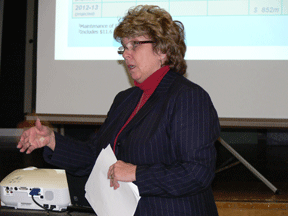 Maine Education Commissioner Susan Gendron explains a point during a Monday night forum at Old Orchard Beach High School about the budget difficulties facing the state and how school districts might be able to manage the situation. (Staff photo by Dan Bustard)
Comments are no longer available on this story