
WESTBROOK – Curt Sachs, an architect offering his services to Westbrook as the city explores the restoration of the Walker Memorial Library, calls the structure built in 1894 a “treasure that almost got lost.”
The city has taken a big first step in ensuring that treasure remains standing for generations to come. The City Council voted Monday night to award the bid to Great Falls Construction in Gorham for the first phase of library repairs that will focus on stopping water from infiltrating the library.
Great Falls’ bid was the lowest of five the city received for the project, coming in at $332,200. City Administrator Jerre Bryant said he was pleased with the pricing.
“For this portion I anticipated a higher number,” he said.
Councilors voted unanimously to award the project to Great Falls, which has worked on other Westbrook projects, including the artisans’ condos on Main Street.
“I feel that we have got a good start at a good price for this portion,” Councilor Paul Emery said at Monday’s meeting.
According to Bryant, the main focus of this phase is to hold back the water that has been eating away at the library. Its condition continues to worsen and the weather this winter has not helped matters, he said.
“I know we’ve had some leaks,” he said.
Bryant said Great Falls Construction would be restoring the slate roof, doing masonry work and improving site drainage to prevent future leaks. The scope of work includes removal and replacement of the slate roof – while reusing as much slate as possible – re-pointing the masonry and granite on the side of the library facing Main Street, repairing and replacing terra cotta elements, re-installing the granite steps that have been removed, installing perimeter drainage and general painting and repairs of exterior features.
The work in this contract is not everything the city hopes to complete in the first phase of the project. Bryant said the city has budgeted $760,000 in total funding, including an $85,000 energy efficiency grant that would pay about 50 percent of the cost of replacing the old oil-fired steam radiator heating system.
Any money remaining after the Great Falls project and the heater replacement could go toward mold abatement and other necessary work, Bryant said.
The total restoration project is estimated to cost $2.2 million. Bryant said completing it in phases is the responsible and necessary way to handle the project in a time when the city is struggling to find funding for all its projects.
“We may not be able to totally restore it, but we can stem the damage,” he said.
The city has found great value in Sachs, an architect and instructor in the University of Maine at Augusta’s architecture school who has volunteered his services to help develop a strategy for the project.
“I don’t think this project would be able to get done without it,” said Brendan Rielly, president of the City Council.
The council authorized Monday an agreement to provide Sachs with professional liability insurance at a cost of $1,575. Bryant described it as a boilerplate agreement for pro bono services.
Karen Valley, library director, said she could not find an adjective to describe how useful Sachs has been through the process so far. That is high praise coming from someone who surrounds herself with books for a living.
“He’s saving the city thousands and thousands of dollars,” she said.
Sachs, of Portland, said he is volunteering his services because “it seemed like the right thing to do” to help restore a “lovely building” from the Queen Anne period. Designed in 1894, the Walker library was constructed during the Industrial Revolution, he said.
“It’s a period that sort of bridged the old with the beginning of the new,” he said.
The majority of activity at the library takes place in the new section, while the grander spaces cannot fulfill their full potential due to the water issues. The first floor gathering room is currently part storage and part staff break area because of water damage downstairs, he said.
Valley said space was tight to begin with, but became even harder to find after the library added 25,000 volumes from the old Warren library last year.
According to Sachs, historic restorations can be tricky because the contractor must follow the parameters the National Park Service established for buildings on the Historic Register. Materials from the period must be used when possible, which can be a challenge; for example, Sachs said the roof is made of Monson slate, which originates from a quarry that is no longer active.
Another challenge with old buildings, he said, is that some damage is only uncovered after the work begins. The first phase includes 20 percent contingency to deal with unforeseen conditions encountered during construction.
“In an old building, you only know so much. There may be some surprises,” he said, adding, “The building has good bones. Some of the fingers and toes need to be replaced.”
Sachs said roof work should begin April 1 and the phase should be complete by mid-August.
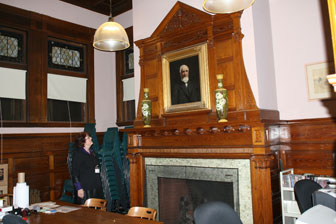 Karen Valley, director at Walker Memorial Library, looks up at a portrait of benefactor Joseph Walker in the historic portion of the library.Staff photo by Joey Cresta
Comments are no longer available on this story