
WESTBROOK – In the past few years, according to Owen Smith, vice president of external affairs at AT&T Corp., the surge in demand for data on cell phones, tablet PCs and other portable devices has been a shock to providers like his.
“We were caught off guard. The industry was caught off guard,” he said. “We’ve been sort of playing catch-up ever since.”
This week, the telecommunications giant announced it has made some headway, in Maine anyway. On Monday, the company held a press conference in Westbrook to tout what the company has been doing to improve voice and data service in Maine.
The conference took place at a facility that serves as the central hub for all traffic, voice and data, for every AT&T customer in Maine and New Hampshire. It is a small, nondescript building, with no signs or other obvious indicators that it is even owned by AT&T, and that’s by design. Executives were even uncomfortable Monday disclosing the facility’s Westbrook address publicly, citing “security reasons.”
But they did allow an unprecedented tour of the building, describing in detail what it does, and how important it is to service in two different states.
“This network, in and of itself, manages everything,” Brian Burchette, area manager for the company’s operations, said, gesturing to the building. Built in 1991 by the now-defunct Vanguard and Cellular One companies, it has more than doubled in size since then, as AT&T took it over and expanded it.
Today, among other systems, the building uses batteries and power generators to make sure the center stays up no matter what. The biggest test for the backups came during the infamous ice storm of 1998. For three days, Burchette and other technicians said, the center provided its own power, and could keep going indefinitely, provided the generators had enough fuel.
To a lay person, most of the building’s windowless rooms house equipment that looks like what hides in the back rooms of the IT departments of most businesses – tangles of multi-colored wires attached to circuit boards in floor-to-ceiling cabinets, humming quietly with an array of flashing lights.
But this building is responsible for handling 6.5 million telephone calls a day, and countless bits of data from text messages, email, and other Internet-based communications. Smith said the company has witnessed an 8,000 percent growth rate in data usage nationwide over the past four years, and the company expects to see 8-10 times that much growth over the next four years. At this rate, he said, it’s possible the network may someday handle more data traffic than voice calls.
“Data is becoming more and more important,” he said.
Some of the equipment in Westbrook bears witness to that change. In one room, a bank of circuit boards is connected by thick copper “T1” lines, which used to be the fastest connective cables around.
But that was 15 years ago. Today, copper cables have been left behind by newer fiber optic lines. Newer rows of boards are connected to those, and as a result, Burchette and other technicians said, the new lines can send data back and forth more than 60 percent faster.
As Burchette showed reporters around, he stopped at a bank of wires and circuit boards taller than the average person’s head, and at least as long. He called it a voice call switch bank, which helps route phone calls. In the 1980s, a bank that handled the same volume of calls would have been about 12 times that size, he said.
Other upgrades in recent years included making the center compatible with 3G technology, a type of wireless signal that is faster and more efficient. Burchette said the center has been upgraded to work with the 3G signal.
“We’ve already added the equipment, the routers, it’s all here in this building,” he said.
That upgrade represents part of $60 million in improvements he said the company has made in Maine from 2008 to 2010, along with upgrades to cell towers in 60 different Maine communities, and the adding of 26 new communities to the network.
Steve Krom, vice president and general manager for AT&T’s New England operations, said Maine, compared to other states in the region, has a population spread out over a much larger area, making it harder to get full coverage to everyone, but that’s part of the future goals for the company in Maine.
“We continue to make investment to improve that coverage,” he said.
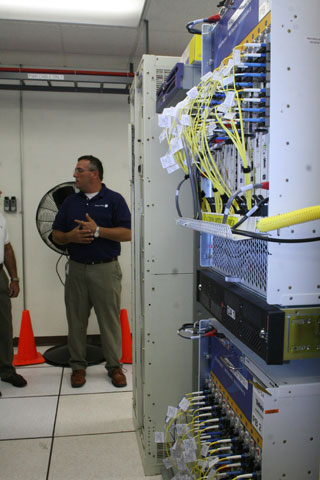 Brian Burchette, area manager for operations for AT&T Corp.,
Comments are no longer available on this story