
FREEPORT – Limbeck Engineering is no multi-million-dollar engineering firm, with dozens of employees.
In fact, Limbeck Engineering has no employees, per se. But it does have four brilliant young minds: Freeport High School seniors Liam Wade, Nick Nelsonwood and Travis Libsack, and junior Josef Biberstein.
Since last summer, these four young men have been working on an inexpensive “submersible,” or submarine, that can be marketed for research purposes. Because they will seek a sale price of about $5,000 for the “AUV/ROV Submersible,” they had to set up a limited liability company. They called the firm Limbeck Engineering.
An AUV is an autonomous underwater vehicle, and an ROV is a remotely operated vehicle. They’ve named their initiative Project Robo Goby. Wade, Nelsonwood, Libsack and Biberstein hope to have the remote-operated submarine – which they figure will weigh less than 100 pounds – ready for market toward the end of next summer. They have contacted both the Gulf of Maine Research Institute and Bigelow Laboratory for Ocean Sciences to gauge interest.
The students are in the process of raising capital for the business. They figure they will need about $5,000.
“Construction has not yet begun,” Nelsonwood said. “We started internal. We’re working on something that does the basic tasks for our senior project. We’ll build the actual submarine around that.”
The students are raising money, selling T-shirts and soliciting from local businesses.
“This project has amazing potential,” Wade said. “Currently there are very few cheap, research-oriented submersibles. While large institutions can purchase ROVs like these, there is nothing reliable out there for private investors or businesses. This project also gives us the unique opportunity to innovate in a field that is lacking.”
Biberstein said that the project started almost as “a whim.”
“We developed a bunch of ideas, and we decided on this, because in the market we see it as having the most room for improvement,” he said.
Kierston Foley Donovan, a science, technology and mathematics teacher at Freeport High, said that dedication is “an understatement” regarding the four students.
“They work tirelessly on their submarine in and outside of school,” Donovan said. “Liam, Joseph, Nick and Travis’ motivation is intrinsic and inspiring.”
Both the Gulf of Maine Research Institute and Bigelow Laboratory for Ocean Sciences are nonprofits. Katie Wurtzell, a graduate research assistant at the Gulf of Maine Research Institute, said that she met with the students two months ago. The organization might not have a use for the ROV, but she was able to refer them to people who might be interested, Wurtzell said.
“I was really impressed with them,” Wurtzell said. “I talked to them about how it might be useful in oceanography, and for fishermen. I referred them to a person I know who has a mussel farm.”
Wurtzell, a graduate student in oceanography at the University of Maine, said that the price of the ROV will work in the students’ favor.
“Typically,” she said, “ROVs are very expensive. That’s what really caught my attention, that they were going to make this thing for an inexpensive amount. I was really impressed with how much research they’ve done on their own. The kids are doing something really unique here.”
Wade said that the AUV/ROV Submersible might afford organizations a less-expensive methodology for studying fish populations, by using their device instead of – for example – using divers again and again.
This past autumn, the students integrated all of the computer components – video streaming, motor controller, sensors, data/power transferring techniques. Now they’re focusing on the shell and float finishing, which they hope to complete by the end of May.
They’re in uncharted waters, so to speak.
“Obviously, a project like this is bound to run into many problems,” Wade said. “We are aware that we may not finish by the designated date, but will try as hard as we can to meet our goal.”
The concept evolved last year in John Amory’s advanced project design class at Freeport High School. Students in the class won the Maine Wind Blade Challenge, a state competition on wind-blade design.
“We all wanted to prove something,” Wade said.
Libsack’s parents spotted the four students money for motors, PVC piping and other materials last summer.
“We did motor testing to find what would be most efficient for our parameters – slow, continuous movement,” Nelsonwood said. “Then we started the electrical, coding side of things.”
Biberstein then mapped out an Xbox controller to operate the submersible. They set up a wireless camera to stream video.
“Most submarines have to run off a bot, but with this, a small float will store batteries and sonar and wireless set up to send and receive data,” Nelsonwood said.
The students have designed a float, and recently were donated a tether.
What started as an educational exercise, Libsack said, has progressed.
“It’s turned out into something a lot bigger,” he said. “We want to build an ROV that can be used in coastal Maine.”
Most ROVs are large, such as Bigelow’s programmed glider, Nelsonwood said.
“With this, you actually have a control in your hand and you tell it where to go,” he said. “Large ones need to be tethered to boats, and go deep. They’re expensive, and are rented.”
“With this,” Wade added, “they can buy one. This will introduce innovation and competition into a market that has not reached its greatest potential.”
A CLOSER LOOK
Limbeck Engineering’s blog is www.robogoby.blogspot.com. Those interested can contribute to the project at a crowdfunding page, http://igg.me/at/robogoby. To donate materials, expertise or shop time, e-mail [email protected].
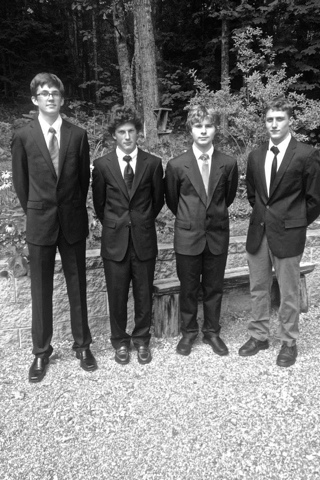 Limbeck Engineering’s founders are Freeport High School students, from left, Liam Wade, Nick Nelsonwood, Josef Biberstein and Travis Libsack.
Comments are no longer available on this story