
A project with big implications for Westbrook and the Presumpscot River will most likely be delayed again.
This time, the removal of Sappi Fine Paper’s hydroelectric dams and the establishment of natural fish passage at Saccarappa Falls will have to wait until Sappi and the other stakeholders can agree on a design.
Since last year, engineers and lawyers working for Sappi, multiple government agencies, and environmental organizations such as the Friends of the Presumpscot River, have been in a back-in-forth about Sappi’s proposed design for fish passage at the site.
Sappi, which has operated the dams for decades, is expected to complete the engineering, design and construction on the dam removal and fish passage project by May 2017 in order to meet the deadline set by the Federal Energy Regulatory Commission. But with the design not yet agreed upon, that timeline is in doubt.
Due to the negotiations, Sappi first requested that the commission extend the date for filing “comments, motions to intervene, and protests” on its dam removal license until July 1 of this year, giving the parties more time to come to an agreement.
“Sappi, Friends of the Presumpscot River and the agencies and the city are actively engaged in ‘settlement negotiations’ to try and avoid challenges to Sappi’s surrender application,” Bill Baker, Westbrook’s assistant city administrator for business and community relations, said this week.
Baker has been closely involved in the process since 2012.
However, due to the lengthy proceedings, Sappi also recently requested a one-year extension of its deadline for implementing fish passage until May 2018.
Baker said the dispute between the parties centers on Sappi’s so-called “western channel” design option, as opposed to the two-channel option that is supported by the Friends of the Presumpscot and the Conservation Law Foundation, which are working together.
Dozens of people packed the Westbrook City Council chambers last August for a public meeting on the two proposed design options for Saccarappa Falls. Each option garnered passionate support.
By all accounts, the Saccarappa site is a complicated one. The site has lower and upper falls, each with a section of dam. Once fish, such as alewife, shad, herring and salmon, make it up the lower falls, there are two channels, called east and west. The east channel flows past the Dana Warp Mill side, while the west begins just under the boardwalk of Saccarappa Park.
One plan, dubbed the two-channel, would open both channels to fish passage. The other plan, the western channel, would open the west channel to fish, while keeping the east channel separate – potentially allowing recreational options for paddlers.
For years, city officials and others have advocated for recreational amenities to coincide with the Saccarappa project, creating a potential draw for downtown Westbrook. These have included a possible “play wave” feature for kayakers.
However, advocates of the two-channel design argue that fish passage comes first, and recreational amenities can follow.
Baker said the Friends of the Presumpscot River and the Conservation Law Foundation might sue to prevent Sappi from implementing its plan if negotiations don’t continue.
Ron Kreisman, an attorney for Friends of the Presumpscot, said Wednesday that the group and the Conservation Law Foundation are “working cooperatively with Sappi and state and federal natural resource agencies to see if previous differences in approach to fish passage can be resolved through the settlement process.”
John Williams, a spokesman for Sappi, confirmed that the extension is for the purpose of allowing the parties to “align on an approach” to fish passage, but he declined to discuss further details of the negotiation.
Williams said the application for the one-year extension has not yet been formally approved by the Federal Energy Regulatory Commission, but that Sappi only recently filed the application for extension.
Michael Shaughnessy, the president of the Friends of the Presumpscot River organization, said this week that lawyers representing both the group and Sappi are talking.
“We will see how it goes,” he said in an email. “There were a lot of issues that Friends of the Presumpscot River had with what Sappi was doing relative to making sure it was well-reviewed and guaranteed. We are trying find that place that will work for both Sappi and be the best solution for the river.”
This isn’t the first time the project has been delayed.
After a series of hearings in 2009, state regulations required Sappi to install fish passage at its Cumberland Mills dam. Sappi’s licenses through the Federal Energy Regulatory Commission began requiring passage on the upstream dams, and were contingent on fish passage at Cumberland Mills.
In 2013, Sappi completed its $4.8 million Cumberland Mills fishway project, which now allows river herring, shad and other types of fish to pass up the Presumpscot River for the first time in more than 150 years. This project uses a Denil fish ladder.
The Federal Energy Regulatory Commission set the deadline for fish passage at Saccarappa, the next dam upstream, for May 2015, and Sappi originally sought to decommission the dams and install a similar fish ladder.
However, soon after, an agreement was reached among all stakeholders to ask the commission to delay the deadline until May 2017, in order to study “nature-like fish passage,” the complete removal of the dams and possible recreational opportunities. The request was approved.
Steven Shepard, a conservation planning assistant for the Fish and Wildlife Service, whose focus is hydro power licensing and fish passage, said this week that the Federal Energy Regulatory Commission will make its decision on the deadline extension based on the “consensus of those with standing in the proceeding.”
Shepard said it simply comes down to agreeing on terms that the commission can adopt.
“The parties would like to find mutually agreeable solutions that the FERC can agree upon and adopt in a surrender and decommissioning order,” he said in an email.
He added that there is “no way of knowing” when the official decision will come forward, but said it would have to be soon, or else it won’t be timely.
Baker agreed.
“I think FERC will not act on the extension request until they get a signal from the parties about whether a negotiated settlement is possible,” he said.
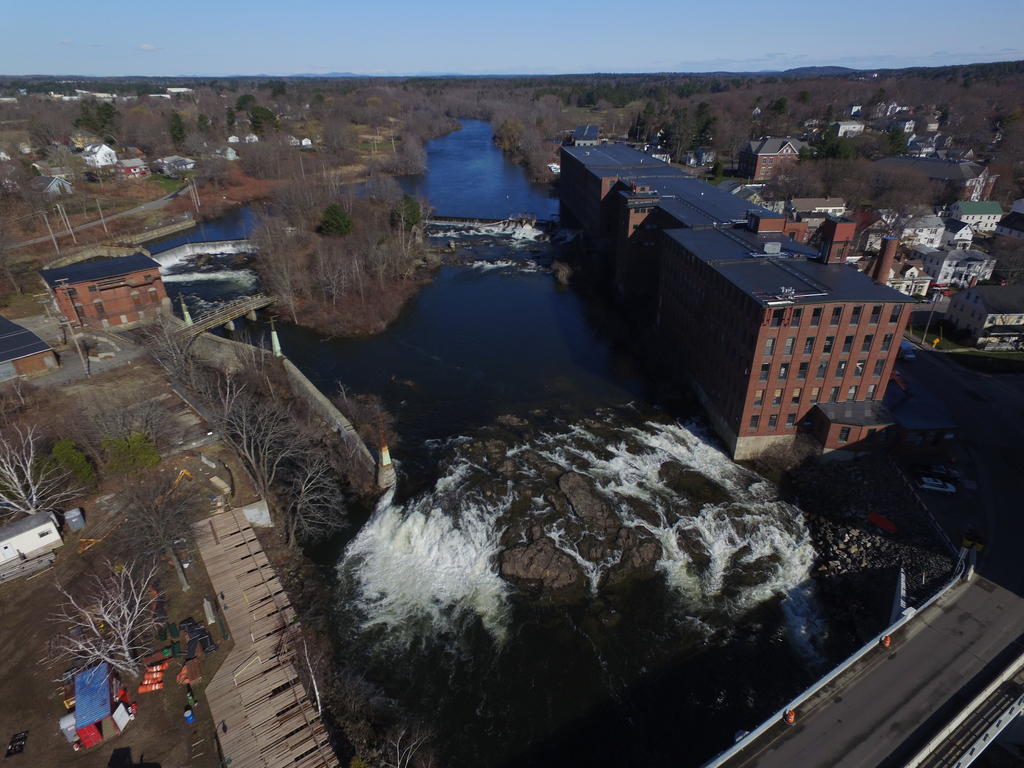
Removal of Saccarappa Falls’ hydroelectric dams, shown here from above, and establishment of natural fish passage will most likely be delayed again.
Comments are no longer available on this story