
While he was a training officer stationed at Kessler Air Force Base in Biloxi, Miss., in the mid-1950s, Joe Caliro first heard about the Negro Leagues, professional baseball leagues for black-only players that ran, off and on, from 1920 to the early 1960s.
He learned about the leagues when he was asked to develop a lecture for newly arriving servicemen and their families on coping with racial segregation and Jim Crow laws that were still prominent in the south before the Civil Rights movement.
Caliro wrote a letter to Jackie Robinson, the first black player to be recruited by a Major League baseball team. He wanted to get Robinson’s perspective on the topic of his lecture, but never heard back.
It wasn’t until after his military career was over that Caliro revisited his interest in the Negro Leagues and began collecting memorabilia, from signed baseballs to game programs, to pins, uniform jerseys and even personal letters.
“It just grew and grew,” Caliro said of his collection, which also includes vintage baseball cards.
On Saturday, May 21, at 2 p.m. Caliro, who now lives in New Hampshire, will give a presentation at the Thomas Memorial Library in Cape Elizabeth on the history of the Negro Leagues. He will also exhibit his extensive collection. The exhibit opens at 1 p.m.
Caliro said the Negro Leagues are “a big, largely unknown piece of American sports history,” and he hopes that attendees of his lecture will enjoy learning about this “hidden part of history.”
He’s especially hopeful that young baseball players will be interested in the lecture and exhibit because Caliro would “hate to see people forget about this time in America’s past.”
Caliro has been giving lectures and showing his Negro League memorabilia across New England for the past six to seven years.
On its website, the Negro Leagues Baseball Museum, which was founded in 1990 in Kansas City, Mo., said the first all-black baseball league was founded in 1920 by Andrew “Rube” Foster, who was a former player, manager and owner for the Chicago American Giants. Foster and a few other Midwestern team owners joined to form the Negro National League, which soon led to rival leagues being formed in Eastern and Southern states.
Negro League baseball was popular in both in urban and rural areas of the country and, according to the museum, the leagues “maintained a high level of professional skill and became centerpieces for economic development in many black communities.”
The original Negro League consisted of eight teams: the Chicago American Giants, the Chicago Giants, the Cuban Stars, the Dayton Marcos, the Detroit Stars, the Indianapolis ABCs, the Kansas City Monarchs and the St. Louis Giants.
It wasn’t until 1945, with the recruitment of Robinson by the Brooklyn Dodgers, that black players began to be allowed to play on Major League baseball teams.
While this event “was a key moment in baseball and civil rights history, it prompted the decline of the Negro Leagues,” the Negro Leagues Baseball Museum website said, because the best black players were now being recruited for the majors.
The last Negro Leagues teams folded in the early 1960s, the museum said, “but their legacy lives on through the surviving players and the Negro Leagues Baseball Museum.”
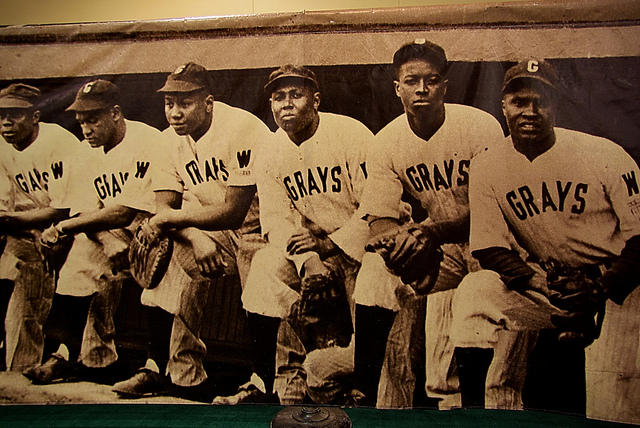
Members of the Grays, a Negro League baseball team.

Another historic Negro League photo.
Comments are no longer available on this story