

The gloom and steady, creeping dread you might be feeling these days is due to the vile conclusion of tax season. The reaper He cometh, the citizens they shudder, and the bombs they are away.
Meanwhile a person must eat, and Portland is a food overachiever by any measure. It ranks easily among the top 15 American cities for its tasteful array of menus, with a spookily elevated restaurants-per-capita ratio of around one for every 118 of us.
Right under our noses, Portland blossoms into an entrée encyclopedia, a dessert dictionary, a digestive Disney World. It all feeds on a tossed salad of culinary talent, daring investment, hard work and disposable income.
This pandering pyramid rests on the shoulders of unsung staff who typically make less than $25 in hourly wages: the dishwashers, servers, cooks, etc. They feed the customers, but how do they feed themselves, and sleep, and where, to be on time for their next shift serving all those 118 hungry people?
Since affordable housing is much on certain people’s minds these days, and thorny questions of income and outlay are in the air, it seemed like the right time to run some hard numbers. I am puzzled about how the restaurant pyramid stands up. For this experiment three food service guinea pigs were selected from the list above, newly hired and seeking shelter. What will they find in this city where the cost of living is roughly 12% higher than the national average, and housing costs up to 36% higher?
My calculations rest on a few basic figures. Most reputable sources agree that housing is affordable when it (rent + utilities) amounts to no more than a third of one’s after-tax annual income. The federal income tax rate for these workers’ should be around 12.0% and the Maine rate is around 6.75%. Minimum wage in Portland is $16.75, which is presumably close to what our dishwasher (“Washer”) earns each hour for a 40-hour work week, 50 weeks a year. The entry-level line cook (“Cook”) makes more, perhaps around $23 an hour on the same calendar, but also probably shares some tips. Wait staff (“Server”) earn a lower wage, close to minimum wage, but true income more than doubles it with tips. Crunching away, we can arrive at some useful sums for the team’s after-tax annual income:
Dishwasher: $27,219, whose affordable housing allocation would be $749/month.
Cook: $44,281, whose affordable housing allocation would be $1,218/month.
Server: $59,719, whose affordable housing allocation would be $1,642/month.
Not too shabby at all! Admirable results!
Now let’s see what Portland’s apartment rental market has to offer. These affordable monthly budget figures were presented as the upper budgetary limit in an online real estate database, which spit out the number of available one bedroom rental units in that price range within a designated geographic area, which was drawn by hand on a map of Portland. The first search zone (search area A) was chosen because it contains most of the restaurants in town, and can be roughly defined as the peninsula within a 3-mile radius of Fore Street restaurant (food ground zero).
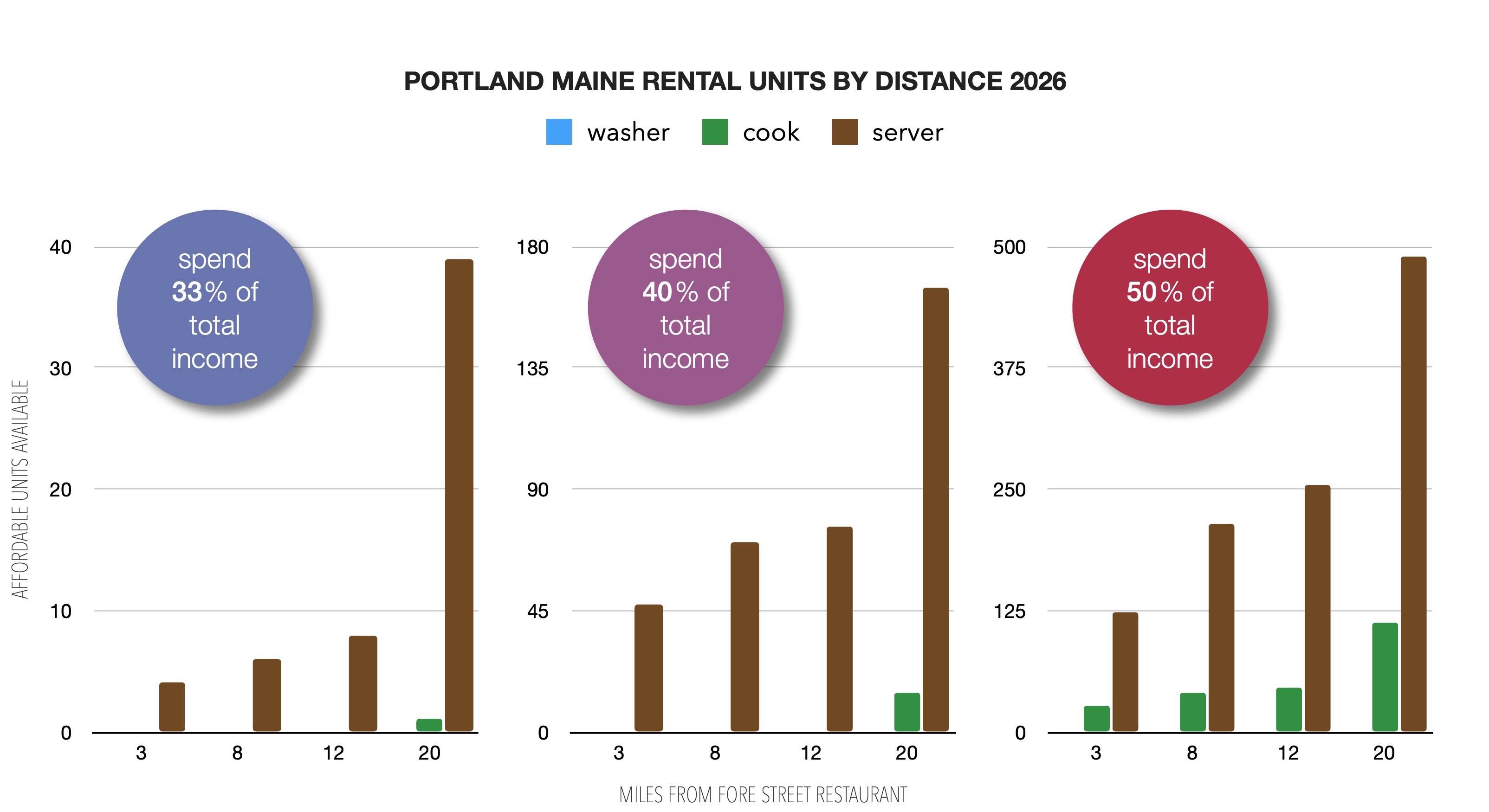
Area A presents Server, our high earner, only four apartments to choose from, while elbowing the other 400 waiters and waitresses who answered the same ad at the same time out of the narrow vestibule. As for Washer and Cook, who make a bit less, the good news is there is no one to elbow or by whom to be elbowed. On the other hand, there are no apartments for you.
We expand our search to area B, which is much larger, as defined by a radius of 8 miles from ground zero, encompassing Back Cove, Westbrook, South Portland, etc. In this terrain, Server picks up two more options, and Cook and Washer remain empty-handed. No one is yet likely to be renting in their affordable orbit. This losing streak continues into a further radius of 12 miles (search area C, which reaches as far as Scarborough to the south and Cumberland to the north), though Server has now doubled her menu of choices since starting on the peninsula to a whopping total of eight possible apartments.
How far, exactly, do Washer and Cook have to go to have a look at a place to live? At a 20-mile radius from the tastefully lit Fore Street wine rack (search area D, which now includes Biddeford, Gorham and Standish), Cook finds a single apartment for rent. How long will it be available? Washer, nearly frantic with anxiety, would have remained sleepless anyway with a $749 monthly budget — which must come as no surprise to anyone currently sleeping behind closed doors in Portland. Washer will need a roommate, who would instantly double his affordable budget and open up three 2-bedroom options within search area D, but none closer. Meanwhile, Server slumming it in area D is awash in 39 listings and can start getting picky about kitchen countertops.
What is most likely to happen to Washer, Cook and Server is that they will not win the sweepstakes for these few available listings. They will be tempted to increase their housing budgets beyond the affordable range, sacrificing financial stability and perhaps incurring extra debt. When they are ready to spend 40% of their after-tax income on housing, Server has 47 apartments to consider in area A (closest to restaurants and other amenities) alone; the options again nearly double when the search radius extends as far as area C. Even spending 40%, however, generates no new options for either Cook or Washer. Fifteen apartments suddenly blip onto Cook’s radar in area D, none at all even that far out for Washer, though with a roommate there could be 32 possible choices.
If Cook and Washer choose to spend half of their income on housing, which is far beyond the affordable range, things get a bit better for Cook, but not as much better as you might think, while Washer’s situation remains unchanged. Now the original puzzle presents itself with a sly vengeance; where in fact do all the Cooks and Washers sleep, along with every other hard worker in Portland making less than $23 an hour? How does the housing system function? Does it function?
To see how these options vary with income and distance from ground zero, my experimental, ballpark statistics are summarized below, where the vertical axis shows units available in a particular price range, and the horizontal axis shows the approximate size of the search area:
You could probably think of a smarter way to do this, so for now let us agree to think of it as a first try, an amusing conversation piece, a bookmark which reminds us to come back later and think about this a bit more. Three times previously this column has examined Portland real estate projects which intentionally sidestepped opportunities for affordable housing development.
Before you chalk all the heartache up to capitalism with some smooth Darwinian twist, it may be best to remember how much you like some of those restaurants where Cook cooks, Washer washes, etc. How proud and prosperous Portland is, thanks to them.
Cities, like coral reefs, need high species diversity in order to stay strong. That is because, we are told, cities and reefs both rely on a social “portfolio effect,” which helps to maintain equilibrium through assorted shocks, downturns and unexpected stresses, pairing strengths with weaknesses, minimizing the chances of a crash.
Portland needs its investors, its sommeliers, and its blissful oyster slurpers; it also needs its Cooks, Washers and Servers. They deserve accommodation rather than excommunication.
Jon Calame holds a master’s degree in historic preservation of architecture and is a Fellow of the American Academy in Rome. He currently teaches art history at the University of Southern Maine. This column is free to access through support by The Dorothea and Leo Rabkin Foundation.
We invite you to add your comments. We encourage a thoughtful exchange of ideas and information on this website. By joining the conversation, you are agreeing to our commenting policy and terms of use. More information is found on our FAQs. You can update your screen name on the member's center.
Comments are managed by our staff during regular business hours Monday through Friday as well as limited hours on Saturday and Sunday. Comments held for moderation outside of those hours may take longer to approve.
Join the Conversation
Please sign into your Press Herald account to participate in conversations below. If you do not have an account, you can subscribe here. Questions? Please see our FAQs.