

A few years ago, artist and musician John Bisbee asked the painter Katherine Bradford to allow him to use her summer studio in the Fort Andross Mill in Brunswick as a gallery when Bradford decamped to New York for the winter. Bradford, always supportive of the Maine art community, agreed. Bisbee dubbed the seasonal venue on the second floor Fort Hall Gallery and has been holding exhibitions from October through April ever since.
Currently at Fort Hall is “No Man’s Land” (through May 22), a collaboration between Bisbee and Bradford (the latter selected the artists — all of whom have studios in the mill — and the former, along with his team, curated the works and hung the show). The title riffs off double meanings. There is the obvious fact that all the artists (Michel Droge, Ellen Golden, Emilie Stark-Menneg, Pam Smith and Carla Weeks) are either women or nonbinary…literally “no man.”
But in more metaphorical terms, the show finds these artists exploring liminal psychic spaces where nothing feels precisely articulated. The works are enigmatic and pregnant with possible interpretations, allowing the viewer to bring their own perspectives to the works. All the artists are also quite different stylistically, ranging from figurative to abstract, from colorful to monochromatic, and from rational to lyrical.
Reviewing them alphabetically, we begin with Michel Droge. For years this artist has worked with marine conservation and research organizations such as the Bigelow Laboratories for Ocean Studies in East Boothbay and the Schmidt Ocean Institute in Costa Rica to respond artistically to the urgent need to preserve marine ecosystems. Though the resulting paintings have discernible forms that relate to their subject matter — octopus tentacles, netting and so on — they are primarily abstractions.
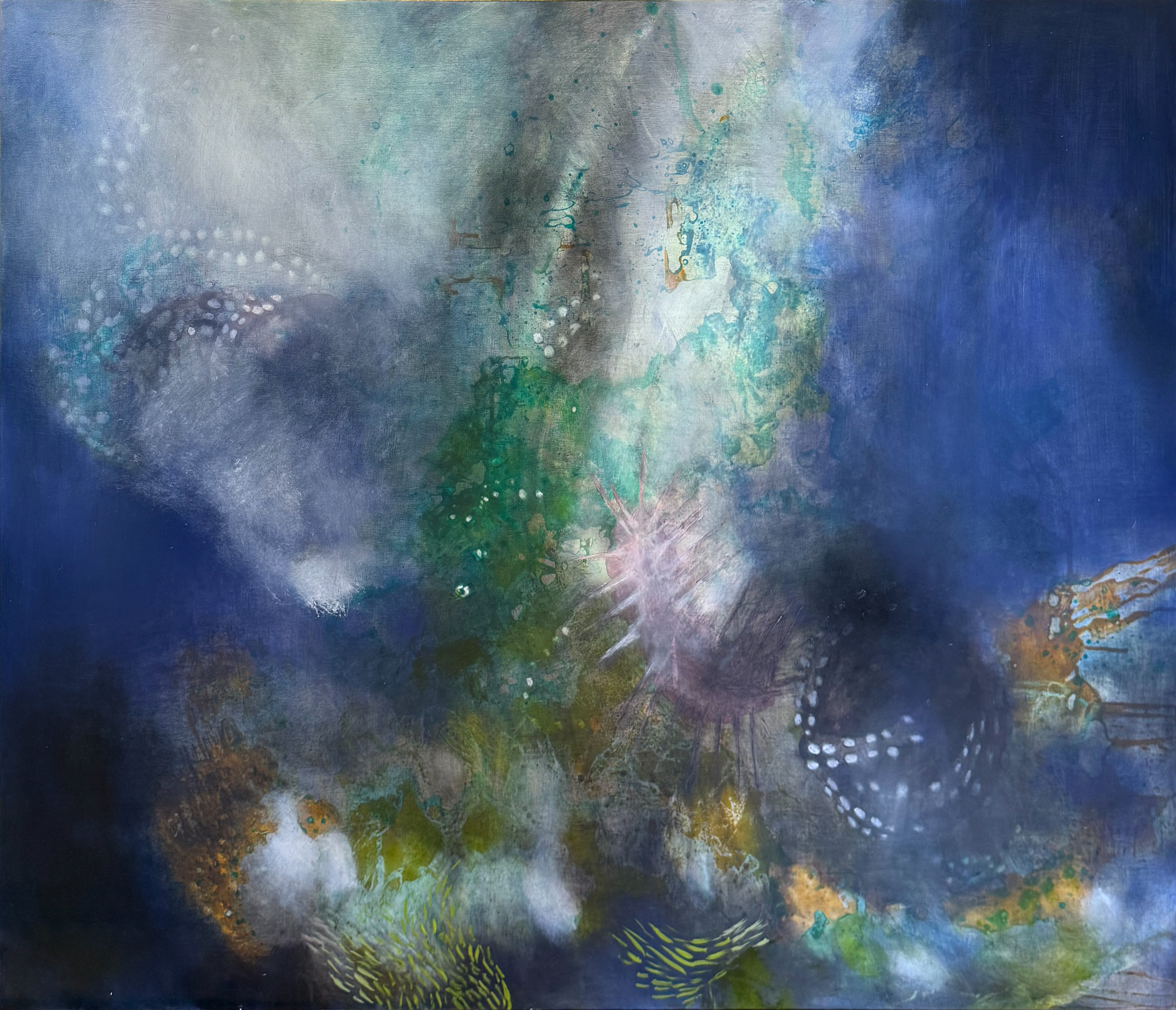
“Andromeda’s Demise” is a ravishing example of work she did with the Schmidt during an Artist-at-Sea residency. I say ravishing because the layering of liquid color and the way it stains and bleeds into other fields of pigment convey a sense of presences not only constantly in motion, but perpetually thinning out to reveal many other layers beneath them. We can vaguely distinguish forms resembling tentacles, perhaps an urchin, and schools of fish, plus the strange phosphorescent creatures found at great oceanic depths.
But in purely abstract terms, it could just as well refer to a more galactic phenomenon or simply to swirling, interacting, erupting fields of color. It is a tour de force and invites long, slow contemplation. The more recent “Night Swimming” leans more heavily into abstraction and thicker laying on of paint. It’s a fine work, but not nearly as complex as “Andromeda’s Demise,” with all its liquified veils of color.
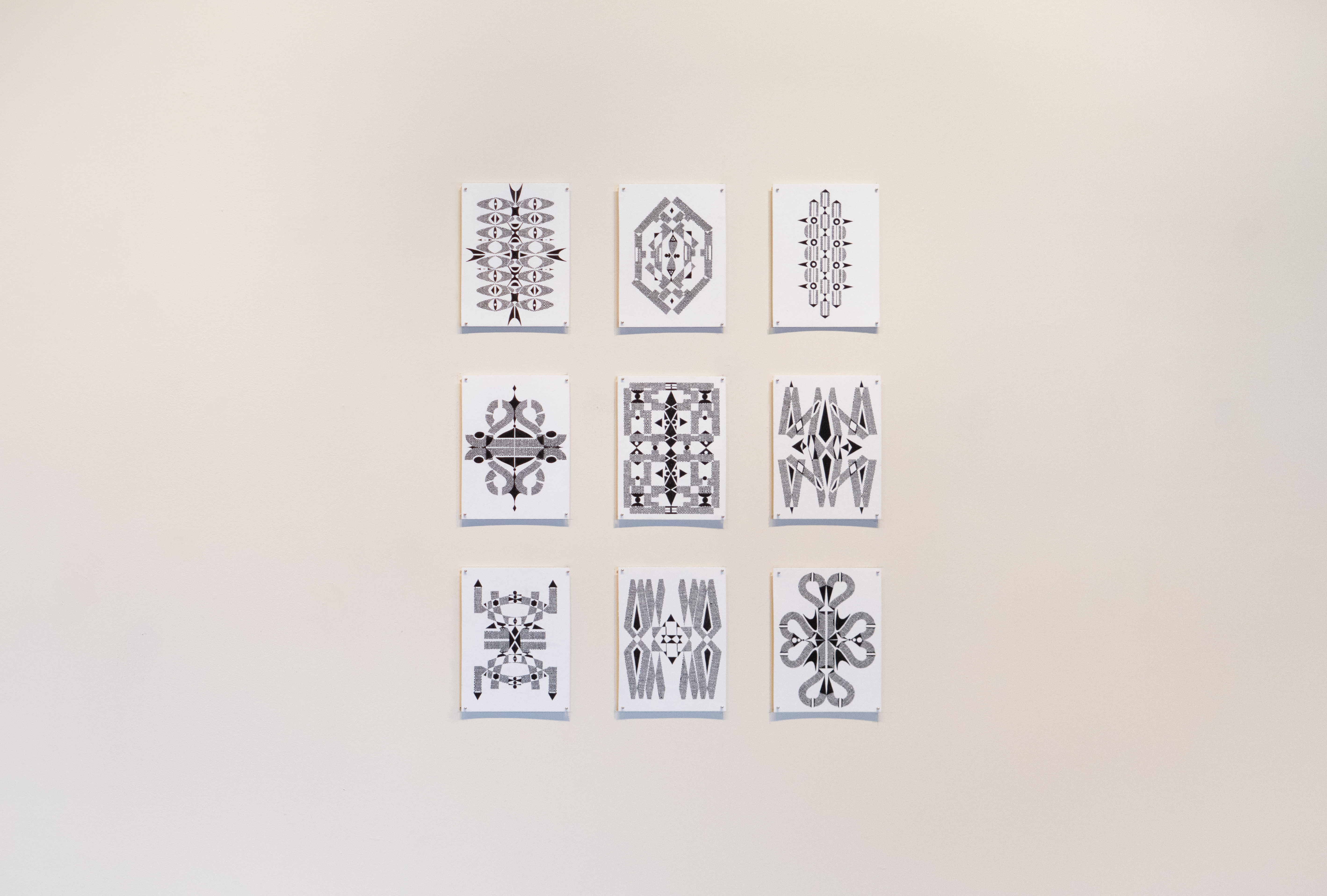
Ellen Golden’s nonet of ink-on-paper works, all made in the last two years, are a world away from the work she has on display currently at the Maine Jewish Museum, which telegraphs a simultaneous sense of a freer yet equally meticulous style. There is nothing random about these works, many of which seem to have a synergistic relationship to weaving patterns. Golden is a world traveler, and many of these do feel inspired by Native and Eastern textiles or tilework.
The title of one, “Mihrab,” seems to indicate as much, as it refers to a niche in the wall of a mosque. Some are also playful, such as “Follow the Lead,” a symmetrical design that suggests the impossible because, like a circle, there appears to be nothing we could identify as a “lead” or starting point. Yet as precise and almost machine-like as these designs initially appear, if we look closely, we can begin to identify the presence of her hand. There is no question they are fastidiously drawn. But imperfect symmetries and mirror images that don’t exactly mirror each other (check out the variously sized diamond forms in “And So It Begins”) indicate a wry interplay between precision and imperfection.
Stark-Menneg is off on another of her fantastical journeys with “Tourmaline,” her only offering in this show and one of a new series she is creating. In the narrative of these new works, she imagines a female figure pregnant not with a fetus, but gestating instead forms and colors. This artist has always been a sensualist, but in these paintings, she posits the idea that what we see can actually convey all other senses: what we hear, taste, smell and feel to the touch.
This is a state or condition psychologists call “synesthesia,” which occurs when “one sensory or cognitive pathway leads to involuntary experiences in other sensory or cognitive pathways.” Stark-Menneg has used often conveyed this in her work, most notably “Strawberry Moon” back in 2021, in which her own self-image crushes strawberries into her mouth in such an act of ecstasy that the viewer can practically taste the fullness of their sweetness, smell their perfume and sense their juicy texture (if not also hear her chomping).
What is interesting about this painting is that it functions as a kind of glossary, albeit it an ever-inventively reconfigured one, of this painter’s vocabulary of images and techniques. They all begin as blocks of color applied in a loose grid, then she starts her multiple layering of color and image. This process involves staining the canvas, painting, airbrushing, glittering, scraping (her previous series relied heavily on this to convey a sense of constant change and motion), flinging of the scraped paint onto the canvas and, in other areas, pushing paint through a screen and applying the resulting dried image (here a butterfly, for example) to the canvas. In Stark-Menneg’s paintings, we are always suspended in a sensual female matrix and definitely in a “no man’s land” of perceptual phenomena and fantasy.
The only artist who I was not familiar with was Pam Smith, who is also a widely published poet. Stylistically, her paintings reflect both sides of her creative nature. I was immediately taken with her geometric abstractions, which feature squares, rectangles, trapezoids and triangles. These normally come in trios of shapes painted in soothing creams, grays and whites, all floating on saturated mossy green grounds.
There is a palpable sense of suspension and stillness in these works, the tone-on-tone shapes quietly hovering one on top of the other. They are all iterations of one basic idea, much in the way of a poem’s rhythmic stanzas and repeating refrains. In this sense, they feel lyrical in a completely abstract way. They are the quietest moments in the show.
Another Smith painting, “Jealous,” however, takes a completely different tack. It reproduces one of her poems as what appears to be words typed on rectangles of paper, which are scattered over a black ground in which white forms fly around like comets. The text reveals the forms to be bullets (the poem’s narrative involves how the mention of another woman’s name hit her like bullets, though eventually the bullets simply roll off her).
This work did not speak to me. It felt like an uneasy marriage of Barbara Kruger and Vija Celmins and, at 58 x 70 inches, also came off as an intrusion. Besides its size, it intrudes on the enigmatic nature of so many of the other works, whose strength comes from their ambiguity, while this one felt too easily parsed and obvious to me. I admit that I was with two women in the gallery with whom it resonated quite strongly, implying all sorts of female vulnerability, the danger of misogynistic violence, and other associations. As a man in no man’s land, then, I defer…
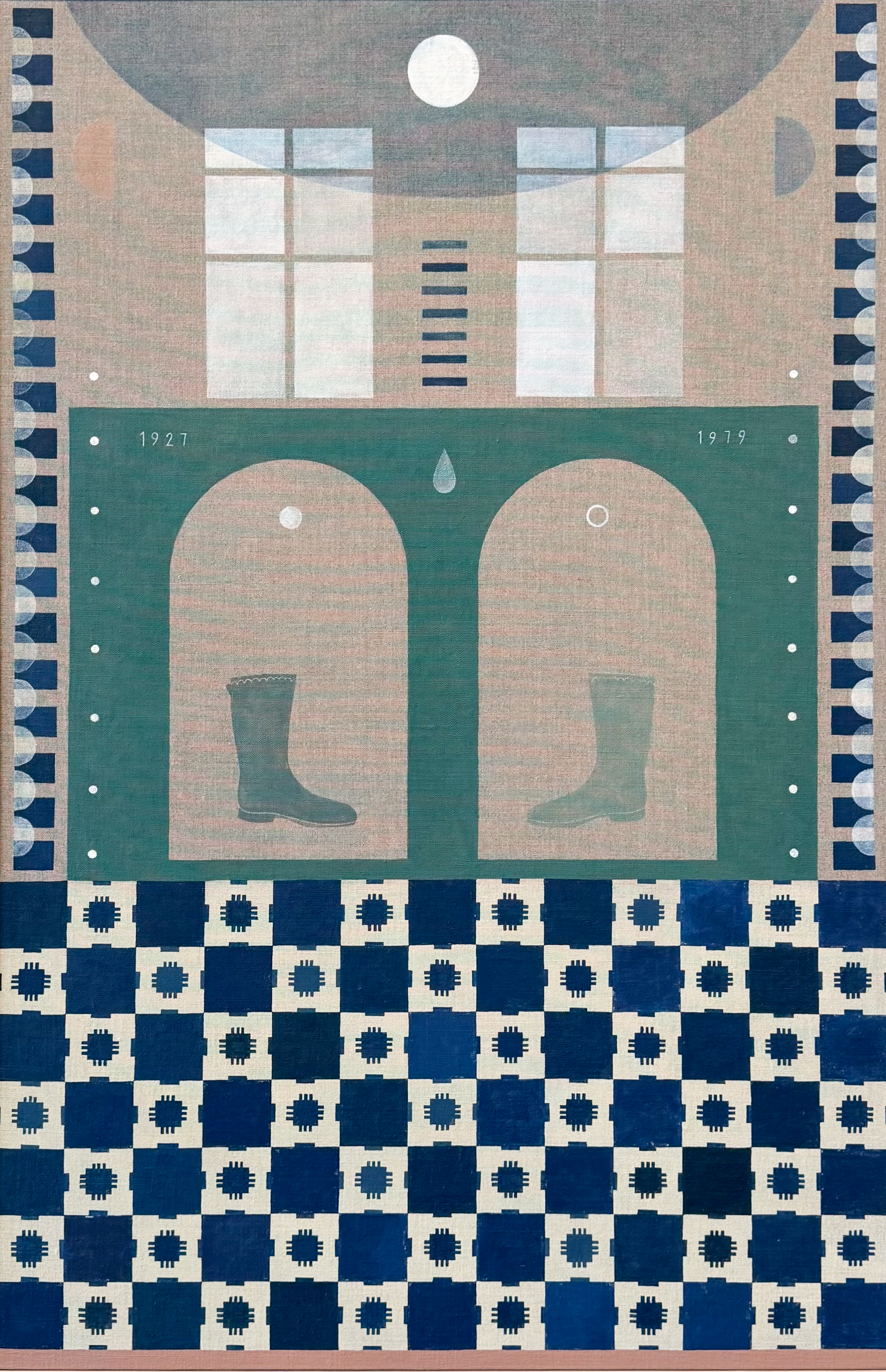
Ambiguity is rife in the paintings of Carla Weeks. This artist has developed very interestingly over the past few years, and the paintings here are among her most intriguing. Their composition and large areas of unpainted surface, as well as their underlying geometry, can appear almost quaint in the manner of colonial samplers. But they are compelling precisely because they are inscrutable.
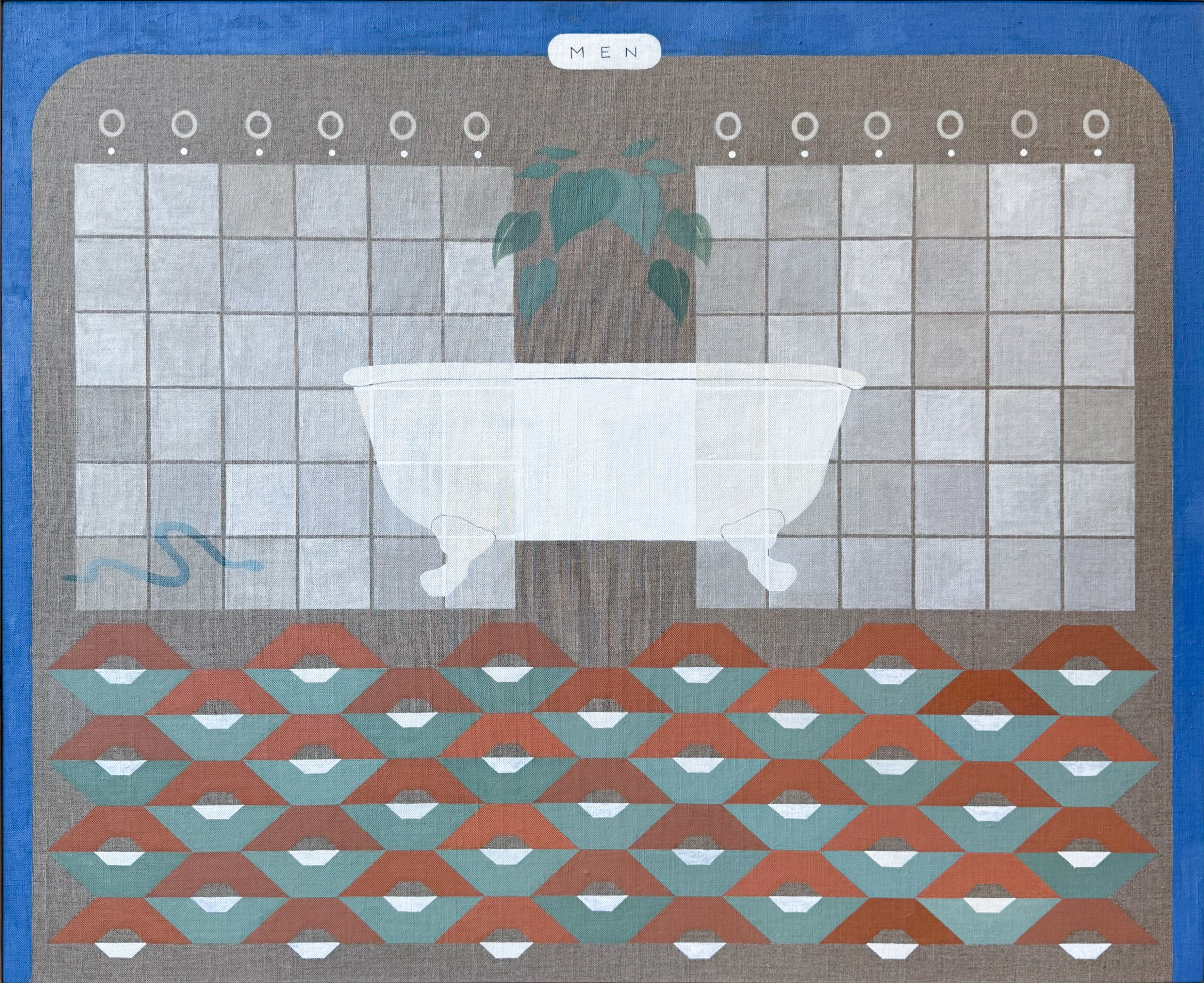
All combine patterns in the lower thirds of the paintings with interior or architectural imagery in the upper two-thirds. They supposedly refer to specific places from Weeks’s memory, but we are not privy to any information about them, deepening the inherent mysteriousness of the works. Weeks also toys with our perception of objects within the picture plane. “Men,” for example, shows a bathtub against what we initially assume is a tile wall. However, the squares of the “tiles” are painted in gradations of gray, sometimes appearing to exist behind the tub and other times like a translucent veil in front of the tub.
Strange goings-on indeed. The conundrum is compounded in these paintings by a personal iconography to which we also have no access: molars floating in the air, tear drops, numbers that appear to be dates (or not), moons, the boots in “Gada’s Boots” (Who’s Gada? What is meaningful about her boots?). The teeth make a bit more sense in “Denture Factory,” but only minimally because it doesn’t look like the molar suspended at center between two windows is in a factory at all.
What seemed deceptively simple and easily digested at first glance suddenly feels layered with complexity. We can intuit in each work a profound personal significance for Weeks as well as many implications imbedded in the places, patterns and objects depicted, and in the positions of all of these components within the boundaries of the picture plane. Yet in the end, they reveal very little to the viewer. And that indecipherability is exactly what gives them their power. I actually didn’t want to know what it all meant. I wanted to continue reveling in, I suppose, no man’s land.
Jorge S. Arango has written about art, design and architecture for over 35 years. He lives in Portland and can be reached at [email protected]. This column is free to access through support by The Dorothea and Leo Rabkin Foundation.
IF YOU GO
“No Man’s Land,” at Fort Hall Gallery, Fort Andross Mill 2, 2nd Floor, 14 Maine St., Brunswick. Through May 22. Hours 11 a.m.-5 p.m. Tuesday-Saturday; Sunday by appointment. For details, forthallgallery.org.
We invite you to add your comments. We encourage a thoughtful exchange of ideas and information on this website. By joining the conversation, you are agreeing to our commenting policy and terms of use. More information is found on our FAQs. You can update your screen name on the member's center.
Comments are managed by our staff during regular business hours Monday through Friday as well as limited hours on Saturday and Sunday. Comments held for moderation outside of those hours may take longer to approve.
Join the Conversation
Please sign into your Press Herald account to participate in conversations below. If you do not have an account, you can subscribe here. Questions? Please see our FAQs.