


The South Portland City Council adjourned a lengthy workshop on Flock Safety cameras Tuesday night without providing direction about how the city should use them.
Councilors heard nearly two hours of public comment about the controversial stationary devices that automatically read license plates, but did not take action and continued the workshop to June 11.
Prior to that, Councilor Misha Pride made an unsuccessful motion to disable the cameras until the city can answer questions about data access.
The city has seven Flock cameras, which use artificial intelligence and machine learning to scan and log the license plate, model, color and other identifying information, like bumper stickers, of every vehicle that passes through its field of view. The city’s contract expires in February 2027.
Flock Safety, an Atlanta-based company that contracts with more than 5,000 law enforcement agencies across the country, has come under fire over who has access to the data it collects. A report last year found that the company shared data with federal immigration and border authorities.
There have been no reported instances of misuse of the technology in South Portland, said Shara Dee, the city’s spokesperson. And surveillance of First Amendment protected actions, traffic, parking enforcement and immigration status checks are prohibited, according to police Chief Daniel Ahern.
Ahern also said there are no comparable alternatives to the cameras.
“This is about public safety,” he said at the workshop. “It’s about trust. Every community member here is safer because of these cameras.”
The department requested funds in this year’s budget for an additional camera and to renew the contract with Flock. The city then withdrew the request and scheduled a public workshop instead.
The existing cameras — two near Interstate 295 by Pape Chevrolet, two on Western Avenue by Maine Mall Road, two at Cash Corner and one on Maine Mall Road — capture between 100,000 and 150,000 images per day.
A database stores images of license plates for 21 days, and detectives and supervisors — the permitted users — need to select a specific offense type and reason to search it. Immigration and reproductive rights are not options on that list, according to Detective Jeff Levesque. He showed an example search and sample images during his presentation at Tuesday’s workshop.
The department has sharing agreements with about 700 agencies through the Flock network, mostly municipal and sheriff offices, according to Levesque.
No Flock for South Portland, a group that has organized in opposition, said in a media release this month that records indicate that 70 of these law enforcement agencies collaborate with federal immigration enforcement. The group alleges the city has shared Flock network access with groups in 44 states, and that more than a hundred of the 2,000-plus searches since April 2025 were on behalf of other agencies, many of them unnamed.
Lucy Perkins, an organizer, said during public comment that more than 350 South Portland residents and more than 590 Mainers signed a petition calling on the city to immediately remove the cameras.
Many residents expressed concern Tuesday about who has access to the city’s data and if the police department can be certain about the system’s security. Some worried whether federal agencies, like Immigration and Customs Enforcement, can access South Portland data through other municipal databases.
“Our municipalities are no match for a multibillionaire company,” said Ernest Braun.
Some clauses in the city’s contract with Flock gave residents pause about the department’s reassurances regarding data security. One stipulates that Flock may access, use, preserve or disclose footage if it has “a good faith belief” that such use complies with federal processes or prevents emergencies. Another says that these terms and conditions in the contract are subject to change.
“Flock could violate terms of contract, and we may not know,” City Manager Scott Morelli said.
Brandon Mazer, the city’s lawyer, said Flock wouldn’t be able to make unilateral changes to the contract without South Portland’s input. And he said that good faith wording is typical in contracts.
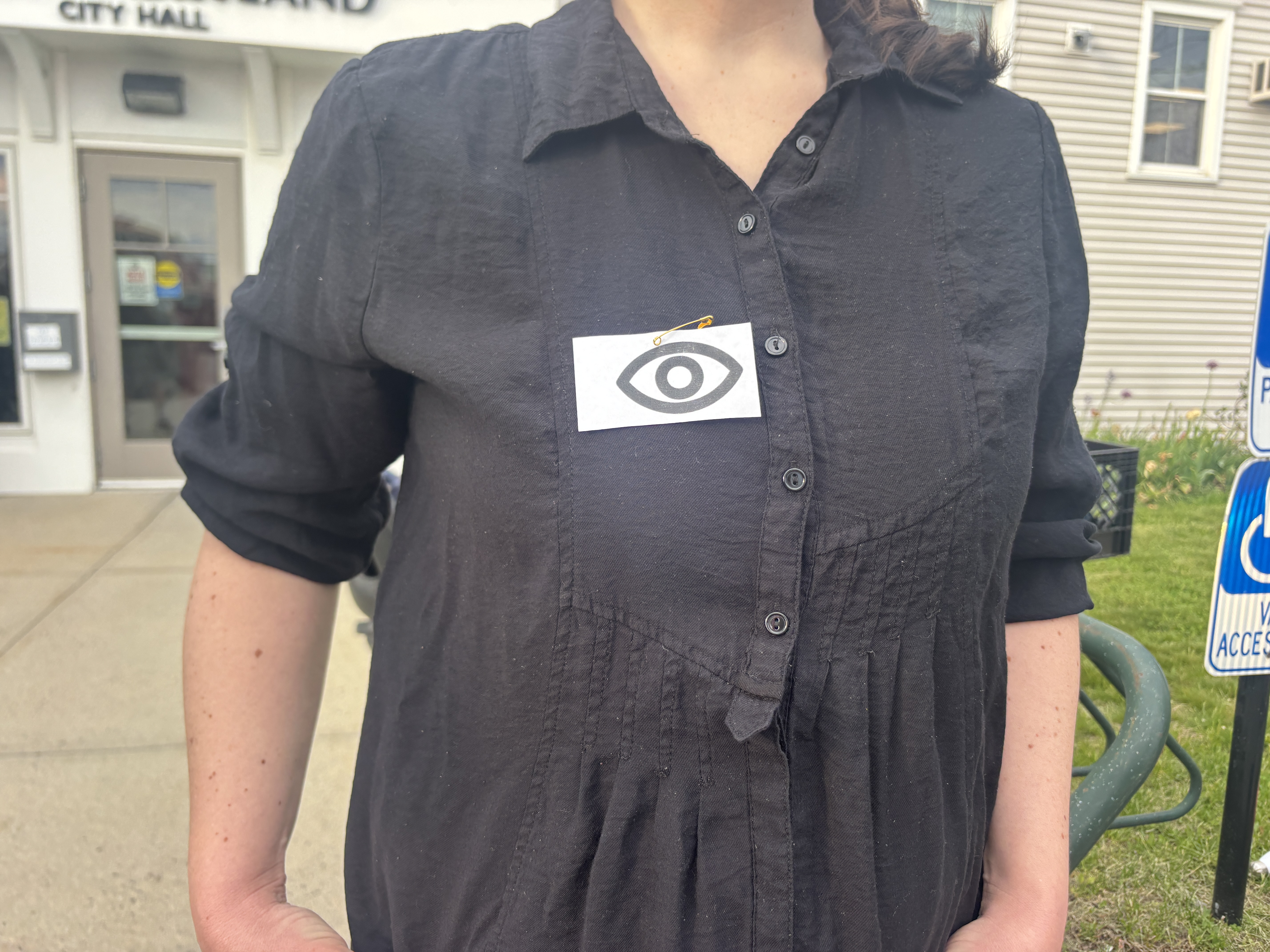
About 30 minutes before the meeting started, a group of about 25 people assembled outside of City Hall, all donning black. One woman passed out white patches with an eyeball icon with bold lines, what she described as a symbol of solidarity.
Nel Lestage wore a black sun hat and cardigan that she purchased earlier that day for $16 at Goodwill because she didn’t own anything black. She heard about these cameras while protesting at the weekly rally at Erskine Park.
“I don’t see why we need surveillance cameras,” she said.
A few minutes after 6:30, the group silently entered council chambers, single file.
During public comment hours later, organizers dressed in black formed a line that stretched through council chambers. They spoke one after the other, picking up where the previous person left off on the group’s platform: that the cameras are a threat to civil liberties, are used by federal agencies and the data can’t reasonably be controlled by municipalities.
Residents said that they don’t trust Flock and the potential for breaches. They don’t trust the usage of artificial intelligence. And some don’t trust the police department, after an investigation in March found that Ahern texted with an immigration agent during the surge operation in late January.
Leaders from other towns urged the council to reconsider the city’s contract.
Wes Pelletier, a city councilor in Portland, which doesn’t use the cameras, said it seemed like an obvious choice.
“We have to balance what they want and the civil liberties of our constituents,” he said. “This seems like a slam dunk.”
Ramona Thieme, a town councilor from Brunswick, called on South Portland to join Brunswick and other towns that opted to not use Flock cameras.
“There’s troubling information that’s been coming out about this company,” she said.

We invite you to add your comments. We encourage a thoughtful exchange of ideas and information on this website. By joining the conversation, you are agreeing to our commenting policy and terms of use. More information is found on our FAQs. You can update your screen name on the member's center.
Comments are managed by our staff during regular business hours Monday through Friday as well as limited hours on Saturday and Sunday. Comments held for moderation outside of those hours may take longer to approve.
Join the Conversation
Please sign into your Press Herald account to participate in conversations below. If you do not have an account, you can subscribe here. Questions? Please see our FAQs.