
A Gorham legislator wants the state to ban a psychedelic drug that is now legally available in Maine and over the Internet.
Rep. Chris Barstow said he will introduce a bill in the Legislature to make Salvinorin A an illegal drug. “It’s a drug very similar to LSD,” Barstow said.
He said his legislation would forbid the use, sale or possession for consumption of Salvinorin A, a mind-altering substance in the leaves of a plant, Salvia Divinorum, of Mexican origin.
Barstow said its leaves are being sold locally.
On the street, the drug is known as Sally D, magic mint or Maria Pastora.
He said users smoke, chew or chew and swallow the Salvia leaves. Leaves could be smoked in pipes or rolled in papers. Barstow thought it sells for $5 to $10 a pouch, which he guessed would contain a couple ounces.
“We need to have it banned as soon as possible,” said Barstow.
Kimberly Johnson of Gorham, director of Maine’s Office of Substance Abuse, informed Barstow about use of the substance in Maine. “It came to me through my staff,” Johnson said about learning of the drug’s use in Maine.
Johnson was told six months ago that juveniles interviewed in a Maine youth center had admitted using the drug. She said it could create “intense” hallucinations and use could be frightening. But she doesn’t believe use of the substance is widespread in Maine now. The drug is widely available over the Internet, and Barstow said he thought it was also being sold locally.
Johnson favored legislation to ban its use.
“You want to catch it early because it’s so dangerous,” she said. “It’s a drug that is as dangerous as LSD.”
Salvia divinorum and its psychoactive ingredient Salvinorin A, which a government report said could cause incoordination, dizziness and slurred speech, are not federally controlled. Barstow worries about highway safety if impaired drivers got behind the wheel.
The U.S. Department of Justice reports that effects include “perceptions of bright lights, vivid colors and shapes, as well as body movements and body or object distortions.” Other effects include hopelessness and uncontrolled laughter, besides hallucinations. Adverse physical effects could cause incoordination, dizziness and slurred speech, according to the government.
Gorham High School Principal John Drisko said the school nurse knew about the drug, but hasn’t heard or seen any evidence of it being used among Gorham students. Use of the drug would violate the school’s policy, Drisko said.
Jim Hager, chairman of the Gorham School Committee, said use of the drug by students would be prohibited by the spirit of the school policy. Hager praised Barstow for his proposal. “I applaud Chris for taking it under his wing.”
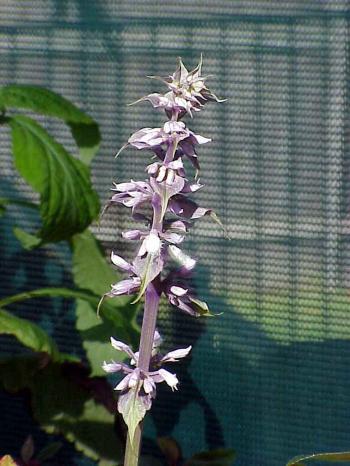
Salvia divinorum is from the sage family. Its name is derived from the Latin word Salvare, which means to heal or save. The plant grows in groups to more than 3 feet in height. It has large green leaves, hollow square stems and white flowers, the justice department described it.
Barstow said it could be grown in Maine, but thrives best in warmer climates.The plant family also has garden varieties that are grown in Maine back yards. Barstow’s bill would exempt those garden plants.
He said police would be only interested in a particular plant – the same as spotting marijuana. Barstow said enforcement would require some “cursory” training for law departments.
“The first big step is to get it off shelves in stores,” Barstow said.
The Department of Justice reported that a number of states have placed controls on Salvia divinorum and Salvinorin A or both. Louisiana, Tennesee, Delaware and Missouri have made it illegal to purchase or distribute Salvia divinorum, and several states have proposed legislation.
 Gorham legislator seeks Salvia ban
  Gorham legislator seeks Salvia ban
Comments are no longer available on this story