



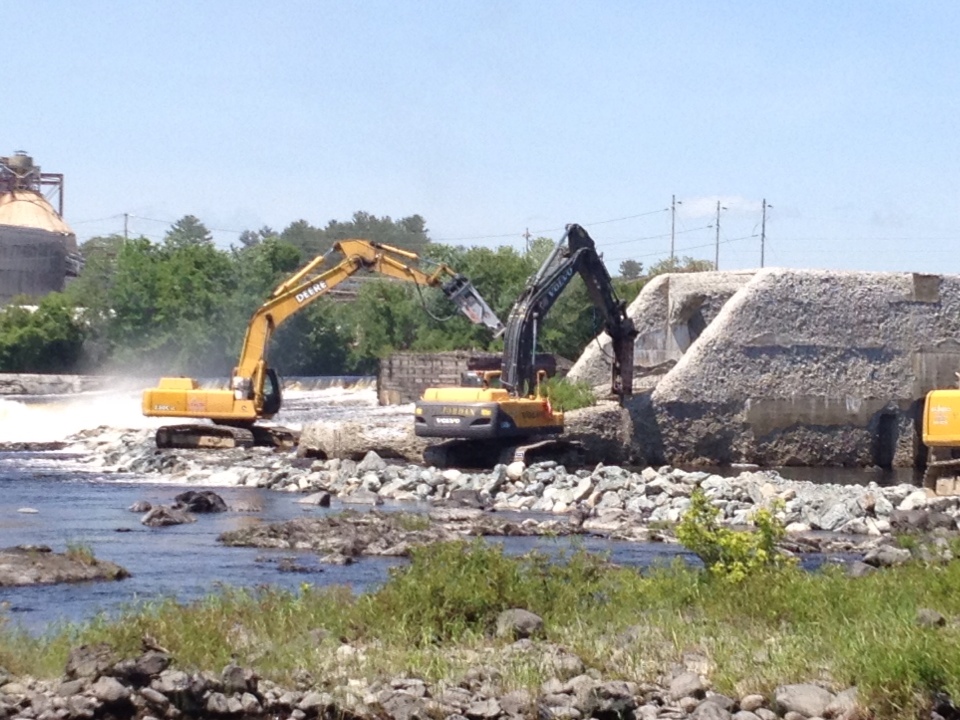
INDIAN ISLAND — Work crews today began demolition of the Great Works Dam on the Penobscot River, the largest-ever river restoration project in eastern North America.
Excavators began pounding the defunct concrete fishway in the middle of the dam following more than an hour of speeches by federal, state and Penobscot Indian Nation officials.
Videos


Additional Photos
Ken Salazar, secretary of the U.S. Department of the Interior, said the $62 million project, which includes the removal of two dams and improved fish passages at two other dams, is a model for other restoration efforts in the nation because of its collaborative approach.
“It’s really a great day for America and a great example for anyone who believes anything is possible,” Salazar said.
Hundreds of people were on hand to hear the speeches and celebrate the project’s start at the dam, the second of three located downstream from Indian Island, the Penobscot Indian reservation.
The project is seen as a model for river restoration in other parts of the world because the terms of a multi-party agreement will allow power companies to increase power generation elsewhere in the river watershed. In the end, there will be no loss of power production.
Environmental groups say the project is the largest-ever river restoration effort in eastern North America and represents the last best hope of restoring wild runs of Atlantic salmon in the United States.
“It’s easy for people in Maine to forget what a big deal this is,” said Landis Hudson, executive director of Maine Rivers.
Salazar was among the dignitaries speaking at a press conference at the dam this morning. Salazar also was to attend a community luncheon on Indian Island sponsored by the Penobscot Indian Nation, which played a critical role in the project.
Patrick Keliher, commissioner of the Maine Department of Marine Resources, was the top Maine official at the event. Gov. Paul LePage, a critic of the project, was invited but did not attend.
Constructed in the late 1800s, the Great Works Dam is a 1,020-foot-long mass of concrete, timber and cribwork situated on a bend in the river between Old Town and Bradley. The river drops 17 feet over a third of a mile and without the dam, there would be rapids.
The dam will be removed slowly over the next six months, although most of the dam will be gone by the end of summer.
The Veazie Dam — scheduled for demolition in 2013 and 2014 — is eight miles downstream from Great Works and is the last physical barrier to juvenile salmon reaching Penobscot Bay and the sea. Scientists monitor returning salmon at fishways and traps at the Veazie Dam. Most are taken to hatcheries or trucked upriver.
In addition, two dams will get significantly improved fish passages: an elevator to lift fish over the Milford Dam, located just downstream from Indian island, and a fish bypass at the Howland Dam.
Because public access to the Great Works Dam is limited, organizers today encouraged people to watch the press conference live-streamed on a 16-foot-wide screen in Sockalexis Hall, the bingo hall on Indian Island.
The Penobscot River Restoration Trust was ferrying the public to the dam site in vans. People interested in seeing the demolition should contact the trust at 699-9492.
The original dam at this site was built in the 1830s as a “wing dam,” parallel to the shore, to provide water for sawmills. It was partially demolished around 1887, when the current Great Works Dam was installed by the Penobscot Chemical Fibre Co., the first pulp mill on the river.
The dam and generating facilities were sold several times over the next century, and purchased by PPL Corp. in 2000. The dam was sold to the Penobscot Trust in 2010 as part of the landmark river restoration agreement.
Before construction of dams on the river, an estimated 75,000 to 100,000 adult salmon spawned on the Penobscot annually. Last year, scientists counted 3,100 salmon, the best run in the past 30 years. Nearly all the fish were raised in hatcheries.
Removing the dams will allow a self-sustaining run of 10,000 to 12,000 fish in 10 to 15 years.
The Penobscots’ status as a sovereign Indian tribe was a crucial factor in the settlement agreement, because it gave the tribe leverage during the federal license renewal process for the hydroelectric dams in the watershed.
Collaborating with environmental groups, the tribe argued that the federal government is required to ensure proper management and protection of tribal natural resources, such as the right to harvest fish within the waters of its jurisdiction.
The tribe’s arguments — initially contested by then-dam owner PPL Corp. — threatened the company’s ability to continue winning licenses from the federal government to produce power on the river.
A deal was reached in 2004 that gave the dam owners certainty over future federal regulation and allowed them to make investments in other hydro dams in the river basin.
The agreement called for PPL to sell the Veazie, Great Works and Howland dams to the Penobscot River Restoration Trust for $24 million. In return, the power company was allowed to increase power generation at six other dams along the river, offsetting the losses incurred when the Veazie and Great Works dams are no longer in use.
R.F. Jordan & Sons Construction Inc. was awarded a $3.5 million contract to remove the Great Works Dam.
Funding comes from a mix of private donations, foundation grants and the federal government, primarily the National Oceanic and Atmospheric Administration and the U.S. Fish and Wildlife Service.
Organizers must still raise $9.5 million to complete the project, and they hope publicity from the removal of the Great Works Dam will spur private donations.
Copy the Story LinkSend questions/comments to the editors.

Success. Please wait for the page to reload. If the page does not reload within 5 seconds, please refresh the page.
Enter your email and password to access comments.
Hi, to comment on stories you must . This profile is in addition to your subscription and website login.
Already have a commenting profile? .
Invalid username/password.
Please check your email to confirm and complete your registration.
Only subscribers are eligible to post comments. Please subscribe or login first for digital access. Here’s why.
Use the form below to reset your password. When you've submitted your account email, we will send an email with a reset code.