



The “Fast and Furious” gunrunning operation has been widely condemned by Republicans, Democrats and even top officials at the Justice Department as a failed sting. The case has led to the ouster of U.S. attorney in Phoenix Dennis Burke, President Obama’s first use of executive privilege and a probable vote of contempt today against the attorney general.
But in the eyes of the man who started and oversaw Fast and Furious, the operation remains an example of smart law enforcement — an approach that simply has been misunderstood.
Additional Photos
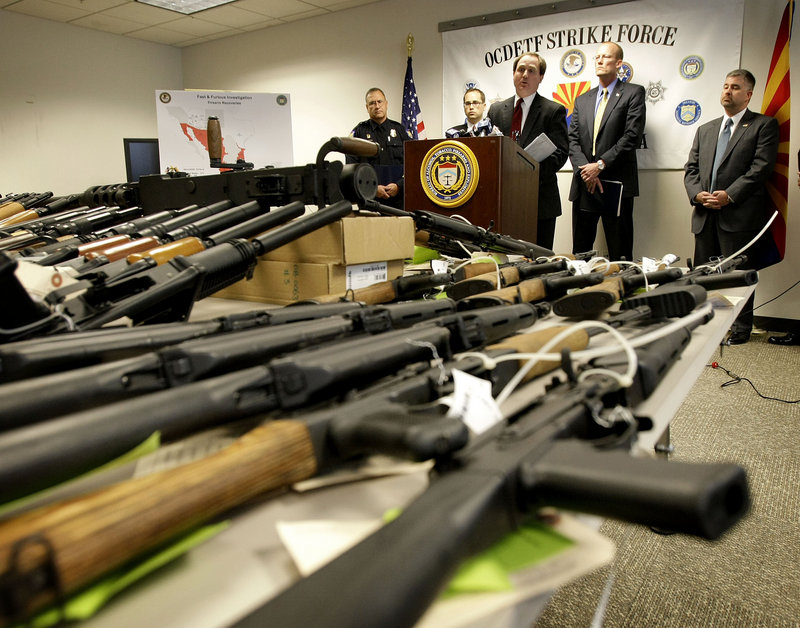
“It was the only way to dismantle an entire firearms-trafficking ring and stop the thousands of guns flowing to Mexico,” said William D. Newell, a veteran federal agent who spent five years as the head of the Bureau of Alcohol, Tobacco, Firearms and Explosives in Phoenix.
In his first public interview about the operation, Newell said that he believed that he and his agents were working the largest gun-trafficking case of their careers and finally had a window into Mexico’s powerful Sinaloa Cartel. To identify cartel members, ATF agents, beginning in 2009, watched as about 2,000 weapons purchased at Phoenix gun stores hit the streets, with the goal of tracing them to the cartel. The tactic became known as “gunwalking.” But on Dec. 14, 2010, Operation Fast and Furious came crashing down. A Border Patrol agent was killed in the Arizona desert, and two AK-47s found at the scene were linked to Newell’s operation. Agents working under him, enraged, went to lawmakers about the operation, sparking an 18-month investigation led by Rep. Darrell Issa, R-Calif., who called Fast and Furious “felony stupid.”
While Attorney General Eric H. Holder Jr. has turned over 7,600 documents related to the case, he has refused to turn over all of the Justice Department memos and emails that reflect internal deliberations that took place after Congress began its investigation. The White House has invoked executive privilege in the matter. As a result, the House is scheduled to vote today on whether Holder should become the first-ever sitting attorney general to be held in contempt.
Democrats charge that the battle is political theater, backed by the National Rifle Association, to embarrass Holder and the White House in an election year. But Republicans adamantly deny the contempt vote is about politics.
They say that the issue is about an attorney general whose Justice Department, in refusing to release documents, is covering up what senior officials knew and when about a botched gun operation that allowed thousands of firearms onto U.S. streets and into Mexico and resulted in the death of a U.S. border agent.
Holder has called the gun operation “flawed” and asked his inspector general to investigate. He has repeatedly maintained that he did not know about the tactics used until February 2011, after Congress began investigating.
According to Newell, there is no evidence that Holder or any high-ranking Justice Department official knew the ins and outs of his gun case. But plenty of other officials in the ATF and the Phoenix U.S. Attorney’s Office did — and approved it, Newell said.
In the fall of 2009, the Justice Department was putting pressure on Newell and his agents to combat Mexican cartels by identifying and eliminating the pipelines used to move guns across the border. There were calls in Washington to bring down the trafficking network, not just the people on the lowest rung who buy guns legally, then transfer them to the cartels.
The small-time gunrunners were simply slapped with small fines or acquitted in court while the cartel bosses stayed safely out of reach of investigators.
Newell’s office developed a plan: To identify the drug networks, his agents would track — but not arrest — the gun buyers. The agents could then follow them and their associates, wiretap conversations, and possibly charge more senior cartel members. The plan was permitted under ATF rules, had the legal backing of the U.S. Attorney Dennis K. Burke in Phoenix, was approved by Newell’s ATF superiors and was funded by a regional task force of the Justice Department.
Newell scoffs when he hears lawmakers and others call those tactics “controversial.” Three similar operations had been tried during the Bush administration by the same ATF field office.
“The notion that there was a secret tactic is totally absurd,” Newell said.
But Newell didn’t count on the possibility that some agents working Fast and Furious on the ground were outraged by the operation. He said he wasn’t aware of complaints of “gun-walking,” or the mutiny brewing below him as agents watched hundreds of guns enter the suspected cartel pipeline.
In December 2010, after Border Patrol agent Brian Terry was gunned down near the Mexico border, several of the agents went to Sen. Charles Grassley (R-Iowa). They said they had warned their direct supervisors that an agent or officer could be killed by one of the guns they were letting go.
Before the investigation began, Newell said that the former acting director of the ATF, Kenneth Melson, had praised him about Fast and Furious. But when Congress began investigating, Melson stopped calling. To this day, no senior Justice official has talked to Newell about Fast and Furious, and his bosses at ATF have never publicly defended him.
Newell has been publicly called “Lying Bill Newell” and “Gunwalker Bill” by conservative bloggers and chastised by members of Congress.
At a packed congressional hearing last July, lawmakers grilled Newell, demanding to know who authorized Fast and Furious and peppering him with stinging criticism. He acknowledged he could have been a better manager. He could have stressed to his superiors the growing number of firearms involved in the case and argued that his agents had enough evidence to seize more guns.
“His actions contributed to deaths and an ongoing public safety hazard,” said Frederick R. Hill, a spokesman for Issa.
Newell, 46, says he is now trying to pick up the pieces of a broken career.
Once a rising star in the ATF, who had spent a decade immersed in the gun wars on the southwest border, he lost his job as special agent in charge of the Phoenix ATF office, as well as a promotion to be the agency’s attache in Mexico. The 24-year veteran was transferred to ATF headquarters in Washington, while his wife and sons have stayed back in Arizona.
“The pressure I have been under over the last several months has been nothing like I have ever experienced,” he wrote in a letter to Congress. “This inquiry and the way it has been handled has taken a physical toll on my family, me and the dedicated men and women who continue to pursue the goals of this investigation.”
Meanwhile, the chance to deeply penetrate a Mexican drug cartel and bring down its trafficking pipelines is gone, Newell said. Federal agents will now be forced to stick to the smaller, easier and more inconsequential gun cases, away from operations that could have a significant impact on the flow of guns to Mexico.
“To this day, I strongly believe that we were doing our best to have the greatest impact on a very serious problem — firearms trafficking to Mexico,” Newell said.
Copy the Story Link
Send questions/comments to the editors.

Success. Please wait for the page to reload. If the page does not reload within 5 seconds, please refresh the page.
Enter your email and password to access comments.
Hi, to comment on stories you must . This profile is in addition to your subscription and website login.
Already have a commenting profile? .
Invalid username/password.
Please check your email to confirm and complete your registration.
Only subscribers are eligible to post comments. Please subscribe or login first for digital access. Here’s why.
Use the form below to reset your password. When you've submitted your account email, we will send an email with a reset code.