



In the skies over America, the squeeze is on.
Legroom on airplanes is going the way of free checked bags, pillows and in-flight meals. Passengers who want a little more wiggle room in their coach seats better be prepared to open their wallets.
Additional Photos
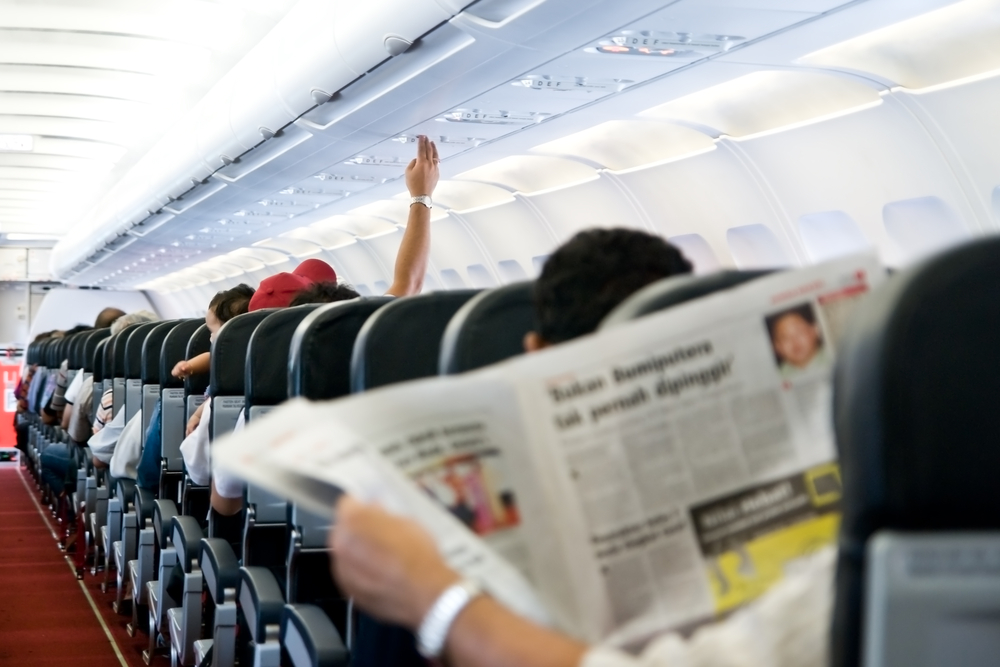
The trend for cash-strapped airlines is to charge passengers extra to sit in a new category of roomier economy seats with names such as Big Front Seat and Economy Plus.
But where’s this extra room coming from? Ask fliers in the cheapest seats, who are now being packed closer together.
“When I fly, I no longer feel like a passenger; I feel like I’m cargo,” said James Mewes, a retired Palm Springs, Calif., lighting company executive. “The seats already do not have enough padding. They have gotten narrower, and the legroom has become smaller.”
Mewes, who stands 5 feet, 8 inches tall, has flown for more than 30 years throughout the Western U.S., primarily in economy seats on United Airlines.
“The CEO and board members from United should have to sit in one of these coach seats for 12 hours,” he said.
The change marks a stark departure from 10 or 15 years ago, when most airlines offered only two choices: first class and coach. The change is an outgrowth of the profit-driven trend to add fees for such things as checking luggage, ordering food and using a pillow.
The move to charge passengers for onboard extras took off in 2008 when the economic recession severely cut demand for air travel, pushing the nation’s largest airlines to find new ways to boost revenue without raising fares too much.
By then, the trend had already begun across the pond. Ryan Air, based in Dublin, Ireland, was one of the first airlines to charge passengers to check luggage. Among other fees, Ryan now imposes an administration fee of about $8 for all flights and a fee of about $26 to hold an infant on your lap.
Such fees have been so lucrative – generating $22.6 billion among 50 airlines worldwide last year – that airlines have spent the past few years crafting one to let economy passengers upgrade to seats with a few inches of extra legroom.
In the past, the economy section on an average long-haul plane represented about 90 percent of the seats, with first-class seats making up the balance. Today, 10 percent to 30 percent of the spots on a major airline are extra-roomy economy seats, according to industry experts.
To make room for the new seats, airlines have eliminated 10 to 40 standard economy seats per plane. On some airlines, many of the remaining economy seats got pushed closer together even as Americans have grown, well, bigger.
“It’s getting to the point where if you are 5-foot-9 and taller, you are hitting your knees on the seat in front of you,” said Joe Brancatelli, a business travel expert and author of the website Joe Sent Me. “And if you are more than 5 pounds overweight, a 17-inch-wide seat is too narrow for you.”
In May, American Airlines unveiled a new seating scheme for its Boeing 777 plane that includes business class seats that can lie fully flat. But in the back of the plane, American plans to squeeze an extra seat into each row, for a total of 10 seats. To make them fit, American is installing seats with a width of 17 inches; first-class seats, by comparison, are 36 inches wide.
A few months later, JetBlue Airways announced plans to reconfigure seating on about 50 of its jets so it can add several rows of seats with 38 inches of legroom, available for an extra fee. But to fit the roomier seats, JetBlue reduced the legroom on 11 rows of economy seats to 32 inches from 33.
The industry leader in squeezing the most passengers into a plane is Spirit Airlines, which bills itself as an “ultra low cost carrier.” It packs 178 seats on an Airbus 320; United, meanwhile, puts 138 seats on the same aircraft model.
“What airlines are doing is creating different tiers of products and price differential,” said Jan K. Brueckner, a University of California-Irvine economics professor. “They are just trying to make money in a fiercely competitive business by parceling out the product in this way.”
The higher-priced, roomier seats include:
n JetBlue’s Even More Space seats, introduced in 2008. Each seat has 5 to 6 inches of extra legroom for $10 to $65 more than standard economy tickets. Nine months after introducing the Even More seats, JetBlue announced that they had helped generate $40 million in additional revenue.
n Spirit’s Big Front Seat, with 6 extra inches of legroom for an added $12 to $199, depending on the length of the flight.
n United’s Economy Plus seats, with up to 5 inches of extra legroom for an extra $9 to $179.
n American’s Main Cabin Extra seats, with 4 to 6 inches of extra legroom for an additional $8 to $108.
Many websites have popped up in recent years to compare seats on various airlines, detailing such things as legroom, seat width and amenities. Among them are SeatGuru, SeatExpert and Routehappy.
“The airlines have realized that charging for baggage has tapped out,” said Jami Counter, senior director at SeatGuru. “What other ways can you drive additional revenue? This is one way to get passengers to pay extra.”
Websites such as SeatGuru also have introduced passengers to industry terms such as “pitch,” the distance between the back of a seat and the back of the seat in front of it. It is generally considered a good indication of legroom.
Even before airlines created the new seat categories, basic economy seats varied in legroom and width not only by airline but also by plane model. Some economy seats on Spirit, for example, have a pitch of as little as 28 inches, less than the average of 31 inches for all U.S.-based airlines, according to Routehappy. On the other hand, United and Frontier Airlines offer some economy seats with a pitch of as much as 36 inches.
The width of seats varies too, ranging from about 17 inches on Southwest Airlines to nearly 20 inches on Virgin America.
In the past couple of years, airlines also have found a new way to fit more seats in planes: install seats with thinner padding. In some cases, the thinner cushions create more legroom for passengers. In other cases, airlines use the freed-up space to cram in more seats.
United announced in August that it was switching to seats with thinner padding in order to add a row of seats without reducing legroom. And in 2010, Spirit began to install seats with thinner cushions and backrests that do not adjust, making it possible for the airline to fit up to 40 more seats per plane than other carriers.
The manufacturers of the seats with slimmer cushions say their products use frames that are made of composite metal, lighter and just as comfortable as the old-fashioned seating.
“When you put more seats on a plane, it’s more crowded,” said Leonard Kazmerski, a spokesman for Timco Aviation Services, a North Carolina company that has designed a slender airline seat called FeatherWeight. “But we hope that with our seats, at least there is some comfort also.”
Alaska Airlines plans to unveil its thinner seat cushions next year on 22 soon-to-be delivered Boeing 737 jets. Alaska said the 32-inch pitch will remain the same in the new seats.
That doesn’t satisfy Carol Churchill, a lawyer from Signal Hill, Calif., who recently flew on Alaska Airlines from Los Angeles to Portland. She described herself as 5 feet, 6 inches tall and “far from skinny” and said she felt squished between the armrests and couldn’t use the tray table without getting hit in the belly.
“And I was always watching my knees for when the seat in front of me reclined,” she said.
Send questions/comments to the editors.

Success. Please wait for the page to reload. If the page does not reload within 5 seconds, please refresh the page.
Enter your email and password to access comments.
Hi, to comment on stories you must . This profile is in addition to your subscription and website login.
Already have a commenting profile? .
Invalid username/password.
Please check your email to confirm and complete your registration.
Only subscribers are eligible to post comments. Please subscribe or login first for digital access. Here’s why.
Use the form below to reset your password. When you've submitted your account email, we will send an email with a reset code.