



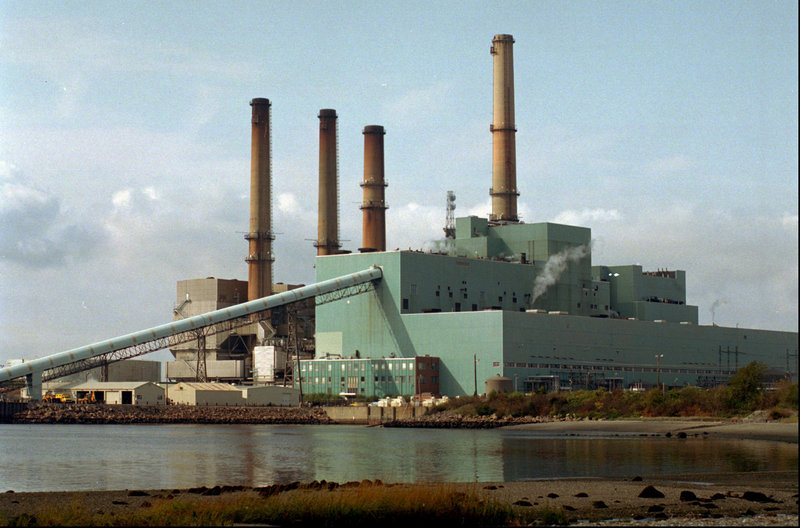
BOSTON – The future of the massive Brayton Point Power Station in southeastern Massachusetts is again in flux, just seven years after it last changed owners.
And environmentalists say the bleak future in New England of the coal it burns is the key reason why.
Additional Photos
In 2000, coal was the third-most-used fuel for electricity in New England, accounting for 18 percent of the region’s power. Now, it produces just 6 percent of regional power, according to grid operator ISO New England.
A variety of factors has reduced its imprint, industry watchers say: pressure from anti-pollution activists, the expense of upgrading older plants and regional energy preferences. But the biggest influence is the low price of natural gas, something the industry itself acknowledges.
“Certainly as long as natural gas prices remain low, the industry will face challenges,” said Lisa Miller of the American Coalition of Clean Coal Electricity.
Coal’s bit role in New England’s energy production is different than in the nation as a whole, where it accounted for nearly 45 percent of all power produced in 2010, according to the U.S. Energy Information Administration.
Owner Dominion said Thursday that it put the Brayton Point plant in Somerset on the market primarily because it’s focusing on businesses in states with regulated energy markets — unlike Massachusetts. In regulated markets, infrastructure costs can more easily be directly passed on to ratepayers. But dismal projected earnings for Brayton Point speak to coal’s increasing struggle to remain competitive, despite its history as a source of affordable power and the tens of billions of dollars Miller notes that the industry has spent on making coal burn cleaner.
Activists in New England, who have worked for years to marginalize coal as a dirty, damaging source of power, say now that it’s down, they’re going to keep it from rebounding.
“A legion of active, knowledge advocates … are going to prevent that from happening by using every tool available,” said Jonathan Peress of the Conservation Law Foundation.
While natural gas is cheap everywhere, coal plant owners in New England must figure out how to compete with it while also maintaining often older facilities that need anti-pollution upgrades to meet tougher environmental standards.
“The rising environmental and economic costs associated with oil and coal have made it difficult for older power plants to compete against generators that use cheaper, cleaner fuel sources,” said Marcia Blomberg of ISO New England.
Some plants have responded to coal’s decreasing competitiveness by dramatically curtailing their use of it. For instance, the 45-year-old Bridgeport Harbor Generating Station in Connecticut ran its coal unit at just 15 percent capacity in 2011, compared with 86 percent in 2008, according to statistics compiled for CLF using data from the EPA.
And last year, Dominion asked for permission to shut down the 60-year-old coal- and oil-fired Salem Harbor Power Station, citing the prohibitive cost of the environmental upgrades. The station has since been purchased by a company that plans to build a natural gas plant there.
At five-decade-old Brayton Point, which also burns oil and natural gas, Dominion spent about $1.1 billion to modernize the plant it bought in 2005. But the estimated earnings are bleak. In a report Thursday, the day of Dominion’s announcement, USB Investment Research projected Brayton Point would lose $3 million this year and again in 2014.
Dominion spokesman Jim Norvelle said the environmental upgrades, due to be fully operational this year, secure Brayton Point’s future and make the company confident it will find a buyer. It projects to complete the sale in the first half of 2013.
The plant, located on Mount Hope Bay across the mouth of the Taunton River, employs 215 people and can provide power to 1.5 million people at full capacity, Dominion says.
Somerset Selectman Chairman Patrick O’Neil said he’s not worried that the plant has a future, but he has concerns a low sale price could drop its assessed value. That would have implications in Somerset, which received a nearly $16 million tax payment from the station this fiscal year — just $2.5 million less than the town’s entire K-8 school budget for fiscal 2013.
CLF’s Peress said he thinks Dominion will struggle to find a taker. The environmental regulations and market forces that have decreased coal’s viability aren’t about to change, he said.
“It’s the continued succumbing of coal to its inefficiency and its obsolescence,” he said. “Let the buyer beware.”
Send questions/comments to the editors.

Success. Please wait for the page to reload. If the page does not reload within 5 seconds, please refresh the page.
Enter your email and password to access comments.
Hi, to comment on stories you must . This profile is in addition to your subscription and website login.
Already have a commenting profile? .
Invalid username/password.
Please check your email to confirm and complete your registration.
Only subscribers are eligible to post comments. Please subscribe or login first for digital access. Here’s why.
Use the form below to reset your password. When you've submitted your account email, we will send an email with a reset code.