



“Maine Women Pioneers III: Homage” is a fascinating show for myriad reasons.
For starters, it not only gives a preview of Lois Dodd (born 1927) before her major solo show opens at the Portland Museum of Art later this month, it puts Dodd in the context of some of her finest contemporaries — 12 other significant, active Maine women artists.
Additional Photos
If you are interested in Dodd’s upcoming PMA show, you should see “Homage.” Conversely, Dodd’s PMA show will remind us that all of these women have created massively rich bodies of work during their careers.
Yet by its placement and scale, Dodd’s presence in “Homage” has the least splash or panache of any of the included artists.
It says something great about a show when Dodd’s works aren’t near the top of the list for excitement. As far as I am concerned, Dodd doesn’t (and probably can’t) miss.
In general, “Homage” presents mini-retrospectives of each of the 13 artists. This makes for a dense but coherent show that self-divides into clear and self-developing chapters.
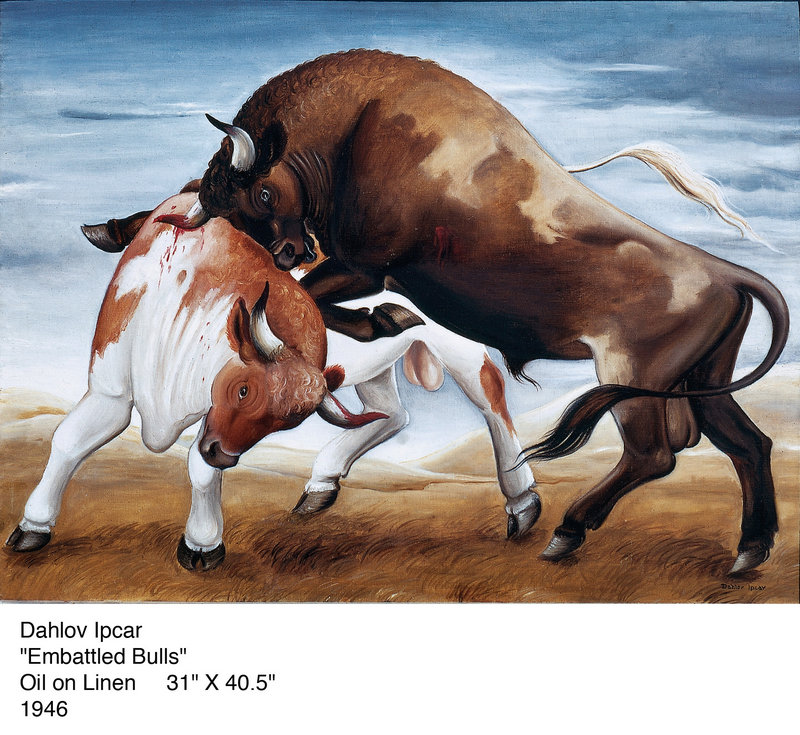
One of the most impressive chapters includes Dahlov Ipcar’s (born 1917) “Embattled Bulls” of 1946 — a fierce and violent scene that echoes Picasso’s “Guernica” in the social Realist style of Thomas Hart Benton. With evident testosterone engines, it’s one of the very few pieces in the show that makes a direct moral comment about gender.
While Ipcar’s powerful anti-war painting would be a stand-out in any show, its placement next to a 2012 canvas — “Serengetti Triad,” showing three cervine inhabitants of the African grasslands — painted by the artist at age 95 is extraordinary.
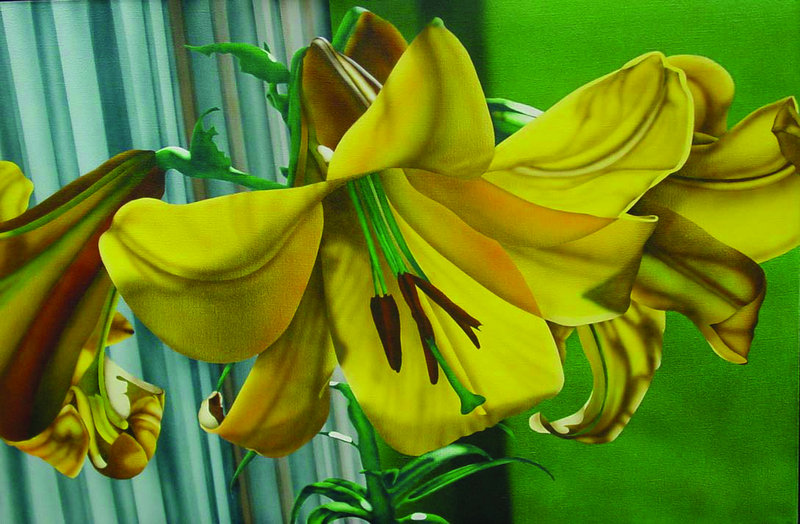
One of the most interesting chapters comprises four works by Beverly Hallam (born 1923), in part because I had never quite been able to wrap my head around her large airbrushed flowers. But with the acrylic paint pioneer’s newest works — abstract shape-oriented computer drawings — and three-color woodcut, Hallam’s commitment to abstract shapes in her airbrushed works becomes clear (think masking).
Alison Hildreth’s (born 1934) newest picture — a tall, elegant topographical work on paper with archeological ambitions — reveals the artist’s shift to the linear intelligence of drawing in its placement next to a large brushy 1986 Abstract Expressionist landscape painting.
Framing this pair, her more complex works easily reveal their densely complicated components of design, notions about linear narrative and complicated relationship between image, object and time process.
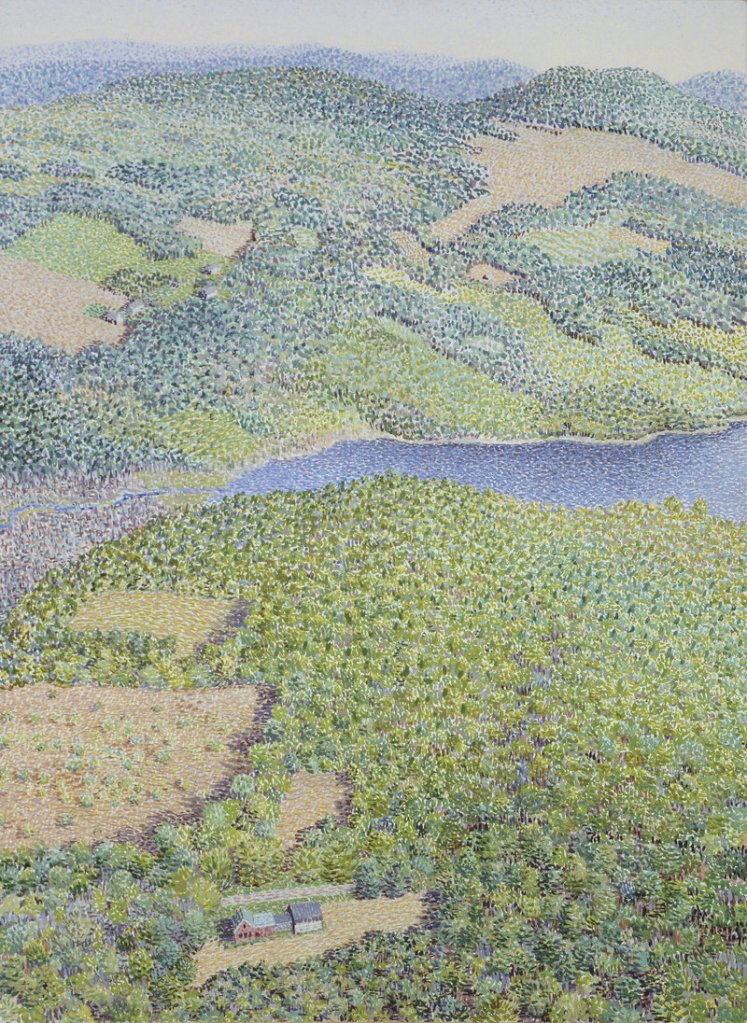
Yvonne Jaquette’s (born 1934) 1976 landscape appears as a Pointillist anachronism (Seurat et al certainly couldn’t make aerial views) next to a sophisticatedly urban 2006 pastel depicting multiple night views of Augusta from a helicopter.
Jaquette’s colored dots on a black ground, “Galaxy of Night Lights” (2008), does something very unusual by shifting a downward view into the upward logic of the night sky. It’s the inverse of a fundamental tension of Modernism — the sometimes dysfunctional relationship between the vertical, painted canvas and the horizontal landscape it depicts.
An excellent example is Frances Hodsdon’s (born 1926) lithograph of patio chairs on a flat ground of garden flora imagery that tries to stand up flat on the surface on which it was rendered. While the chairs are superb analogs for the human body, their sense of design encourages the linear greenery to play the part of decoration or even fabric. “Fascinated IV” is a brilliant little gem.
Every artist in “Homage” is worth a critical discussion, but there simply isn’t space here. To merely mention or describe a work by any artist tends to incidentally deny its serious depth; the work of Maggie Foskett, Susan Groce or Marilyn Quint-Rose is as strong as anything.
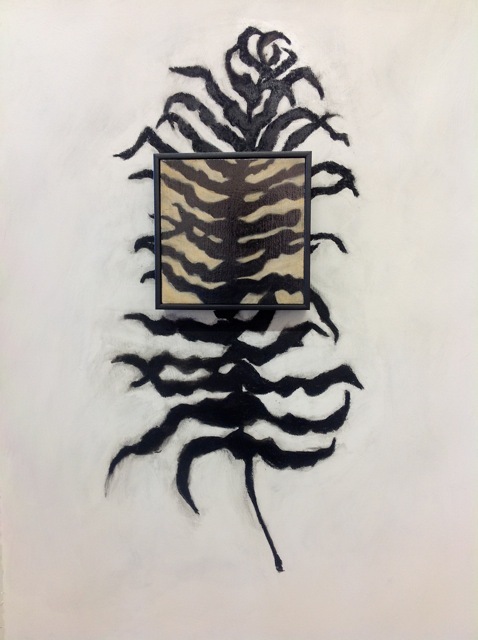
One artist who does stand out, however, is Lissa Hunter (born 1945). Her “Rush Hour” moves from a painting of birds to charcoal drawing of the corvine figures directly on the wall under the entry title. Yet that is surpassed by her smartly whimsical chair installation, and that by her brilliant encaustic-painted basket — and that by her dialectically electric fern painting/drawing.
Hunter’s basketry is reprised by Katarina Weslien’s (born 1952) “When We Walk We Talk.” It has the presence and visual ambition to match any painting in “Homage,” but it walks the line between basketry, collage and fiber — and its transformational power (think Henry James) is showcased as it faces off against a suite of her thoughtfully meditative environmentalist video work.
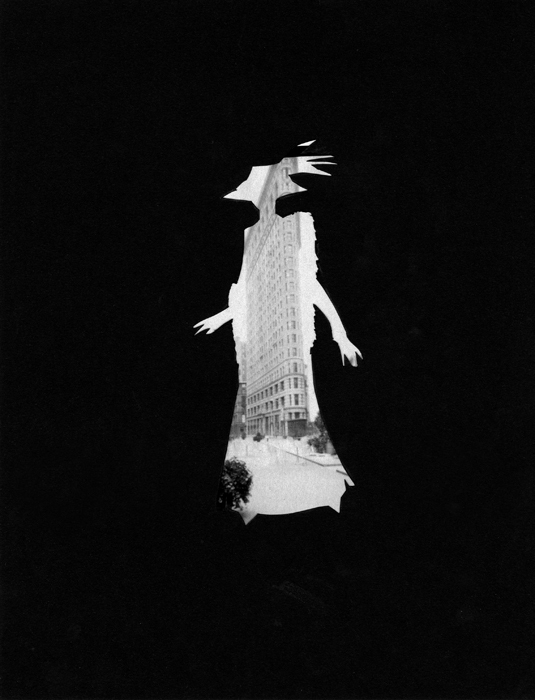
Rose Marasco’s (born 1948) fantastic photos of Maine granges remind us of the major role of women in grange culture. The rural Maine imagery, however, is thrown into sharp relief by silhouettes of couture-dressed women masking photos of same period NYC skyscrapers — perky meditations on time-flavored masculinist monumentality versus ephemeral feminine fashion.
One great pairing comprises Frances Kornbluth’s (born 1920) larger paintings. They are extremely similar in scale, size, shape and color, but they could hardly be more different, as one tilts towards landscape and the other insists on being abstract.
To illustrate that such a vast difference is so delicately — but clearly — balanced on the finer points of painting is an artistic triumph that Picasso would envy (he pursued this kind of distinction of legibility in late Cubism).
The unassailable conclusion of “Homage” is the triumph of active Maine women artists. It’s not intended to be fully comprehensive; rather, it successfully posits a polemic about the critical density of the community of accomplished women in Maine art.
It is a highly enjoyable and successful show.
Freelance writer Daniel Kany is an art historian who lives in Cumberland. He can be contacted at:
dankany@gmail.com
Copy the Story Link
Send questions/comments to the editors.

Success. Please wait for the page to reload. If the page does not reload within 5 seconds, please refresh the page.
Enter your email and password to access comments.
Hi, to comment on stories you must . This profile is in addition to your subscription and website login.
Already have a commenting profile? .
Invalid username/password.
Please check your email to confirm and complete your registration.
Only subscribers are eligible to post comments. Please subscribe or login first for digital access. Here’s why.
Use the form below to reset your password. When you've submitted your account email, we will send an email with a reset code.