



One sure sign of a good book is that you can read it straight through enjoyably. The sign of a superb book is that you find yourself debating its propositions and arguments weeks after reading it.
“American Nations: A History of the Eleven Rival Regional Cultures of North America” by journalist-historian Colin Woodard is a superb book. Woodard makes a compelling argument that the United States was founded by contradictory regional convictions that continue to influence current attitudes and policy on a national level.
Additional Photos
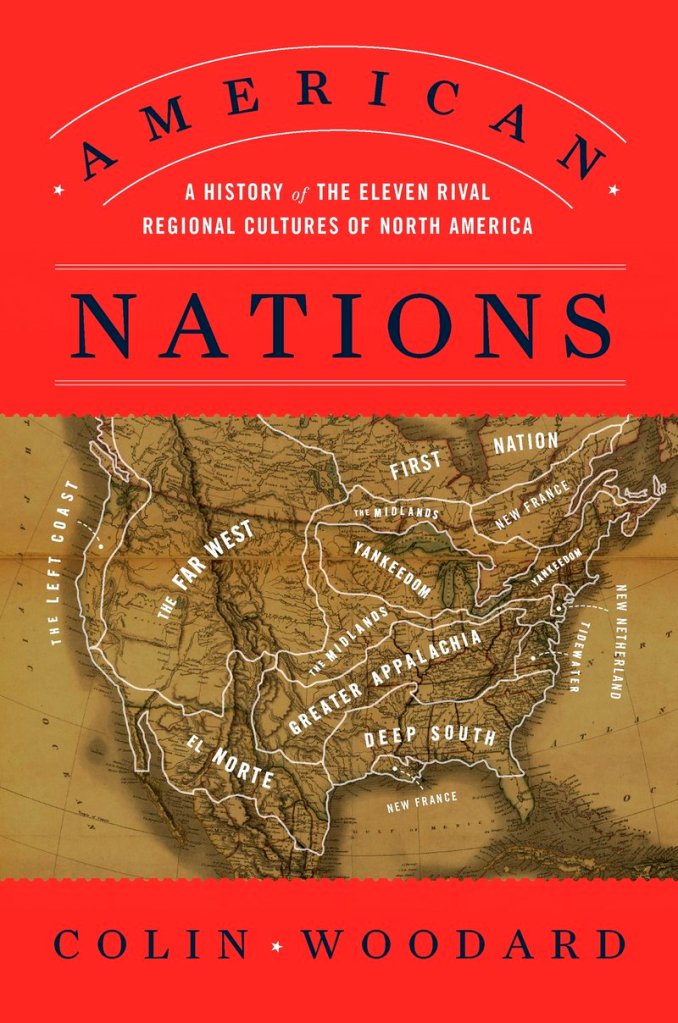
Indeed, the reader is taken on a knowledgeable, whirlwind tour from El Norte (on the Mexican-U.S. border) to New England and New France (the latter across the Canadian-U.S. border and Louisiana) to the Midlands, New Netherlands, Deep South, Far Left Coast, etc.
If this sounds familiar, the framework idea derives from Joel Garreau’s book, “The Nine Nations of North America” (Houghton Mifflin, 1981), which Woodard acknowledges. A friend lent me his copy of Garreau, and it is really more about the economy than about adherence to ideas and approaches to doing things.
The negative notion of “rival” is integral to Woodard’s thesis.
Think back to Adams vs. Jefferson; the Era of Good Feeling (so-called); the foiled presidential quests of Webster (New England), Clay (Appalachia) and Calhoun (Deep South); the split of the politically inept Confederate States of America (within which the politicians of 11 states failed to adequately aid the whole while looking to their own well-being); the continuing expansion of the United States; the isolation of the Deep South; the anomaly of Woodrow Wilson; and on up to World War II and the development of the Far West and the New South.
If it sounds complicated, it is not. Woodard knows his history in terms of great movements, geography and facts, and he brings them together in tidy journalistic form.
If there is a hitch, it is that there are two missing parts to the map: South Florida and the Caribbean, and Hawaii and the Pacific. They would have presented a new level of complexity, even if they perhaps do not yet have the same influence of the other “nations” or powers.
On the other hand, the Bush-Gore presidential race was determined in Florida, and President Obama’s birthplace was in Hawaii.
There are good arguments to be made for exclusion or inclusion. The key thing about “American Nations” is that Woodard has begun a discussion of our history, and he offers a fundamentally different way of looking at our present, in which the right and left in Congress have, in the name of part- isan ideology, brought a once functional and demonstrably great government to a near halt.
There seem to be no practical visionaries in leadership positions, only front people wishing for a photo-op at the helm (where they hope nothing really bad happens).
This unfortunate situation can be reckoned by a variety of historical approaches, but sectional ideology is one way to consider things, because it also carries the seeds of ethnicity, religion, custom, geography, economics toward education, neighbors and what kind of God we worship or repudiate.
It also gives agency to the peoples of Mexico and Canada, who, in direct or indirect ways, have shaped the republic as well as their own countries.
“American Nations” smashes the idea of political borders, for we live on international boundaries and know that human transfer is inevitable, necessary and has been going on since the first Europeans took over. Native Americans still dominate in the far north of Canada, and are scattered throughout the three recognized countries.
There is much to grapple with in this well-written book.
William David Barry is a local historian who has authored/co-authored six books, including “Deering: A Social and Architectural History” and the novel “Pyrrhus Venture.” He lives in Portland.
Copy the Story Link
Send questions/comments to the editors.

Success. Please wait for the page to reload. If the page does not reload within 5 seconds, please refresh the page.
Enter your email and password to access comments.
Hi, to comment on stories you must . This profile is in addition to your subscription and website login.
Already have a commenting profile? .
Invalid username/password.
Please check your email to confirm and complete your registration.
Only subscribers are eligible to post comments. Please subscribe or login first for digital access. Here’s why.
Use the form below to reset your password. When you've submitted your account email, we will send an email with a reset code.