



AUGUSTA – A federal judge ruled Friday that Gov. Paul LePage was within his right to “government speech” when he removed a mural depicting labor history from a state office building.
U.S. District Judge John A. Woodcock Jr. issued the 91-page ruling dismissing the lawsuit, which was filed last year and sought to have the mural reinstalled at the Department of Labor. Oral arguments were held in U.S. District Court in Bangor earlier this month.
Additional Photos
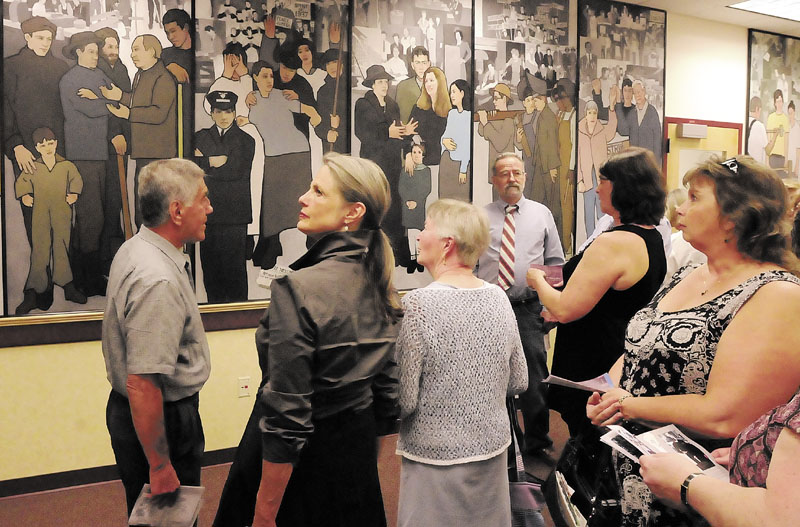
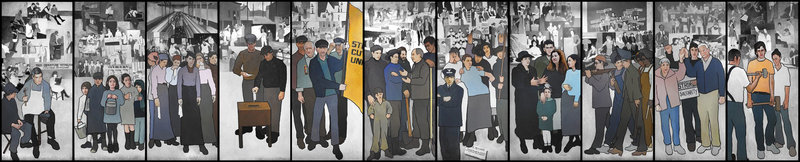
“The governor has as much right not to project a message about the history of Maine labor in a state-owned mural as he would to decline to read aloud a history of labor in Maine written by the prior administration,” Woodcock wrote. “In other words, as the Supreme Court held, a government entity has the right to ‘speak for itself.”‘
The controversy surrounding the 11-panel mural began a year ago, when LePage ordered it removed from a small waiting room and stored in a secret location. The mural depicts the history of organized labor in Maine and the country, with images of Rosie the Riveter and a shoe-worker strike in Lewiston. It’s removal became a national news story.
At the time, LePage called the mural “one-sided” and said he did not want to send the wrong message to employers in Maine.
The mural’s removal prompted widespread criticism and the federal lawsuit filed on behalf of three artists, a workplace safety official, an organized labor representative and an attorney alleging that LePage violated First Amendment rights protected in the U.S. Constitution, as well as the state’s contract with the artist.
“We have a legal decision but nothing resembling justice,” artist Robert Shetterly, one of the plaintiffs, told The Associated Press. “What’s been censored, what’s been removed and suppressed, is not just (the artist’s) free speech against the governor’s free speech or government speech — what’s been censored is our history.”
But LePage spokeswoman Adrienne Bennett said Friday that the administration felt all along that the lawsuit was more about politics than art.
“We’ve always believed this was a frivolous, politically motivated lawsuit,” she said. “It would be stunning if government officials were to be barred from making different artistic choices from their predecessors.”
Attorney Jeffrey Neil Young, who represented the plaintiffs, said in a statement that they won the case “in the court of public opinion.”
“Mainers recognize what the court has failed to appreciate,” he said. “That the removal of the mural is nothing less than government censorship of artistic speech in violation of the First Amendment. The mural is no more government speech than the mural that hangs in the lobby of the courthouse in Bangor when you go through security to enter the building.”
The plaintiffs haven’t yet decided whether to appeal.
The mural was commissioned in 2008 by then-Gov. John Baldacci’s administration during renovations of the leased office space in Augusta. The state spent $60,000 on the piece and directed artist Judy Taylor of Tremont to create a mural that emphasized the “value and dignity of workers and their critical role in creating the wealth of the state and nation.”
During oral arguments in Bangor, plaintiffs’ attorney Jonathan Beal argued that because the artist created the work and was expressing her ideas, LePage’s decision to remove the mural stifled her free speech rights.
Woodcock ruled that it was a case of government speech and that he was wary of setting a precedent in which sitting governors could be cross-examined in court and asked to explain their political decisions.
“To hold a jury trial and subject elected officials to cross-examination whenever a dissident group contends that a governmental action, which affects a governmental message, is politically motivated would risk transforming the courts into stages for political theater,” he wrote.
In arguments submitted to the court, the plaintiffs argued that giving government officials power to remove works of art they disagree with would have a chilling effect on a state program that encourages artists to display their work in public buildings.
However, Woodcock said that artists must know if their work can be perceived as partisan, it may be taken down — or put back up — by new government officials.
“Of course, the political world constantly turns and in time the rejected often become the elected,” he wrote. “If the artwork is stowed away, the returned leaders may well unpack it and restore it to its original place.”
Attorney General William Schneider said in a statement that individuals and the government have a right to free expression.
“As citizens, we want our government officials to speak and express their views,” he said. “Any effort by a small group to attempt to control government’s speech by bringing elected officials to trial should be viewed as a threat to our democratic principles. I am pleased that the Court agreed that just as individuals are free to speak, so too is the government.”
State House Writer Susan Cover can be contacted at 620-7015 or at:
scover@mainetoday.com
Send questions/comments to the editors.

Success. Please wait for the page to reload. If the page does not reload within 5 seconds, please refresh the page.
Enter your email and password to access comments.
Hi, to comment on stories you must . This profile is in addition to your subscription and website login.
Already have a commenting profile? .
Invalid username/password.
Please check your email to confirm and complete your registration.
Only subscribers are eligible to post comments. Please subscribe or login first for digital access. Here’s why.
Use the form below to reset your password. When you've submitted your account email, we will send an email with a reset code.