



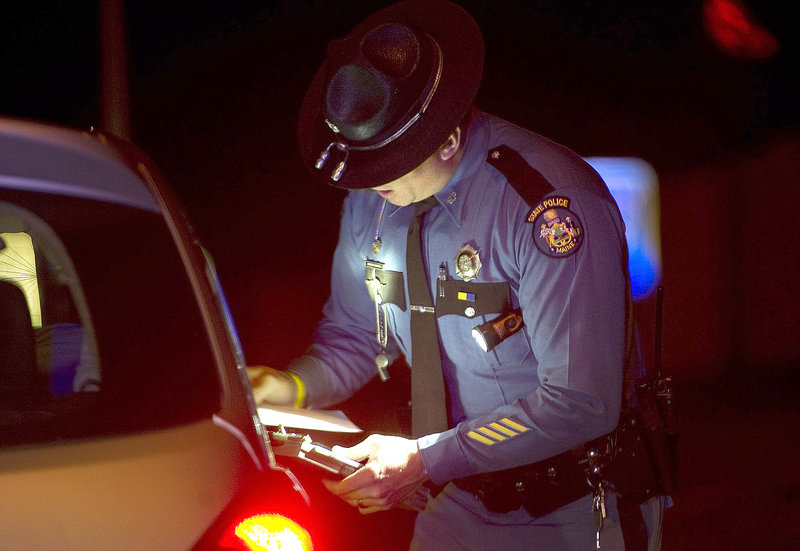
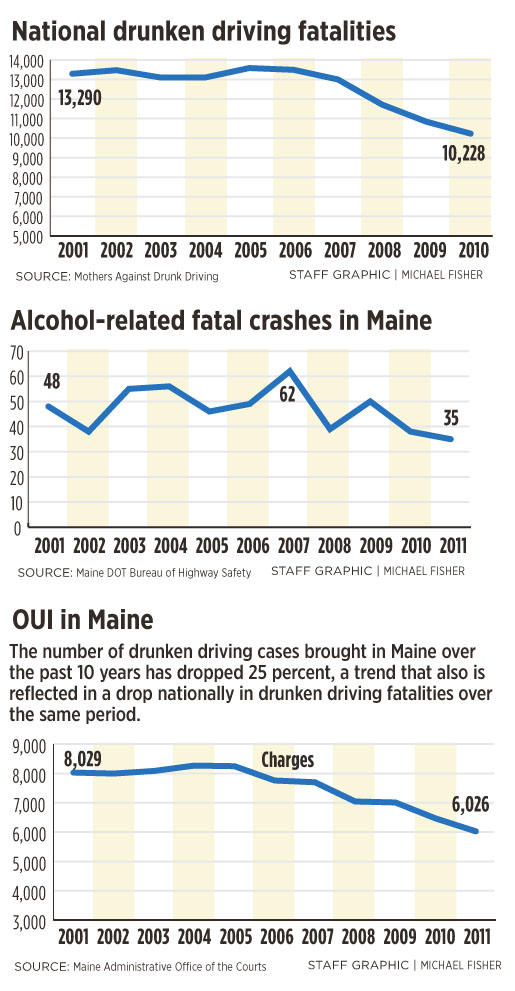
As police crack down on drunken driving this Fourth of July holiday week, an analysis of court data shows a 25 percent drop in the number of people charged with driving drunk in Maine over the past 10 years.
Police and anti-drunken-driving advocates aren’t sure why the numbers are down.
Additional Photos
Some say fewer people are taking the chance of driving under the influence because of tough penalties and tough talk. Others say the decline reflects cutbacks in law enforcement and increasing demands on officers, who have less time to patrol for drunken drivers.
Portland police Sgt. Scot Mattox, the department’s expert on the issue, said, “I think staffing has been reduced, and with reduced staffing you get a cascading effect of less time for pro-active activity and fewer officers to make arrests.”
Mattox also sees “a cultural shift” away from drinking and driving. “We see a lot more taxis in the Old Port, for example, than we did 10 years ago,” he said.
The Portland Press Herald’s analysis of data from the Maine Administrative Office of the Courts shows that the number of drunken-driving charges brought by Maine police dropped from 8,029 in 2001 to 6,026 in 2011.
During that period, the number of licensed drivers in the state grew 9 percent, to 1,014,826 by last year, according to the Secretary of State’s Office.
The total number of crashes involving alcohol in Maine, including those in which a driver was drinking but not over the legal limit, went down 28 percent, from 1,752 in 2002 to 1,265 in 2010, according to data from the Maine Department of Transportation.
Col. Robert Williams, chief of the Maine State Police, said that when he was working on the roads in the 1980s, he could pull over a half-dozen drunken drivers on a single Friday or Saturday night. “Now, you can be working hard and only get one in a weekend,” he said.
“Over the last 20 years or more, there has been such an emphasis on (drunken driving), I don’t think it’s as prevalent as it used to be,” Williams said. “People who socialize a lot, they tell me they know police are looking, they know the consequences are severe and they either make arrangements (for someone else to drive) or take a taxi.”
Cumberland County Sheriff Kevin Joyce said his department has issued slightly fewer drunken-driving citations, but aggressive deputies are still keeping their numbers up.
Maj. William King of the York County Sheriff’s Office said he believes that the stigma and penalties associated with drunken-driving arrests are leading more people to arrange for designated drivers.
Nationwide, the number of drunken-driving fatalities dropped 23 percent, from 13,290 in 2001 to 10,228 in 2010, mirroring a decline in the total number of fatal crashes, according to statistics provided by Mothers Against Drunk Driving.
Police say that could reflect fewer drunk drivers, but it may be attributed in part to safer vehicles and even improvements in emergency medicine.
In Maine, drunken-driving fatalities went from 38 in 2002 to a high of 62 in 2007, then dropped to 35 last year, according to the Maine Bureau of Highway Safety.
There were no alcohol-related fatalities in Maine from July 3-5 last year. There were three in that period in 2010 and two in 2009. Last year, Labor Day was the worst holiday period for fatal drunken-driving crashes, with five.
The drop in drunken-driving charges may reflect competition for police officers’ time, said Williams, chief of the state police.
For example, the Portland Police Department once staffed a van that helped officers test suspected drunken drivers, but that program lapsed as priorities changed.
“Demand for police service is much higher than it was 20 years ago,” Williams said. “You have the same two people working a town, and 10 years ago, they had eight to 10 complaints (during a shift). Now, they have 15 to 20.”
More demand means less time for proactive enforcement like keeping watch for drunk drivers, he said.
That’s why police like dedicated patrols – like those that will be deployed this weekend in advance of the July 4 holiday.
Several departments plan coordinated enforcement in the Scarborough and Saco area, with officers from both communities and deputies from Cumberland and York counties, as part of the Regional Impaired Driving Enforcement pilot project in Cumberland County.
The Maine Bureau of Highway Safety has awarded $250,000 in federal highway funds to 50 departments this year to support expanded drunken-driving patrols.
A recent effort, on June 16 in the Lakes Region, involved seven officers patroling from Bridgton to Windham. The saturation patrol, part of the regional pilot project, led to six drunken-driving arrests out of 89 drivers stopped, one drug arrest, two charges of driving with a suspended license, and dozens of warnings for vehicle defects, speeding and other moving violations.
From today through next week, state police will use aircraft, unmarked cruisers and extra troopers to watch for impaired and aggressive drivers, and for drivers who are texting or aren’t wearing seat belts.
Westbrook police plan saturation patrols and sobriety checkpoints.
“The focus of most law enforcement agencies, including mine, is that drunk drivers have no business being on the road, and we’re going to do everything we can to get them off the road,” said Joyce, Cumberland County’s sheriff.
Technology including social media may be playing a role in how police crack down on drunken driving.
Matt Nichols, a lawyer who specializes in drunken-driving defense, said saturation patrols are more effective at deterring drunk drivers than roadblocks, because word about roadblocks spreads fast.
“In today’s world of social media, if someone sees you setting up a roadblock at 9 p.m. on west Commercial Street or Franklin Arterial, within a half-hour, hundreds of their friends know, and before you know it, people are taking alternative routes to get out of Dodge,” Nichols said. “If you have a saturation patrol, there’s no way to really do that.”
Carl McDonald, the national law enforcement initiatives manager for Mothers Against Drunk Driving, said federal funds for enforcement details have largely been unscathed despite the economic downturn and related budget cutting. But he worries that local and state budget cuts could make traffic safety less of a priority.
Sobriety checkpoints and saturation patrols have been criticized for not catching enough drunk drivers, but they remain important and need to continue, he said.
Low arrest numbers aren’t a measure of failure, but success, he said.
Some people have learned that driving drunk isn’t safe. Others may fear arrest. “Either way, we win,” McDonald said. “We get safer roads because of that.”
Staff Writer David Hench can be contacted at 791-6327 or at:
dhench@pressherald.com
Copy the Story LinkSend questions/comments to the editors.

Success. Please wait for the page to reload. If the page does not reload within 5 seconds, please refresh the page.
Enter your email and password to access comments.
Hi, to comment on stories you must . This profile is in addition to your subscription and website login.
Already have a commenting profile? .
Invalid username/password.
Please check your email to confirm and complete your registration.
Only subscribers are eligible to post comments. Please subscribe or login first for digital access. Here’s why.
Use the form below to reset your password. When you've submitted your account email, we will send an email with a reset code.