



CAPE CANAVERAL, Fla. — A 150-foot-wide asteroid will come remarkably close to Earth next week, even closer than high-flying communication and weather satellites. It will be the nearest known flyby for an object of this size.
But don’t worry. Scientists promise the megarock will be at least 17,100 miles away when it zips past next Friday.
Additional Photos
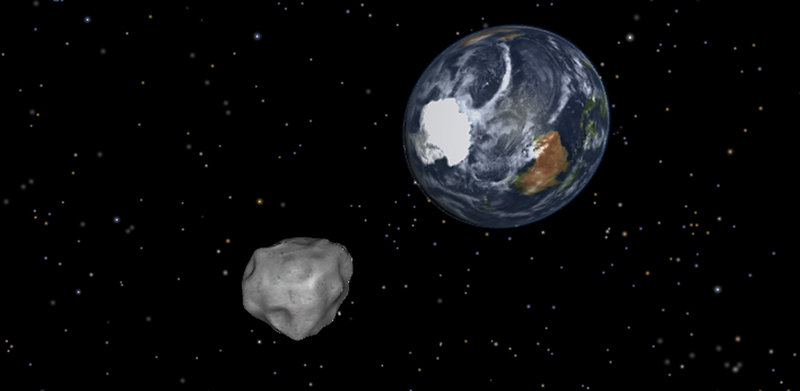
“No Earth impact is possible,” Donald Yeomans, manager of NASA’s Near-Earth Object program at Jet Propulsion Laboratory in Pasadena, Calif., said Thursday.
Even the chance of an asteroid-satellite run-in is extremely remote, Yeomans and other scientists noted. A few hundred satellites orbit at 22,300 miles, higher than the asteroid’s path, although operators are being warned about the incoming object for tracking purposes.
“No one has raised a red flag, nor will they,” Yeomans told reporters. “I certainly don’t anticipate any problems whatsoever.”
Impossible to see with the naked eye, the asteroid is considered small as these things go. By contrast, the one that took out the dinosaurs 65 million years ago was 6 miles wide.
Yet Asteroid 2012 DA14, as it’s known for its discovery date, still could pack a wallop.
If it impacted Earth — which it won’t, scientists were quick to add Thursday — it would release the energy equivalent of 2.4 million tons of TNT and wipe out 750 square miles. That’s what happened in Siberia in 1908, when forest land around the Tunguska River was flattened by a slightly smaller asteroid that exploded about five miles above ground.
The likelihood of something this size striking Earth is once in every 1,200 years. A close, harmless encounter like this is thought to occur every 40 years.
The bulk of the solar system’s asteroids are located between the orbits of Mars and Jupiter, and remain stable there for billions of years. Some occasionally pop out, though, into Earth’s neighborhood
The closest approach of this one will occur next Friday afternoon, Eastern time, over Indonesia. The asteroid will zip by at 17,400 mph. That’s roughly eight times faster than a bullet from a high-speed rifle.
The asteroid will be invisible to the naked eye and even with binoculars and telescopes will appear as a small point of light. The prime viewing locations will be in Asia, Australia and eastern Europe.
Astronomers using NASA’s deep-space antenna in California’s Mojave Desert will have to wait eight hours after the closest approach to capture radar images.
Scientists welcome whatever pictures they get. The asteroid offers a unique opportunity to observe something this big and close, and any new knowledge will help if and when another killer asteroid is headed Earth’s way.
Copy the Story Link
Send questions/comments to the editors.

Success. Please wait for the page to reload. If the page does not reload within 5 seconds, please refresh the page.
Enter your email and password to access comments.
Hi, to comment on stories you must . This profile is in addition to your subscription and website login.
Already have a commenting profile? .
Invalid username/password.
Please check your email to confirm and complete your registration.
Only subscribers are eligible to post comments. Please subscribe or login first for digital access. Here’s why.
Use the form below to reset your password. When you've submitted your account email, we will send an email with a reset code.