




PORTLAND – A collection of rare 19th-century hand-painted banners commissioned by an association of Portland tradesmen is going up for auction next month, and the Maine arts community fears their sale may lead to the loss of important cultural artifacts.
The Maine Charitable Mechanic Association owns the 17 banners and has consigned them to James D. Julia Inc., an auction house in Fairfield. The banners will be offered during Julia’s late-summer sale, set for Aug. 25-27.
Additional Photos
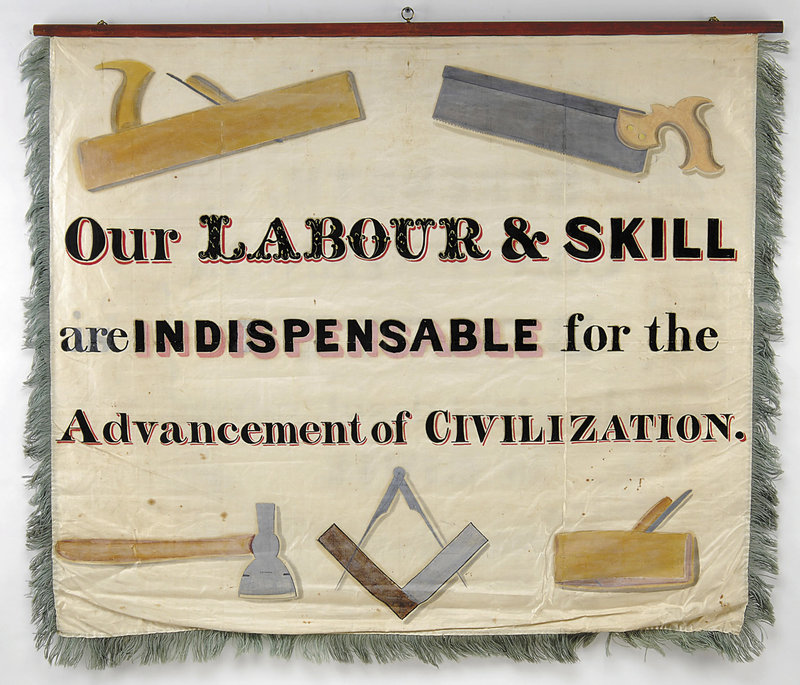
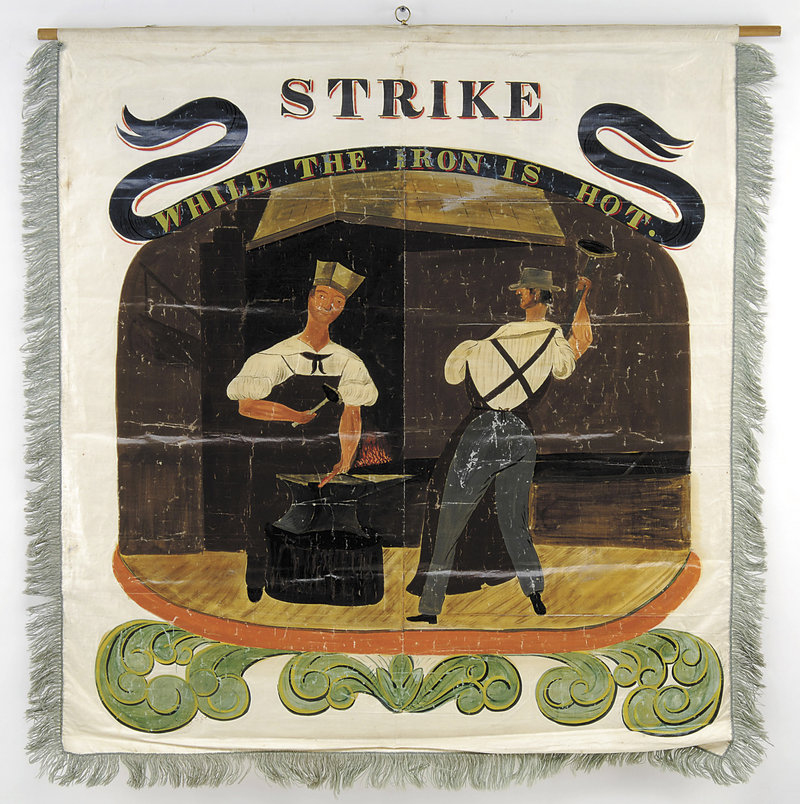
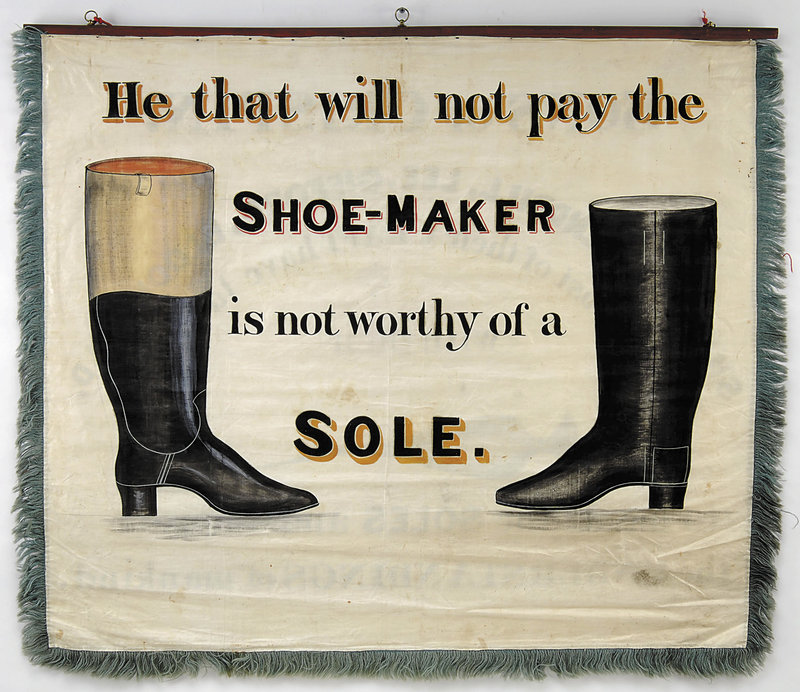
The association, which was founded in 1815 as a forum for skilled craftsmen, commissioned the banners as a way to espouse members’ skills and social virtues. The decorative painter William Capen made most of the colorful banners in 1841, painting elaborate images of the trades on silk. Many were outlined with fringe and attached to wooden arms for hanging or carrying in a parade.
They include such language as, “Our LABOUR & SKILL are INDISPENSABLE for the advancement of CIVILIZATION.” Another says cleverly, “He that will not pay the SHOE-MAKER is not worthy of a SOLE.”
Collectively, the banners are worth between $100,000 and $200,000, according to the auctioneer.
They are being offered for sale because the association needs the cash, said Gregory St. Angelo Jr., vice president of the Maine Charitable Mechanic Association. It owns a building at 519 Congress St. and has about 300 members.
“We are like every other organization. Our cash flow is lacking,” St. Angelo said. “The biggest asset is our building. The biggest liability is our building. It’s an old building and needs a lot of repair.
“We have these banners just sitting there doing nothing. They get shown in exhibitions now and again, but our main motive is to get some cash flowing into our coffers,” he said.
The decision to sell the banners has angered the arts and cultural community.
Earle G. Shettleworth Jr., director of the Maine Historic Preservation Commission, said the potential loss of the banners to a private collector would deprive the community of the opportunity to enjoy the banners and would hurt the ability of the association and others to educate the public about the role and history of skilled laborers in establishing Portland’s identity.
The banners are state treasures and should be preserved, he said. They are culturally significant because they express the emerging awareness of the labor movement in America, and particularly in Portland. They were used to grow greater awareness of the labor movement and to advocate for better working conditions for laborers, Shettleworth said.
“It all goes back to the theme of responsible stewardship and making responsible decisions about what you may have in your care or collection,” he said. “If it’s a question of money, then reach out to the community and find a solution. Don’t put objects at risk of leaving the community and state, which is what this action does.”
Dominic Faietta, an association janitor, found the banners in the 1980s in a basement storage area. They have remained in the collection and care of the organization.
The Maine Historical Society worked with the Charitable Mechanic Association to conserve the banners and has shown some of them over the years. Most recently, two of the banners were part of the historical society’s 2005 exhibition, “A City Awakes: The Arts and Artists of Early 19th-Century Portland Maine.”
Richard D’Abate, executive director of the historical society, said the potential sale of the banners “is the worst possible thing from our point of view. We have been worried about these banners for a long time. They are fabulous artifacts that speak eloquently about an important time and a group of people in the city and the state. There just aren’t collections of them around.”
James D. Julia agreed that the broadsides are rare and valuable, with uncommon social impact. He called them “a terrific treasure trove” that offers “a great kind of sense or overview of the economic structure and how things were done a hundred or so years ago.”
Julia said the auction house is willing to work with Maine institutions that would like to bid on the banners, by arranging financing while those institutions raise money for their purchase. “The goal is to generate money for the Charitable Mechanic Association, but give Maine institutions the opportunity to retain these things,” Julia said.
D’Abate said representatives of the Maine Historical Society, the Portland Museum of Art and Maine State Museum would discuss a strategy for keeping the banners in Maine. None of the organizations has the money to compete with private individuals at auction, he said.
The lack of funds has Shettleworth concerned.
“I think the important issue here is that as the economy changes, as institutions change, it’s inevitable that important objects run the risk of going out to the general marketplace. We need to make people aware that there are viable alternatives to that,” he said.
“Unfortunately, Portland has a history of losing important cultural artifacts. A good example is the carved weathercock from 1785 that was on the old First National Bank for 100 years. It was sold to a private collector in the 1980s. He said, ‘Oh yes, I will keep it in Maine.’ But he didn’t. It’s now in an apartment in Manhattan, and nobody sees it.”
Staff Writer Bob Keyes can be contacted at 791-6457 or at:
bkeyes@pressherald.com
Copy the Story Link
Send questions/comments to the editors.

Success. Please wait for the page to reload. If the page does not reload within 5 seconds, please refresh the page.
Enter your email and password to access comments.
Hi, to comment on stories you must . This profile is in addition to your subscription and website login.
Already have a commenting profile? .
Invalid username/password.
Please check your email to confirm and complete your registration.
Only subscribers are eligible to post comments. Please subscribe or login first for digital access. Here’s why.
Use the form below to reset your password. When you've submitted your account email, we will send an email with a reset code.