



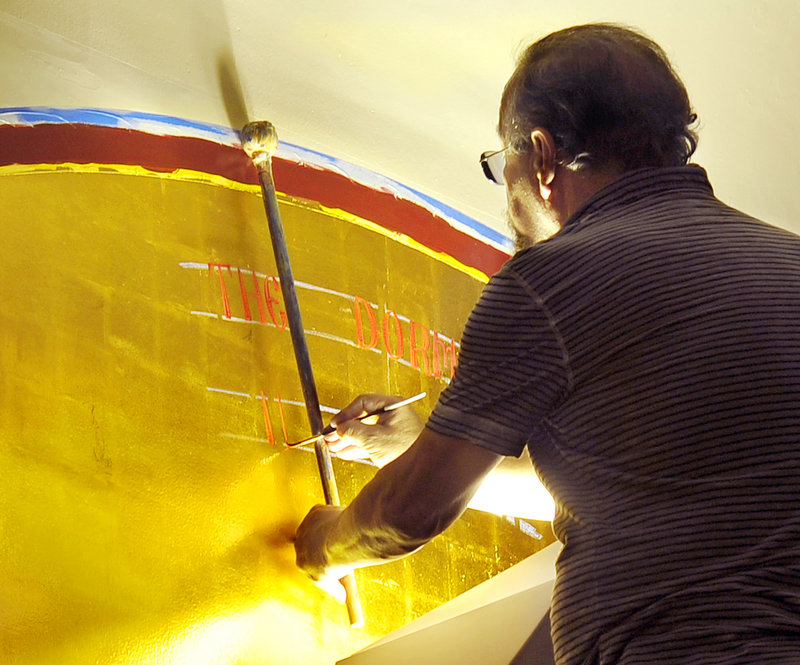
PORTLAND — George Papastamatiou put the finishing touches on his work: He applied 23-karat gold leafing behind Jesus’ shoulders and painted clouds beneath his feet.
The icon known as the Dormition of the Virgin Mary fills a space between stained-glass windows at the Holy Trinity Greek Orthodox Church.
Additional Photos
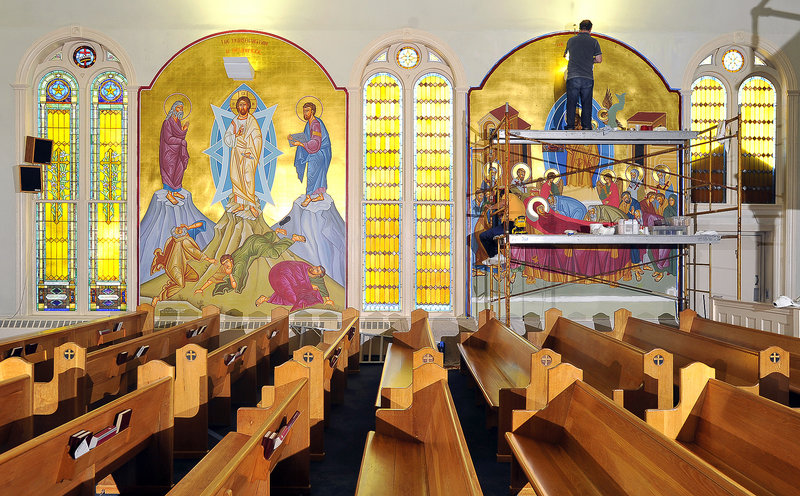
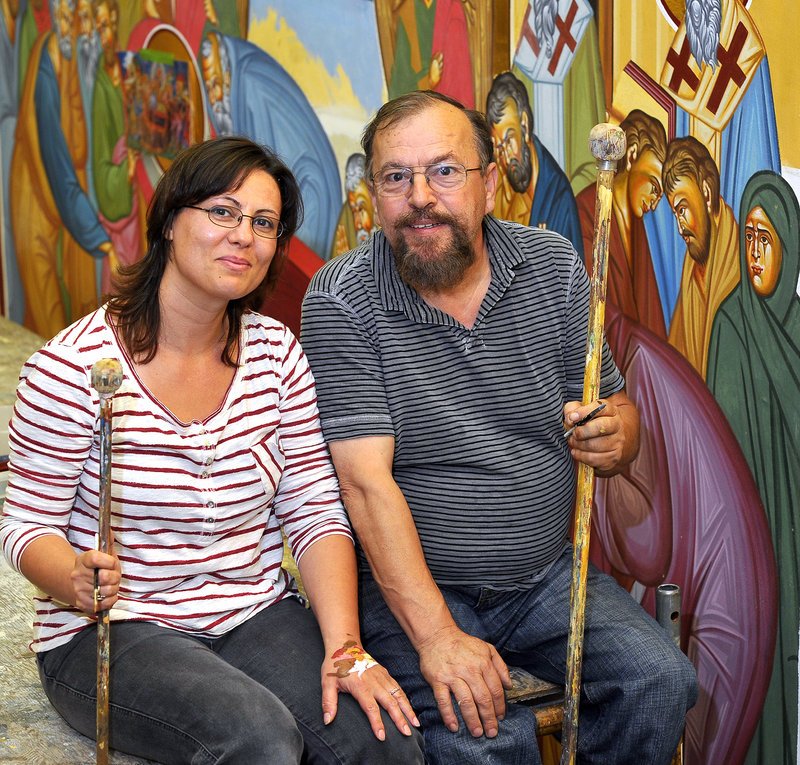
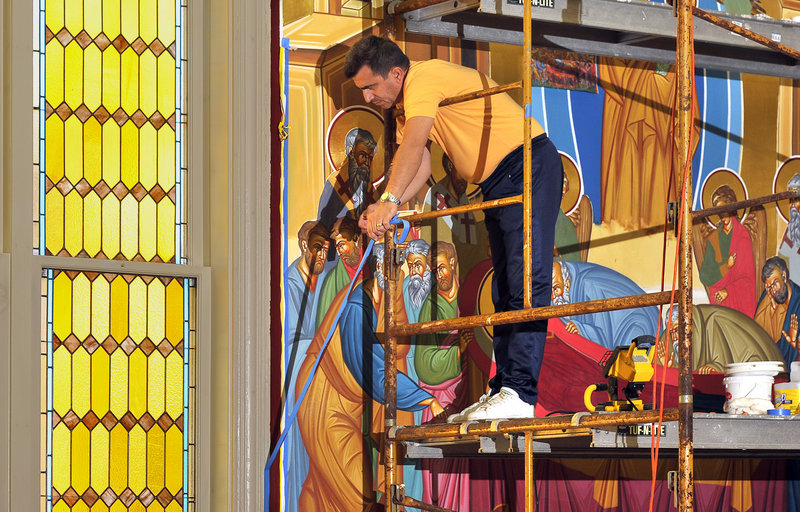
Papastamatiou, a Greek-born, world-renowned iconographer, was commissioned by the Pleasant Street church to create the icon, one of a group that also includes images of the transfiguration, resurrection and baptism of Christ.
The icon, which he completed last week, depicts the divine spirit of Christ hovering over Mary upon her death, with a baby in his arms.
“The icon, in essence, reverses the imagery of Christmas,” said the Rev. Constantine Sarantidis.
“In the Orthodox icon of Christmas we see Mary holding the infant Jesus wrapped in swaddling clothes. Now, in the image of the Dormition, the son becomes the mother, in a certain sense.”
The $20,000 image was funded by a member of the church as a dedication to his mother.
Papastamatiou has been working on the icon for more than a month. He spent the last week installing it at the church, with help from his wife, Brunilda Rizaj-Papastamatiou, and an assistant from Greece.
Papastamatiou, 62, started helping his father paint icons at age 12.
A third-generation iconographer, his work can be found in churches of different denominations around the world, in places including Australia, Africa, Europe, Canada and Argentina.
“People know when it’s a Papastamatiou,” he said of his work, which abides by traditional Byzantine style, but also displays a signature style he developed with experience.
The art of iconography has changed since his grandfather was practicing.
“Gone are the days of Michelangelo lying on his back for years painting the Sistine Chapel,” said Sarantidis, who was involved with commissioning the icon.
The icon process starts in Papastamatiou’s Boston studio, where he works alongside his wife, a mosaicist and stained-glass artist from Albania.
Rizaj-Papastamatiou uses a digital photo-editing program to illustrate a design, which blends elements from historic Byzantine art with the preferences of those who commission the work.
She adjusts colors before printing out a model to work from.
“It’s still a traditional form of art. You can’t just go to school to learn it, or paint however you like. You apprentice,” said Rizaj-Papastamatiou, who met her husband when she was his student.
After the model is printed, the traditional art begins, but not yet on the site of the icon.
Papastamatiou begins painting the piece on canvas in his studio and, upon completion, transfers it to the walls of its destination, meticulously melding the edges and applying gold leafing to the background.
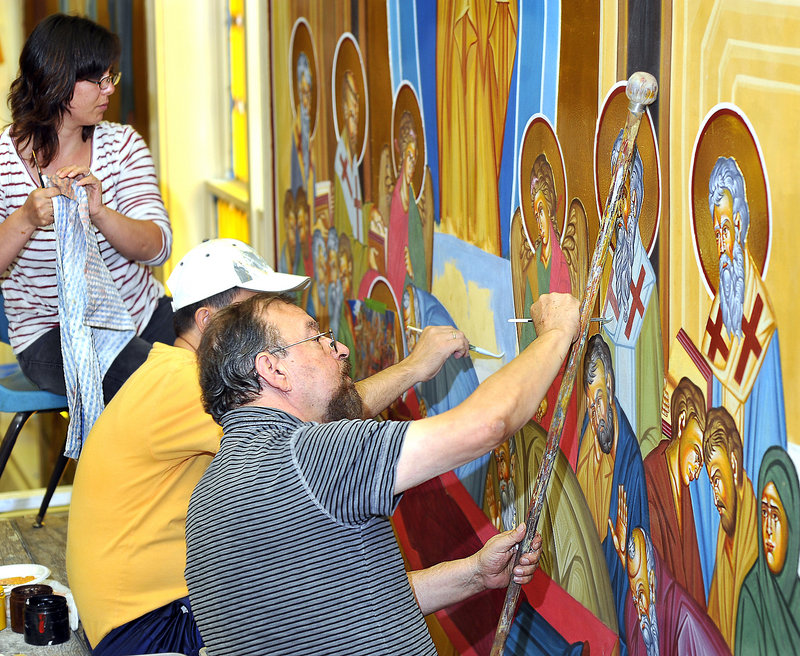
Last week, Papastamatiou, his wife and an assistant perched on a scaffolding, silently and intently painting.
Papastamatiou worked on clouds, while his wife touched up the icon’s faces and the assistant accented a white halo around the image of Jesus.
“She became better than me at miniatures,” Papastamatiou said of his wife’s work. “She has better patience, better eyesight,”
Over the years, Papastamatiou has painted several icons in the church. He also restored older icons in the fall of 2010, bringing them into symmetry and harmony with his own newer works.
Sarantidis, the priest, said the rendering of the Dormition of the Virgin Mary will be formally unveiled later this month, a fitting time, since that is the month of the icon’s holy day.
Plans are under way for additional icon work in the future, as the church, built in 1820, continues to fill segments of white wall with colorful and symbolic imagery.
Sarantidis said icons are an important part of their worshiping tradition.
“Icons enhance our worship and the ability to meditate and understand what is spoken in Mass,” he said. “They remind us of our communion and fellowship with saints … to look to them as inspiration and care for each other as human beings, and to care for all of nature and creation.”
Staff Writer Colleen Stewart can be contacted at 791-6355 or at:
cstewart@pressherald.com
Copy the Story Link
Send questions/comments to the editors.

Success. Please wait for the page to reload. If the page does not reload within 5 seconds, please refresh the page.
Enter your email and password to access comments.
Hi, to comment on stories you must . This profile is in addition to your subscription and website login.
Already have a commenting profile? .
Invalid username/password.
Please check your email to confirm and complete your registration.
Only subscribers are eligible to post comments. Please subscribe or login first for digital access. Here’s why.
Use the form below to reset your password. When you've submitted your account email, we will send an email with a reset code.