



Maine’s U.S. Senate candidates apparently won’t follow the example being set in Massachusetts’ high-profile Senate race for diminishing the influence of third-party groups.
Independent candidate Angus King sent a letter to his five opponents Wednesday morning asking them to forgo the benefit of expenditures made by outside organizations on their behalf.
Videos


Additional Photos
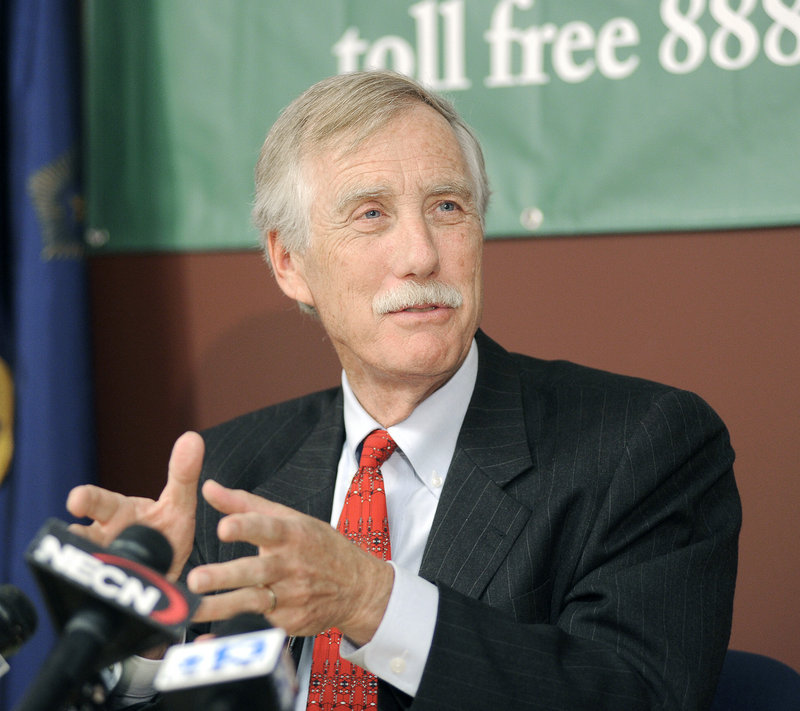
The former Maine governor noted that Massachusetts Senate candidates Elizabeth Warren, a Democrat, and Scott Brown, a Republican, agreed earlier this year to discourage spending by third-party groups. They signed a pact requiring the candidates to notify outside groups that they do not want them to advertise on their behalf on television, radio or the Internet. If the groups do, the candidate being supported must pay a price by donating half the value of any ad to a charity of their opponent’s choice.
King’s proposal to do a similar thing in Maine was dead by late Wednesday afternoon.
Charlie Summers, who won the Republican nomination in Tuesday’s primary, rejected King’s offer. He said in a prepared statement that his campaign will not get involved in the “tit-for-tat gimmickry of Washington politics.”
Summers said King is trying to distract voters by talking about the intricacies of campaign financing rather than the economy. “This is exactly what is wrong with Washington,” he said.
Cynthia Dill, who won the Democratic primary, issued a statement Wednesday that managed to be both supportive and critical of King’s proposal.
She said she appreciates the chance to have a dialogue about money’s corrupting influence on politics, which she described as an issue of great concern to her. However, she said, King’s proposal lacks detail and substance.
“Given the number of candidates in the race and the vast disparity of personal wealth among them, the devil will be in the details,” she said. “We look forward to seeing a proposed agreement, the terms of which would be carefully considered.”
The third-party groups that figure in King’s proposal are known as super PACs, a new kind of political action committee created in response to the U.S. Supreme Court’s Citizens United ruling in 2010.
Super PACs are allowed to raise unlimited sums of money from corporations, unions, associations and individuals, then spend unlimited sums to advocate for or against political candidates.
“This money is destroying our politics,” King said at a news conference Wednesday at his campaign headquarters in Brunswick. He said he would agree not to benefit from super PACs if the other candidates agreed.
In his letter to Dill, which she provided to the Portland Press Herald, King said an agreement in Maine would be more complex than the one in Massachusetts because there are six candidates here, including independents Steve Woods of Yarmouth, Danny Dalton of Brunswick and Andrew Ian Dodge of Harpswell. But he said be believes an arrangement could be made.
King wrote: “I sincerely hope you will join me in this effort; together, we can establish an important precedent in Maine that the integrity of our elections should not be compromised by unlimited and effectively anonymous flows of cash into our political process.”
Super PACs were created two years ago, after the outcome of a federal court case known as SpeechNow.org v. Federal Election Commission. That ruling was influenced by the Citizens United ruling earlier in 2010, in which the Supreme Court ruled that corporations and labor unions may spend their own money to support or oppose political candidates through independent communications, such as television advertisements.
Super PACs are prohibited from donating money directly to candidates.
King said Wednesday that third-party money has created a system in which candidates aren’t held accountable for the way campaign money is spent on their behalf.
“It’s a question of fundamental honesty. The people of Maine should know who’s influencing these campaigns,” he said.
As of Wednesday, 596 groups organized as super PACs had raised $221 million in the 2012 election cycle, according to the Center for Responsive Politics, a nonpartisan group that monitors campaign finance.
Super PAC money has had relatively little influence in Maine’s Senate race so far, although that is likely to change when the campaigns ramp up their television ad campaigns after this summer.
King is the only current Senate candidate who has benefited from a super PAC.
IcPurple, launched by the California billionaire Ted Waitt to help moderate candidates in federal races around the country, spent $23,600 in May to produce an online video endorsing King as an alternative to partisan politics. The video shows children arguing over what color to paint their playground — red or blue — then deciding to mix the colors to create purple.
FreedomWorks, a Washington, D.C.-based group chaired by former U.S. House Majority Leader Dick Armey, donated $30,000 to Bruce Poliquin, who finished second in Tuesday’s six-way Republican primary.
Staff Writer Tom Bell can be contacted at 791-6369 or at:
tbell@pressherald.com
Twitter: TomBellPortland
Copy the Story Link
Send questions/comments to the editors.

Success. Please wait for the page to reload. If the page does not reload within 5 seconds, please refresh the page.
Enter your email and password to access comments.
Hi, to comment on stories you must . This profile is in addition to your subscription and website login.
Already have a commenting profile? .
Invalid username/password.
Please check your email to confirm and complete your registration.
Only subscribers are eligible to post comments. Please subscribe or login first for digital access. Here’s why.
Use the form below to reset your password. When you've submitted your account email, we will send an email with a reset code.