



SANTA ANA, Calif. — When Timmy Nguyen comes to his pre-calculus class, he’s already learned the day’s lesson — he watched it on a short online video prepared by his teacher for homework.
So without a lecture to listen to, he and his classmates at Segerstrom Fundamental High School spend class time doing practice problems in small groups, taking quizzes, explaining the concept to other students, reciting equation formulas in a loud chorus, and making their own videos while teacher Crystal Kirch buzzes from desk to desk to help pupils who are having trouble.
Additional Photos
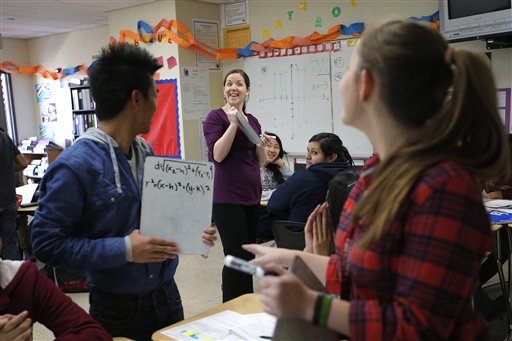
It’s a technology-driven teaching method known as “flipped learning” because it flips the time-honored model of classroom lecture and exercises for homework — the lecture becomes homework and class time is for practice.
“It was hard to get used to,” said Nguyen, an 11th-grader. “I was like ‘why do I have to watch these videos, this is so dumb.’ But then I stopped complaining and I learned the material quicker. My grade went from a D to an A.”
Flipped learning apparently is catching on in schools across the nation as a younger, more tech-savvy generation of teachers is moving into classrooms. Although the number of “flipped” teachers is hard to ascertain, the online community Flipped Learning Network now has 10,000 members, up from 2,500 a year ago, and training workshops are being held all over the country, said executive director Kari Afstrom.
Under the model, teachers make eight- to 10-minute videos of their lessons using laptops, often simply filming the whiteboard as the teacher makes notations and recording their voice as they explain the concept. The videos are uploaded onto a teacher or school website, or even YouTube, where they can be accessed by students on computers or smartphones as homework.
For pupils lacking easy access to the Internet, teachers copy videos onto DVDs or flash drives. Kids with no home device watch the video on school computers.
Class time is then devoted to practical applications of the lesson — often more creative exercises designed to engage students and deepen their understanding. On a recent afternoon, Kirch’s students stood in pairs with one student forming a cone shape with her hands and the other angling an arm so the “cone” was cut into different sections.
“It’s a huge transformation,” said Kirch, who has been taking this approach for two years. “It’s a student-focused classroom where the responsibility for learning has flipped from me to the students.”
The concept emerged five years ago when a pair of Colorado high school teachers started videotaping their chemistry classes for absent students.
“We found it was really valuable and pushed us to ask what the students needed us for,” said one of the teachers, Aaron Sams, now a consultant who is developing on online education program in Pittsburgh. “They didn’t need us for content dissemination, they needed us to dig deeper.”
He and colleague Jonathan Bergmann began condensing classroom lectures to short videos and assigning them as homework.
“The first year, I was able to double the number of labs my students were doing,” Sams said. “That’s every science teacher’s dream.”
In the Detroit suburb of Clinton Township, Clintondale High School Principal Greg Green converted the whole school to flipped learning in the fall of 2011 after years of frustration with high failure rates and discipline problems. Three-quarters of the school’s enrollment of 600 is low-income, minority students.
Flipping yielded dramatic results after just a year, including a 33 percent drop in the freshman failure rate and a 66 percent drop in the number of disciplinary incidents from the year before, Green said. Graduation, attendance and test scores all went up. Parent complaints dropped from 200 to seven.
Green attributed the improvements to an approach that engages students more in their classes.
“Kids want to take an active part in the learning process,” he said. “Now teachers are actually working with kids.”
Although the method has been more popular in high schools, it’s now catching on in elementary schools, said Afstrom of the Flipped Learning Network.
Fifth-grade teacher Lisa Highfill in the Pleasanton Unified School District said for a lesson about adding decimals, she made a five-minute, how-to video kids watched at home and in class, then she distributed play money and menus and had kids “ordering” food and tallying the bill and change.
A colleague who teaches kindergarten reads a storybook on video. The video contains a pop-up box that requires kids to write something that shows they understood the story.
The concept has its downside. Teachers note that making the videos and coming up with project activities to fill class time is a lot of extra work up front, while some detractors believe it smacks of teachers abandoning their primary responsibility of instructing.
“They’re expecting kids to do the learning outside the classroom. There’s not a lot of evidence this works,” said Leonie Haimson, executive director of Class Size Matters, a New York City-based parent advocacy group. “What works is reasonably sized classes with a lot of debate, interaction and discussion.”
Others question whether flipped learning would work as well with low achieving students, who may not be as motivated to watch lessons on their own, but said it was overall a positive model.
“It’s forcing the notion of guided practice,” said Cynthia Desrochers, director of the Center for Excellence in Learning and Teaching at California State University-Northridge. “Students can get the easy stuff on their own, but the hard stuff should be under the watchful eye of a teacher.”
At Michigan’s Clintondale High School, some teachers show the video at the beginning of class to ensure all kids watch it and that home access is not an issue.
In Kirch’s pre-calculus class, students said they liked the concept.
“You’re not falling asleep in class, “said senior Monica Resendiz said. “You’re constantly working.”
Explaining to adults that homework was watching videos was a little harder, though.
“My grandma thought I was using it as an excuse to mess around on the Internet,” Nguyen said.
Copy the Story Link
Send questions/comments to the editors.

Success. Please wait for the page to reload. If the page does not reload within 5 seconds, please refresh the page.
Enter your email and password to access comments.
Hi, to comment on stories you must . This profile is in addition to your subscription and website login.
Already have a commenting profile? .
Invalid username/password.
Please check your email to confirm and complete your registration.
Only subscribers are eligible to post comments. Please subscribe or login first for digital access. Here’s why.
Use the form below to reset your password. When you've submitted your account email, we will send an email with a reset code.