



Somewhere in his suburban Dallas home, Daryl Reaugh has videotapes of a television broadcast from a 1994 ECHL playoff game.
At the end of his playing career with the Dayton Bombers, Reaugh started doing play-by-play of the team’s games. When his teammate, Ray Edwards, became injured, Edwards was called on to add color commentary.
Additional Photos
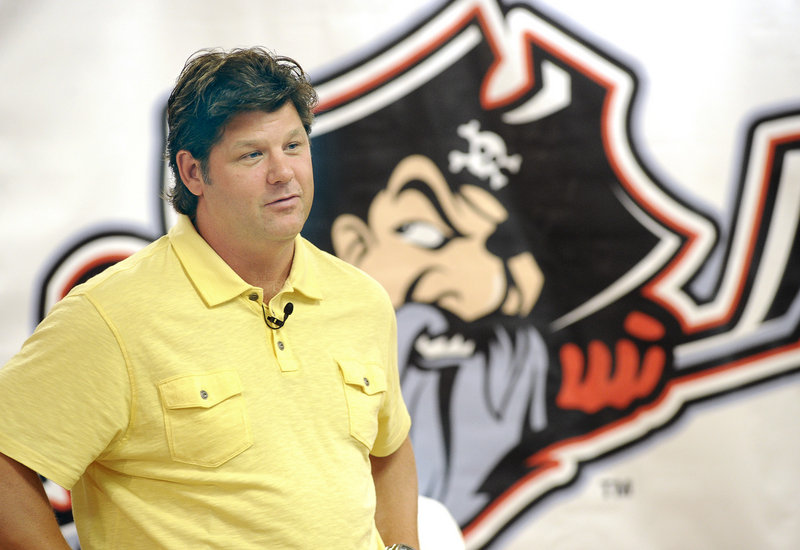
Edwards, Reaugh said, wasn’t the most refined broadcaster. But he did possess a certain perspective for elements of the game that may have gone unnoticed by others.
“His insight was great,” said Reaugh, now a color commentator for the Dallas Stars and for NHL games on Versus. “And it’s been interesting to follow what he’s done since then.”
Edwards’ career didn’t culminate in a broadcast booth. Instead it wound through the hinterlands of hockey, where he did everything from selling tickets to recruiting players.
It was on that path that he came to a career crossroads in West Virginia in 1998.
He had to decide which was worth more: keep chasing the dream of playing in the National Hockey League, or accept a coaching job offered by the owner of the ECHL’s Huntington Blizzard.
The offer was a sign.
“When those things happened, I realized I didn’t have anything to fall back on,” Edwards said. “I sought out the front office and said, ‘If there’s anything I can do, can I do it?’ I knew this was a chance for me to learn and to grow.”
Thirteen years later, on June 27, the Portland Pirates named Edwards as the seventh coach in their 18-year history.
The Phoenix Coyotes moved their minor league operations from San Antonio to Portland — a traditional hockey market, compared to the path that Edwards, 41, has traveled.
“It will be fun to be a little bit more under the microscope,” said Edwards, who coached the San Antonio Rampage the last two seasons.
“I’m going to embrace that whole process. You’re not in Vancouver or Toronto, but you’re in a potent hockey market. I’m looking forward to building on the tradition they have in Portland.”
MAN OF MANY JOBS
For Edwards, the physical cost of chasing the hockey dream was steep.
One season he was kicked in the face and suffered a shattered jaw. Another season, a debilitating shoulder injury. Yet another season, torn ligaments in his ankle.
When he chose to end his playing career, Edwards had nothing to fall back on when it came to his future. But others saw a future.
“When you played with Ray, you saw that he was going to be a successful coach,” said Derek Schooley, who was Edwards’ teammate in Huntington from 1994-96. “He taught the game really well and he played it with a tremendous amount of passion. He was a player who put the team first.”
In his first year playing for Dayton, Edwards missed four months with an injury. Coach Claude Noel — who now coaches the Winnipeg Jets and who offered Edwards a job as an assistant coach, which he turned down last week — began assigning Edwards off-ice responsibilities.
“It wasn’t a whole lot,” Edwards said, “but it was enough to get my interest sparked. I thought, ‘I need to continue doing this to learn it.’ I learned a little bit from every guy I worked with and played with.”
By the time he joined the Blizzard, Edwards juggled roles. He was a player and an assistant coach. He recruited players and scouted them. When he wasn’t on skates, he worked in the box office and marketing department, selling season-ticket packages and promoting the Blizzard in the community, more than 250 miles southwest of Pittsburgh, the closest NHL city.
Each time he sold another ticket or boarded the bus for another ECHL town, Edwards didn’t ask himself, “There has to be a better way than this, right?”
Instead he kept hustling, making move after move to stay in the game.
“I knew that Ray would do whatever he possibly could to be successful in that job,” said Schooley, who is in his eighth season of coaching men’s hockey at Robert Morris University in Moon Township, Pa. “If moving to the next level meant sharpening skates, he’d do that.”
LONG, HARD ROAD
Edwards’ playing and coaching career has snaked through some arcane areas of hockey. Birmingham, Alabama. Pensacola, Florida. Dayton, Ohio. San Angelo, Texas. Albuquerque, New Mexico.
In San Angelo, a city of 92,000 between Dallas and El Paso, community support was scant. The Central Hockey League team folded after the 2004-05 season. In New Mexico, Edwards took the Scorpions to the Southern Conference finals in 2006-07, its first season in the CHL — and three seasons before the franchise shut down.
Despite an overall growth of hockey in the Sun Belt — the NHL has eight of its 30 franchises south of the 36th parallel and youth participation has grown in the six Southern states where the league plays — the lack of fan interest in minor-league game could have discouraged Edwards.
“For me, the motivation was to help the players,” he said. “It’s like any other job. When you see employees have success and move on, it gives you a lot of joy. For me, that was the drug.”
In the fall of 2007, the Coyotes named Edwards an assistant coach of the Rampage and two years later, he replaced the fired Greg Ireland as interim coach.
“Ray has paid his dues and has coached on different levels,” said Rob Zamuner, Edwards’ former junior hockey teammate who is now a divisional player representative with the NHL Players’ Association. “And he didn’t get anything handed to him. He wasn’t the star player. He had to work for everything he had. That’s what his players can feel, and that’s understood in the way he coaches.”
In two years as the Rampage head coach, Edwards was 70-56-0-6, and his team didn’t qualify for the playoffs. Yet his philosophy on developing players as athletes and individuals emphasizes core values garnered from a long road through hockey’s back country.
“You’ve got to be a good person,” Edwards said. “You’ve got to do the right thing. You’ve got to make the right decisions. You think about the type of person you are and how to treat people. Players are expected to give back and treat each other with respect, and that’s the basis of success. If you do that, you work hard, you invest and you’re attentive and coachable — those types of people have success.”
Staff Writer Rachel Lenzi can be reached at 791-6415 or at:
rlenzi@pressherald.com
Twitter: rlenzi
Copy the Story Link
Send questions/comments to the editors.

Success. Please wait for the page to reload. If the page does not reload within 5 seconds, please refresh the page.
Enter your email and password to access comments.
Hi, to comment on stories you must . This profile is in addition to your subscription and website login.
Already have a commenting profile? .
Invalid username/password.
Please check your email to confirm and complete your registration.
Only subscribers are eligible to post comments. Please subscribe or login first for digital access. Here’s why.
Use the form below to reset your password. When you've submitted your account email, we will send an email with a reset code.