



Federal and state officials pushed oil giant BP to intensify its efforts to cap a leaking oil well in the Gulf of Mexico and to contain the slick that is threatening the shores and livelihoods of people in five states.
As crude oil began to come ashore in Louisiana, Interior Secretary Ken Salazar met with the company’s top executives and engineers and urged them to “work harder and faster and smarter to get the job done,” he said.
Additional Photos
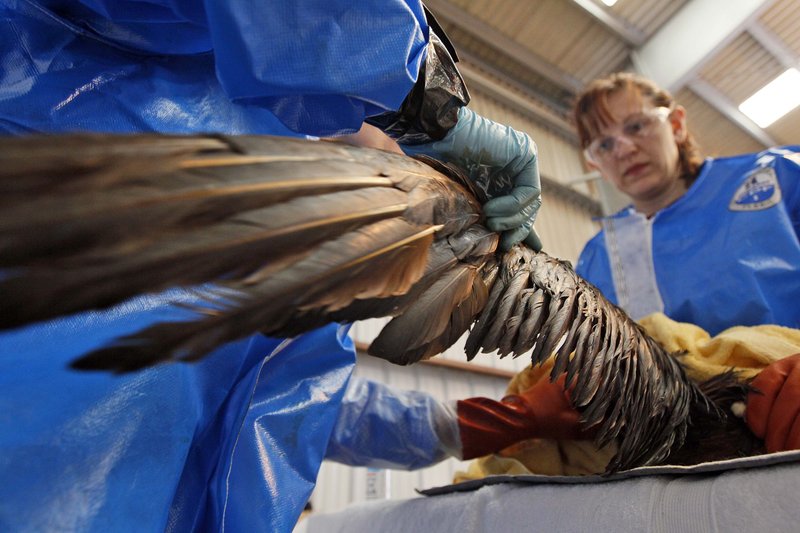
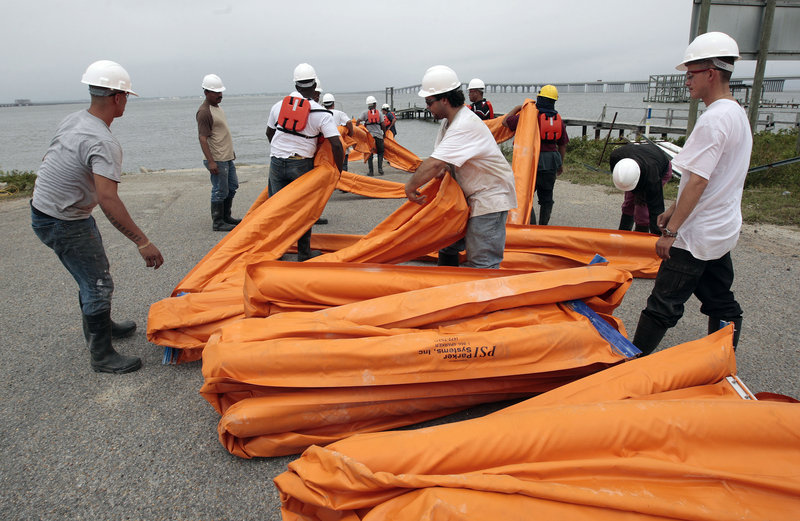
“We cannot rest and we will not rest until BP permanently seals the wellhead and until they clean up every drop of oil,” Salazar said.
Heavy winds and high tides impeded efforts to contain the growing slick on Friday, and oil continued to gush from the damaged exploration well, sending pungent odors through neighborhoods near New Orleans. Governors from the region expressed frustration at the company’s inability to get the situation under control.
The widening crisis began April 20, when Deepwater Horizon, a drilling rig owned by Transocean and leased by BP, caught fire and sank, killing 11 people. Ten days later, coastal residents, state officials and environmental groups began to question whether the oil industry and Interior Department regulators had done enough to prepare for such a catastrophic accident.
Coast Guard Commandant Thad Allen said in an interview Friday that the company’s plans for responding to oil spills did not address the complete failure of equipment on the sea floor designed to prevent a blowout of the sort that took place on the massive drilling rig.
“We’re breaking new ground here. It’s hard to write a plan for a catastrophic event that has no precedent, which is what this was,” Allen said, defending the company against not writing a response for “what could never be in a plan, what you couldn’t anticipate.”
Hammond Eve, who did environmental impact studies of offshore drilling for the Interior Department’s Minerals Management Service (MMS), said the federal agency never planned for response to an oil spill of this size. “We never imagined that it would happen because the safety measures were supposed to work and prevent it from happening,” he said.
He added that MMS began from the “premise that if something like this happened that it would be shut down fairly soon and a discrete amount of oil would be released and these clean-up measures would begin and you would never end up with a situation like this.”
Eve, who lives on the water 20 miles east of New Orleans, said strong oil fumes were engulfing his neighborhood. “You can’t breathe the air comfortably,” he said. “It bites you right in the back of the throat and your eyeballs burn.”
Obama administration officials fanned out across the Gulf of Mexico states pledging attention and assistance. In an already troubled economy, the oil slick threatened to damage the region’s fishing and tourism industries as well as disrupt shipping along the Mississippi River.
On Friday, Louisiana’s departments of Health and Hospitals and Wildlife and Fisheries announced severe restrictions on fishing and oyster harvesting east of the Mississippi River.
“I do have concerns that BP’s current resources are not adequate to meet the challenges that we face,” Louisiana Gov. Bobby Jindal said at a news conference in New Orleans. “I’ve urged them to seek even more help from the federal government and from others.”
In Washington, President Barack Obama said that “BP is ultimately responsible under the law for paying the costs of response and cleanup operations, but we are fully prepared to meet our responsibilities to any and all affected communities.”
He said there were now five staging areas to protect sensitive shorelines and approximately 1,900 federal response personnel and more than 300 vessels and aircraft on the scene.
“We’ve also laid approximately 217,000 feet of protective boom, and there are more on the way,” Obama said.
“It’s a two-front war,” said the Coast Guard’s Allen. “The center of this whole thing is the leakage on the bottom,” he said, adding that the priority is capping the leak. “If we don’t do that we are going to be fighting an endless oil spill on the top.”
The oil spill has buffeted BP, whose stock price has plunged more than 13 percent this week, wiping out about $20 billion of market value.
“We are doing absolutely everything in our power to eliminate the source of the leak and contain the environmental impact of the spill,” BP chief executive Tony Hayward said in a statement.
“We are determined to fight this spill on all fronts, in the deep waters of the Gulf, in the shallow waters and, should it be necessary, on the shore.”
He said the company welcomed offers of assistance from government agencies, other oil companies and even members of the public.
An official at the Organized Seafood Association of Alabama said his group would meet on Saturday with BP representatives about possible compensation for lost fishing income.
But some people said the company, in addition to bearing financial responsibility under a 1990 law, also bore responsibility for being too optimistic in its planning.
In the exploration plan that BP Exploration and Production Inc. submitted to the MMS for the Mississippi Canyon Block 252 lease on Feb. 23, 2009, the company expressed confidence it could handle a spill even larger than the one caused by the explosion at Deepwater Horizon.
It said the company “has the capability to respond to the appropriate worst-case spill scenario,” which it defines in a chart as a “volume uncontrolled blowout” of 300,000 gallons a day.
On April 6, 2009 MMS approved the drilling with a warning: “Exercise caution while drilling due to indications of shallow gas and possible water flow.”
MMS officials said they could not comment on the Deepwater Horizon incident, but added that the agency was reassessing the way it judges companies’ abilities to cope with spills.
The cause of the well explosion remains uncertain.
Oil industry experts say that in deep-water wells such as this one, which was drilled in water 5,000 feet deep, high pressure increases the risks of a blowout.
BP has pointed a finger at Transocean, which owned and operated the rig.
Transocean has pointed at a company called Cameron, which made a key valve in the malfunctioning blowout preventer.
John Amos, who spent 10 years as a consulting exploration geologist for oil and gas companies and now heads SkyTruth, an operation that uses government satellite imagery to monitor environmental disasters, said he was not surprised that both oil executives and federal officials failed to properly forecast the risks associated with offshore drilling.
“Just like the explosion of a volcano, to a geologist like myself, these kinds of incidents are fairly predictable, but when they happen, they come as a shock to us,” Amos said.
House Energy and Commerce Committee Chairman Henry Waxman, D-Calif., whose panel has already sent letters to BP America, Transocean and oil services giant Halliburton inquiring into the cause of the explosion and the companies’ inability to staunch the flow of oil, said he hoped to get more answers when officials from the three companies testified before his committee on May 12.
Halliburton was in charge of cementing for Deepwater Horizon — plugging holes in the pipeline seal by pumping cement into it from the rig.
“The companies have the obligation, it seems to me, to have a plan, to anticipate and do what they could to prevent this sort of thing from happening,” Waxman said in an interview. “They obviously didn’t anticipate this.”
Washington Post staff writer Juliet Eilperin contributed to this report.
Send questions/comments to the editors.

Success. Please wait for the page to reload. If the page does not reload within 5 seconds, please refresh the page.
Enter your email and password to access comments.
Hi, to comment on stories you must . This profile is in addition to your subscription and website login.
Already have a commenting profile? .
Invalid username/password.
Please check your email to confirm and complete your registration.
Only subscribers are eligible to post comments. Please subscribe or login first for digital access. Here’s why.
Use the form below to reset your password. When you've submitted your account email, we will send an email with a reset code.