September 2, 2012

Cuzzi & Demeritt: Convention leaves Paul delegates, other Republicans with a chill

MICHAEL CUZZI: The Romney campaign shows its obsession with image-making as it squashes any dissent.

click image to enlarge

The Associated Press

DAN DEMERITT: A vote for Romney is going to be more against Obama than in support of the GOP nominee.

In 1964, U.S. Supreme Court Justice Potter Stewart coined the phrase, “I know it when I see it,” to describe his threshold test for pornography.

The definition of political favorability is just as elusive. It is hard to define, harder still to obtain and will almost undoubtedly decide this year’s presidential election.

Despite a willingness (or eagerness) to question the Republican establishment, I can generally be counted on to cast a partisan vote in favor of GOP candidates. In November that means a check next to Mitt Romney’s name.

At this point in the campaign, I am concerned that I will be voting against President Obama’s policies rather than for Romney. While it may sound overly nuanced, this kind of ambivalence in a partisan voter like me speaks to Romney’s favorability challenge.

My strongest impression of Romney is that he is a successful businessman who stands for, first and foremost, getting himself elected president.

He is too much polish and not enough principle. He is aloof rather than authentic. And he has changed his positions to better position himself with voters. Romney desperately needs a couple rounds of golf with Govs. Chris Christie of New Jersey and Paul LePage.

The infamous Etch A Sketch comment from a Romney adviser, referring to a general election reset of the campaign, perfectly captures an all-too-common and unfortunate perception of Romney.

The fact that the Republican National Committee went to such great lengths to replace Ron Paul delegates from Maine at the national convention last week is but another example of over-managing and scripting by the Romney campaign.

In the end, I do not know where Romney draws a line in the sand on the issues. But even if he is ambiguous in his stands, I believe Romney will be better on my core issues than President Obama.
Make no mistake; I want to like Mitt Romney. And I know there is a great deal to respect about his accomplishments.

He won statewide elected office in Massachusetts – one of the toughest states in the country for Republicans – and stood up to a Democrat-led legislature by vetoing 800 bills. He cut Massachusetts’ deficit without raising taxes and put $2 billion in the state’s rainy day fund.

But he also enacted health insurance reform that, like President Obama’s Affordable Care Act, includes an individual mandate that requires individuals to purchase insurance.

In business, Romney led Bain Capital, an investment firm that launched or rebuilt more than 100 companies. But critics argue Romney and his firm made millions by over-leveraging struggling firms with new debt. Romney’s management skills are widely credited with saving the Salt Lake City Olympics in 2002. Coming shortly after the terrorist attacks of Sept. 11, 2011, the highly successful games were a time of great national pride and unity.

Romney’s devotion to his family and his faith are also admirable. One can also perversely admire the decade of dedication it took for him to secure the Republican nomination. He outlasted, outspent and outran the competition.

The Romney campaign recognizes the need to humanize its candidate and spent much of last week’s convention introducing Romney to the country. Photo-ops flipping pancakes, a personal speech from Ann Romney and a heavy dose of the Romney family were all on the agenda.

With just over nine weeks to go, Romney has to close the favorability gap with Obama. In a recent national poll, only 40 percent of voters have a favorable view of Romney. His favorability deficit of 11 points is a historic high, and voters find Obama more likeable by 61 percent to 27 percent.

Given the state of the economy, the massive Obama deficits and high energy prices, you would think the time would be ripe for a polished and accomplished business executive to take the keys to the Oval Office.

But history is clear. Americans like to like their presidents.

It is too soon to tell what kind of favorability bump Romney will get out of the Republican convention, and too early to say he cannot build a stronger bond with the electorate over the next nine weeks.

Here’s hoping that I, along with millions of swing voters across the battleground states, see something we like in Romney soon.

Dan Demeritt, a Republican political consultant and public relations specialist, is a former campaign aide and communications director for Gov. Paul LePage. He can be contacted at:

dan@win207.com

Twitter: @demerittdan

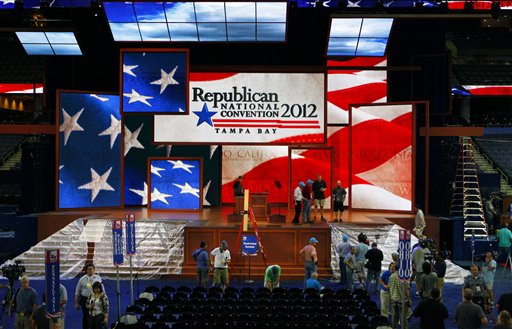
Last week, half of Maine's Ron Paul delegates to the Republican National Convention were unceremoniously stripped by party officials of their "duly elected" status and told they were no longer invited to the Tampa party.

The Paul delegates have a right to be indignant. They were disenfranchised in the name of political tidiness and a desire for a superficial display of unity at the made-for-TV event.

Notwithstanding the claims of credentialing, ballot and floor security issues, the decision to replace Maine's Republican delegates was a matter of cold political calculation. The delegates were treated like expendable cogs in the national GOP political machinery because that's exactly what they were.

Romney didn't need Maine's delegates to reach his nomination threshold. Maine is not a battleground state and its four Electoral College votes are nearly certain to go to President Obama. The Romney campaign has little more than a symbolic on-the-ground presence here. To the extent that Romney ads are running in the southern Maine media market, it is to influence eastern and coastal sections of New Hampshire, a real battleground state.

Maine is about to lose a Republican-held U.S. Senate seat to an independent former governor.

Put it all together and, for the Romney campaign, it was a political no-brainer to strip Maine's Paul delegates of their status and replace them with compliant Romney supporters, rather than risk political embarrassment at the convention.

The resulting local hue and cry is -- from a national campaign perspective -- a tempest in a political teapot.

But the whole affair lays bare that national political conventions -- Republican and Democrat alike -- are now scripted messaging events that have a single purpose: to powerfully launch the major parties' candidates into the fall campaign.

Conventions are no longer grassroots, party-building affairs. The days of messy floor fights, multiple ballots and vociferous platform debates are long past.

Delegates are basically extras in a large television production, expected to wave signs and cheer on cue. As Maine's Ron Paul delegates learned, anything that injects unpredictability into the proceedings is squashed.

Even so, Romney's campaign has taken run-of-the-mill image-making and risk management and elevated it to an almost pathological obsession with power consolidation.

The Romney campaign went so far as to propose a Republican National Committee rules change that would allow future Republican presidential nominees -- presumably Romney in 2016 -- to veto any delegates sent by any state.

In other words, Romney's campaign sought to enshrine in the Republican Party's own rules their ability to subject any delegation to the treatment they've meted out to Maine. One prominent GOP operative called it "the biggest single power grab in the history of the Republican Party."

The Romney campaign's power grab is no less visible at the local level. It's hard to imagine the February caucus irregularities -- where all of Washington County and many Waldo County Republican caucus-goers were initially disenfranchised -- didn't reveal the strong arm of Romney operatives pressuring Charlie Webster to deliver a win after three consecutive primary-season losses to former Sen. Rick Santorum.

It's also unlikely that Romney's Maine campaign chairman, Peter Cianchette, filed the original complaint against Maine's slate of Ron Paul delegates without the direct participation and consent of the Romney campaign.

Romney's maneuverings within his own party and his policy flip-flops reveal that he is capable of saying and doing whatever it takes to become president.

He was for a woman's reproductive rights before he was against them. He instituted reforms nearly identical to "Obamacare" when he was governor of Massachusetts before calling for the Affordable Care Act's repeal. He once promised to be better than Ted Kennedy on gay rights issues before tacking right to win his party's nomination.

So when faced with the prospect of a potentially messy Ron Paul circus at "his" convention, the decision to shake up Maine's delegates (like, say, an Etch A Sketch) and replace them with a Mitt-friendly slate was an easy one.

In the end, Romney had the convention he so desperately wanted, but left Maine Republicans to repair the divisions and heal the wounds he inflicted on them. What a guy.

Michael Cuzzi is a former campaign aide to President Obama, Sen. John Kerry and U.S. Rep. Tom Allen. He manages the Portland office for VOX Global. He can be contacted at:

mjcuzzi@gmail.com.

Twitter: @CuzziMJ


Were you interviewed for this story? If so, please fill out our accuracy form

Send question/comment to the editors


Further Discussion

Here at PressHerald.com we value our readers and are committed to growing our community by encouraging you to add to the discussion. To ensure conscientious dialogue we have implemented a strict no-bullying policy. To participate, you must follow our Terms of Use.

Questions about the article? Add them below and we’ll try to answer them or do a follow-up post as soon as we can. Technical problems? Email them to us with an exact description of the problem. Make sure to include:
  • Type of computer or mobile device your are using
  • Exact operating system and browser you are viewing the site on (TIP: You can easily determine your operating system here.)