




When Dakotah Clement hopped over the boards to join the third line on her Boston Shamrocks hockey team, it became clear this was no ordinary group of high school players.
Third lines on high school teams usually feature slower, less-developed players. But Clement’s third line kept up a blazing pace with aggressive forechecking and back-checking, crisp passes, powerful shots.
Additional Photos
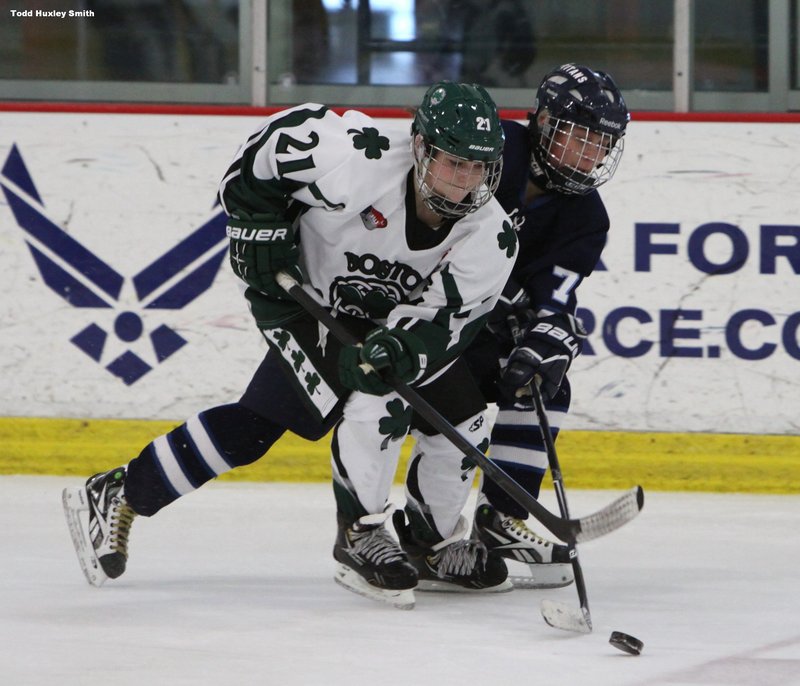
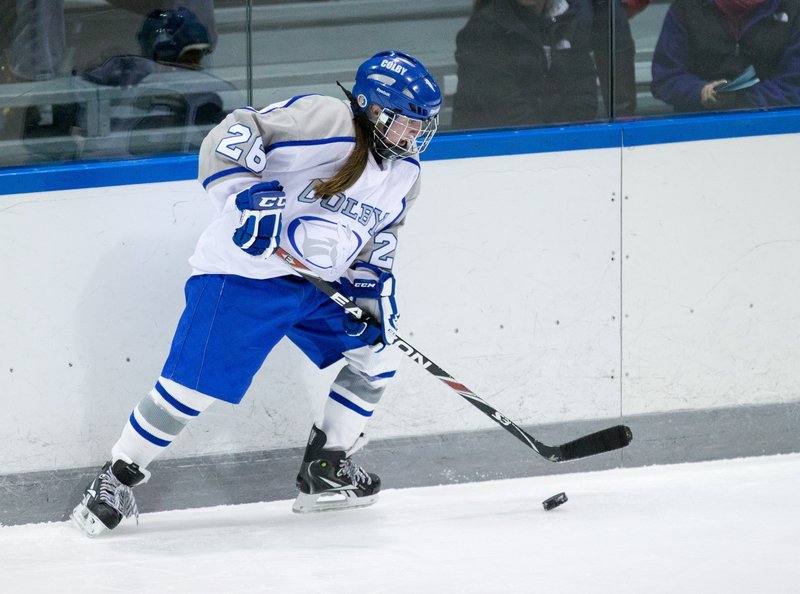
Clement, of Berwick, left her home and school to join the Shamrocks of the Junior Women’s Hockey League, a collection of 12 intense teams from across the United States and Canada that demand commitment and pricey fees, with a schedule of more than 65 games. Clement’s goal is to play hockey in college, preferably on scholarship at a Division I school. For that, she is willing to make sacrifices.
“I gave up pretty much all my social life,” Clement said. “I don’t see my friends as much, or my family.”
Clement, like many girl hockey players in Maine, believed she had to go away to get noticed by a college.
“If you play for a high school in Maine, the chances of you being recruited are slim and none,” said David Venditti, the Colby College women’s hockey coach. “I don’t mean that in a negative way, but you have to play for other teams — you have to be seen.”
Maine high schools began sponsoring high school hockey in 2008. Now with 16 teams, the talent is improving. But the best players believe they have to leave to get a chance at playing in college. Many of the top boy players also leave their high schools, but they have other opportunities locally, playing juniors hockey.
The girls usually go. Ashley Winslow of Portland attended St. George’s School in Newport, R.I., and is now a goalie at Quinnipiac University. Abby Rutt of Scarborough is finishing her senior year at the New Hampton (N.H.) School.
There are exceptions. Katy Massey of Waterville played for her high school — on the boys team — before making the University of Maine team. Megan Fortier played prep school hockey at North Yarmouth Academy, but missed her friends at Falmouth High and returned there for her senior year. Fortier stayed in Maine and still made the Colby College hockey team. She plays on the Mules’ top line as a freshman.
But most players do not simply jump to college from a high school team, especially in Maine. They have already played on travel youth teams and/or gone to prep school.
So what is the best way a player can be “seen?”
“I get that question asked a lot,” said Katie LaChapelle, a Lewiston native and now an assistant coach and recruiter for Boston University. “Obviously a lot of it depends on the kid and the family.”
THE OLD DAYS
When LaChapelle began playing hockey in the late 1980s, there were few avenues for girls. She played on the Lewiston High boys team, graduating in 1995.
Back then, the NCAA did not sponsor a college women’s hockey championship. Few schools offered scholarships, yet LaChapelle landed one at Providence College.
In 1995, there were 11 Division I colleges sponsoring women’s hockey teams, and 10 Division III teams. At the University of Maine, the women’s hockey club threatened legal action if it was not made a varsity sport. Maine elevated women’s hockey to varsity status in 1997 and began offering scholarships the next year.
That year, 1998, also featured the first Olympic women’s hockey competition, with the United States defeating Canada for the gold medal. Interest spiked.
In 2000, the NCAA began sponsoring women’s hockey. This year, there are 34 Division I teams and 49 in Division III. ( In the NCAA, Division I programs can offer a set number of scholarships — currently a maximum of 18 for women’s hockey. Division III schools cannot offer athletic scholarships. The NCAA also has a Division II in several sports, featuring a limited number of scholarships, but does not sponsor Division II hockey.)
“There are a lot of opportunities now,” LaChapelle said. “It’s awesome. But it’s also difficult.”
The difficulty is to stand out enough to earn that opportunity. While there are more college hockey teams, there are also many more female players. According to USA Hockey, the sports governing body in the United States, over 10,000 females were registered in youth and some adult leagues in 1992-93. By 2010-11, that number grew to more than 65,500.
Opportunitities opened up in high schools, too. In hockey-crazed Minnesota, play began in 1994. Minnesota has 121 girls teams, and it is one state where players are routinely recruited straight from high school.
Maine began with 17 teams in 2008. Two schools have since dropped the sport, while another, Mt. Ararat High in Topsham, joined this year. Five of the current 16 teams are merged squads, using players from two schools to fill out the roster.
THE PREP SCHOOL ALTERNATIVE
But for an elite player, the competition pales compared to that of a first division prep school or a top tier youth team.
Abby Rutt played at Scarborough High, where she was known for skating from one end of the ice to the other and scoring. After three years at Scarborough, she left for New Hampton, a top prep school that features plenty of hockey, but also rigorous academics.
“Initially it was for hockey, to develop more as a player,” she said. “As I looked into it more and more, I realized it could help a lot academically.”
New Hampton’s tuition is $49,500 for boarding students, with financial aid available. Rutt plays a 33-game schedule, with abundant practice time. In the classroom, she’s enrolled in the school’s demanding International Baccalaureate program.
Rutt has been recruited by Division I colleges and she said, “it’s easy to get caught up in that.” But she is leaning toward playing for Division III Wesleyan, a private school in Connecticut with a generous, need-based financial aid program.
“Abby is a Division I talent,” New Hampton coach Craig Churchill said. “However, Abby is very focused academically. It says a lot about her maturity.
“Hockey is awesome, but four years from now, hockey will be over.”
‘LITERALLY JUNIOR HOCKEY FOR WOMEN’
Many prep school and high school players keep ties with a youth team, playing with them on Sunday. Several of the top high school players in southern Maine also play for the Portland Junior Pirates. Other youth organizations, like Casco Bay Hockey in the Portland area and Huskies Hockey in Gorham, also offer girls travel teams.
The Maine travel teams play in Tier II, the second-highest level of competition. The best New England youth teams — the Tier I teams — are found mostly in southern New England. In boys hockey, there is a level beyond youth leagues called juniors — clubs that draw players away from their school teams, in order to provide better competition.
Officially, there is no juniors level for girls hockey, but the JWHL is as close as it gets. Clubs such as the Boston Shamrocks offer housing while players either attend local high schools or take courses online.
Fees vary. A Boston Shamrocks player who requires housing can pay up to $20,000. At the National Sports Academy in Lake Placid, a boarding student’s tuition is almost $38,000, with another $8,000 for the girls hockey program. Most of the programs offer some type of need-based financial aid.
The JWHL schedules are long, with the Shamrocks going from Aug. 30 to March 10. There is practice nearly every day, with workouts in a gym twice a week.
“It’s literally junior hockey for women,” said Shamrocks head coach Josh Hector, a former assistant coach at Brown. “This is the highest there is for high school players. There is a huge difference between kids who play hockey and kids who focus on hockey.”
The JWHL features talent that attracts college coaches. Three times a year, all 12 teams gather for a showcase event. Each showcase is held in a different part of the country, in order to draw as many college coaches from that region as possible.
At a showcase in Hudson, N.H., three weeks ago, the Shamrocks played a game in front of about a dozen family members and friends — and 15 college coaches.
“We go to a lot of showcases,” University of Maine coach Maria Lewis said. “They get the best talent from different areas to play against each other.”
TALENT ‘IS GOING TO BE FOUND’
The JWHL isn’t the only league to have showcase events. The travel youth teams also get together, attracting college coaches. The Connecticut Polar Bears, a unique girls-only youth hockey organization that began in 1985, puts on an annual tournament in late December, attracting about 140 teams of different age groups and talent levels.
For college coaches, the Tier I Under-19 and Under-16 teams are the big attractions. There are also Tier II teams, such as the Portland Junior Pirates, that play in the tournament.
Kent Hulst, the former Portland Pirates captain and now director of player development of the Junior Pirates, said there are not yet enough talented players in southern Maine to make up a Tier I team.
But even in Tier II, the Junior Pirates play in showcase events and even compete against Tier I teams.
“They get noticed,” Hulst said.
Besides team showcases, there are individual festivals sponsored by USA Hockey throughout the United States. College and prep school coaches scout those regularly. No matter the venue, Hulst said a player who has ability will attract attention.
“If a kid is really good, she is going to be found,” he said.
FOR MAINE, A FUTURE FULL OF PROMISE
The sport is taking baby steps in Maine. Some teams have feeder systems, with middle school and junior varsity teams. At other schools, players recruit their friends who have never played before in order to make up a full team.
“The level of play continues to improve,” said Bob Blais, a coach at York High, one of the most established programs.
Venditti, the Colby coach, is hopeful. “I would love to have six or seven Maine kids on my team,” he said. “I think we’re getting there.”
Bangor, with a vibrant youth program, appears ready to put together a high school team from its area.
Other youth organizations are establishing all-girl teams where none existed before. And more younger players are coming up through the system. According to Casco Bay Hockey president John Veilleux, 173 of his organization’s 846 players are girls — 20 percent. And those players are getting better.
“The large segment of our girl players are from 9 to 12 years old, which is a shift for us,” Veilleux said. “The past few years, the majority of our girls skaters were in the 12 to 14 age group. Many of our 9 to 12-year-olds have been skating with us and playing hockey since they were very young, which likely explains the improving skill level.”
As Maine develops its players, maybe they can push each other, rather than going elsewhere for competition.
“Right now, some of the higher end players do need to leave the state to develop and get better,” said Lewis, the UMaine coach. “But that doesn’t mean it will always be like that. As the numbers at the grass-roots level grow, and more players come in and start playing the game, then we can build some strong teams in Maine. Then you will have a state full of good players.”
Staff Writer Kevin Thomas can be contacted at 791-6411 or at:
kthomas@pressherald.com
Twitter: KevinThomasPPH
Send questions/comments to the editors.

Success. Please wait for the page to reload. If the page does not reload within 5 seconds, please refresh the page.
Enter your email and password to access comments.
Hi, to comment on stories you must . This profile is in addition to your subscription and website login.
Already have a commenting profile? .
Invalid username/password.
Please check your email to confirm and complete your registration.
Only subscribers are eligible to post comments. Please subscribe or login first for digital access. Here’s why.
Use the form below to reset your password. When you've submitted your account email, we will send an email with a reset code.