



Will Barnet’s prints and drawings are so serenely perfect that they seem inevitable. You might think he reached out and grabbed the essence of his subject — pure and unadorned — and crystallized it into a picture.
Additional Photos
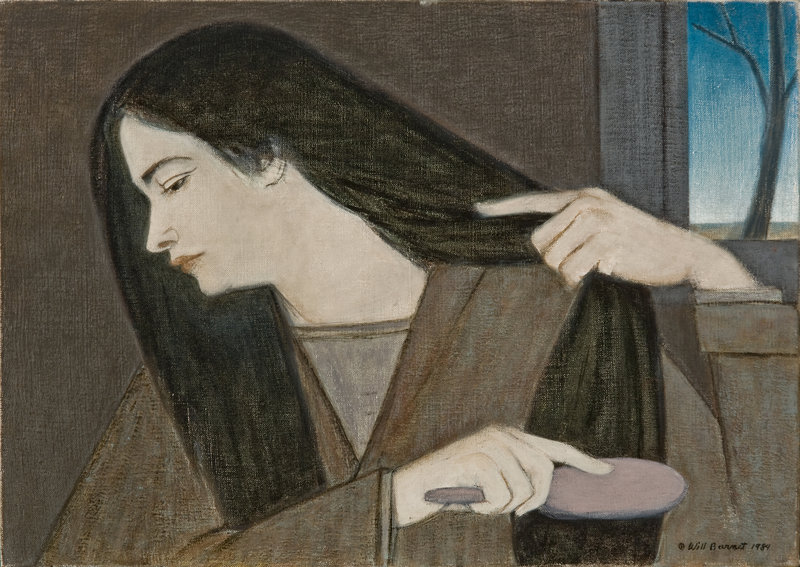
Of course, achieving such graceful clarity means there was nothing inevitable or simple about the process. It means solving all tension within the image’s structure. And above all, it means patiently working through every detail.
Cartoonists perform a sort of shorthand in which style is all about legible convention. They draw all hands and all eyes, for example, in a certain way.
Barnet does the painstaking opposite: He takes every hand and every pair of eyes, and gets to know them perfectly. This kind of minimalism requires patience, observational skill and technical talent.
It’s the kind of thing that drove the old masters to draw and draw and make study after study.
Barnet studied the masters until he knew them in his bones and ingrained this approach so long that he became one of them. His paintings reveal this. His prints prove this. And his drawings show us why.
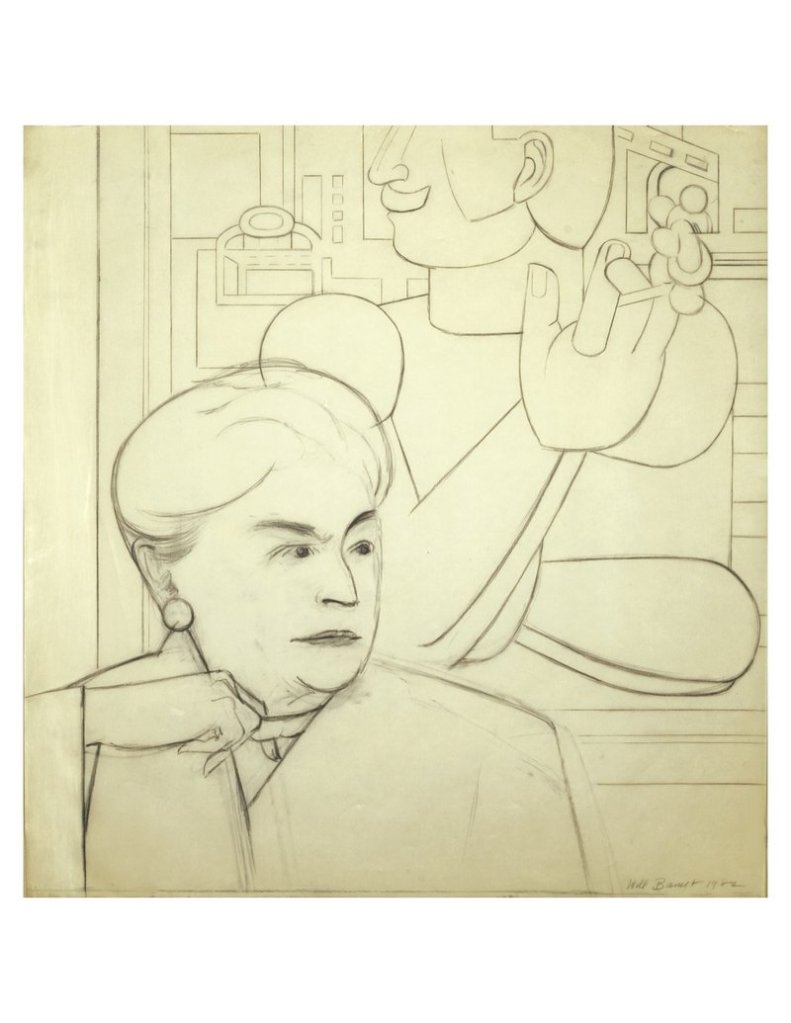
While we tend to associate Barnet with elegant lines and classical rhythms, “The Art of Will Barnet” at the Ogunquit Museum of American Art shows off the artist’s supreme draftsmanship primarily in the details of descriptive drawing.
Yet we also see how Barnet worked out his compositions by balancing longer lines with details. This kind of relationship is something almost never talked about, because it’s virtually impossible to see. But in Barnet’s spare and well-ordered world, every seemingly minor change is important.
In “Study for Janitus” (1969), we see a beautiful mature woman in portrait pose. Her body turns so that we see the curve of her left bosom in profile while the lapel line of the right side of her jacket drops straight down — facing us. Her face turns away from her body in three-quarters pose to her right.
The details of eyes, mouth and face are so stunningly apt that we can’t doubt their accuracy. Yet they are offset by the elevated bun on the back of her head, and every line in the drawing is part of a complex and perfectly resolved balance.
The irony is that the irony is invisible. There should be a tension between the buxom volume of her body and the insistent flatness of the lines on the drawing’s surface. But the tension is utterly resolved. She is a beautiful woman. And this is a beautiful drawing.
Barnet’s apparent need to know his subject so well visually is possibly why we see his family again and again. The intimacy, however, puts up no private walls. On the contrary, it allows Barnet to understand his subject and pass that sense of comfortable space on to the viewer.
One of the pieces in the show seems to cut to the quick of Barnet’s plaintive attitude toward his subjects — “The Spider Sewed at Night.” While the title ties the piece to an Emily Dickinson poem, the piece has a patient-Penelope-waiting-for-Odysseus feel that might be the single most important quality of Barnet’s work through the decades: The palpable longing of a woman for her lover’s return.
The figure gazes out the night window with her back to us. The moon is in the sky. The spider web is apparent as a compositional device — a curve in the window balancing the figure — but we might not recognize it if not for the title.
While waiting for Odysseus to return, Penelope wove at her loom during the day and undid the work at night in order to keep at bay her suitors, who were forcing her to take a husband on her completion of the shroud.
The night work was Penelope’s testament of faith. And it is this component of love — faith in the face of deferred passion — that underlies Barnet’s work. It may seem a rather Victorian idea, but it’s a perfect metaphor for figurative art: Art is not that person or thing, but a marker of its absence. Art in this sense is all about faith. She longs for him just as the artist (or viewer) longs for her.
Much of Barnet’s work, in other words, is a perpetual love letter — as well as a metaphor for art.
My favorite piece in the show is “The Caller.” Clearly, it is based on Barnet’s thorough understanding of Fragonard’s “A Young Girl Reading” at the National Gallery. (Though I’m not a fan of Fragonard in general, this might be my favorite painting in the world.) A girl sits reading a book, but Barnet’s girl has a surprise visitor in the form of a bird perched on the book. (A “caller” is traditionally the term for a romantic visitor.)
The changes in this drawing say more about Barnet’s thought processes than anything else I have ever seen. The bird seems to have been a late solution. To accommodate him, her knee curve was moved down, the mat on which she sits was extended and the line defining the left side of the image was pushed over as well.
Moreover, the line on the bottom of her robe was thickened to add both the sense of physical weight but also a visual channel to bring your eye around to her knee so that it will make the synaptic jump from the slender bird to the girl’s full brow — the space right between her eye and her brain.
The bird was drawn over the top corner of the book, which itself posed a significant pictorial issue for Barnet: How to keep the image flat and elegantly linear with an open book as the central punctuation? Barnet’s flattening of the book with awkward geometry made the caller seem, well inevitable.
It might surprise you that most of the changes in the drawings are to seemingly innocuous details. But Barnet can draw like a master. He isn’t working out problems of drawing but of structure and composition — and the devil is in the details.
Barnet is not only one of America’s greatest living artists, he’s one of our greatest artists of the past century. “The Art of Will Barnet” is a chance to see what he has been up to all these years.
Freelance writer Daniel Kany is an art historian who lives in Cumberland. He can be contacted at:
dankany@gmail.com
Send questions/comments to the editors.

Success. Please wait for the page to reload. If the page does not reload within 5 seconds, please refresh the page.
Enter your email and password to access comments.
Hi, to comment on stories you must . This profile is in addition to your subscription and website login.
Already have a commenting profile? .
Invalid username/password.
Please check your email to confirm and complete your registration.
Only subscribers are eligible to post comments. Please subscribe or login first for digital access. Here’s why.
Use the form below to reset your password. When you've submitted your account email, we will send an email with a reset code.