



The principal exhibition of work by an artist who lives in Maine — of this season and likely this year — is “Joseph Nicoletti: A Retrospective” at the Bates College Museum of Art. Nicoletti teaches at Bates, but this isn’t the obligatory one-person show accorded a senior faculty member. (Those often demonstrate why they are obligatory.)
This wonderful exhibition celebrates an artist of dark imagination, who urges the subconscious and those of us who have similar preoccupations.
Additional Photos
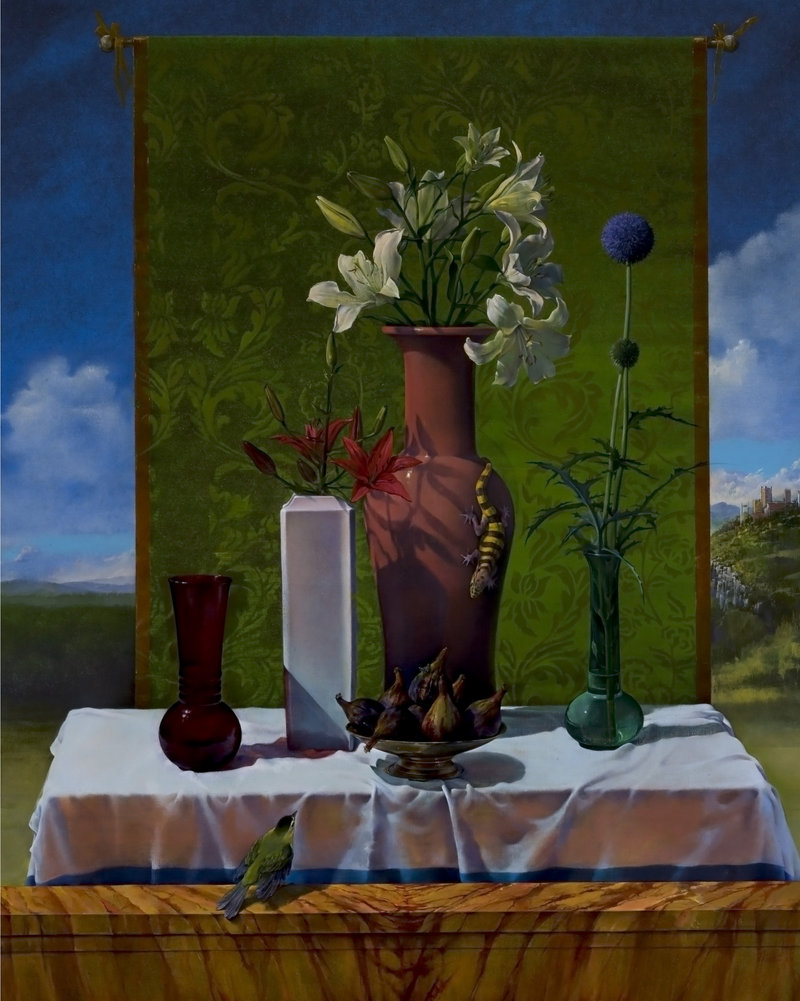
The darkness in Nicolette’s work is more than a matter of mood. It is a matter of a haunted imagination. In it are mystic plants coated with substances intended to confuse malevolent spirits. The plants and the spirits antagonize one another.
From those botanic abrasions come lilies that mask the smell of the embalmer. Spidery plants, fetid and bitter, survive in it to preside over the trays and hard tables of the post-mortem examiner.
There are altars in his work that exist in a state of piety and mission. Their appointment is to console the viewer through the use of mystical equivalents. It is not a matter of simply providing symbols; rather it is the intensity that he has infused into those symbols that are his achievement.
You can test this by considering the objects that furnish his altars — still life compositions. Their subjects — the cloth, the vessel, the severed bread, the flowers in lieu of candles, the liquid — speak of sacrifice, of mystery and death.
They are beautifully painted, in some cases ravishingly so, but the artist’s skill at this is secondary to his haunted imagination. This is rare in still life painting. The immediacy of the things portrayed is the usual name of that game.
With Nicoletti, they are the things by which the game can be played. They give form to the recesses of his mind.
Mystery and reminders of death are not the sum of Nicoletti’s work. The show also includes several beautiful paintings that treat of the landscape of Italy and a few of Maine.
But they are not fundamental to his accomplishment. It is the studio paintings that are his legacy to us. They inform us that there is a cloak of darkness over the symbols of hope.
GROOME KEEPING TRADITION
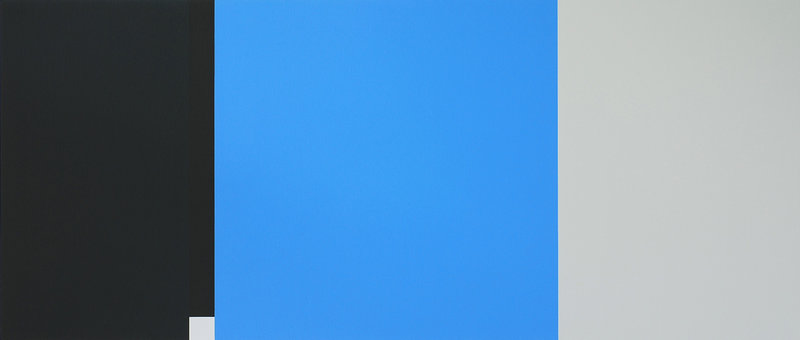
I am a years-long admirer of the work of Martha Groome, and I welcome the opportunity to put a few words to it. Her paintings are geometric abstraction in its most reductive form. Their severity and thrift are classically obtained from the early work of the likes of Barnett Newman, Brice Mardin and Ellsworth Kelly.
I don’t usually dabble in art history, but I wish to emphasize that the conviction I find in Groome’s paintings is a staunch continuation of a brilliant American tradition. They are exquisite in their appeal to the rationalist side of my nature. You can view a selection of them this month at ICON Contemporary Art in Brunswick.
Composed of groups of rectangular forms, the paintings have an inevitable affinity for one another. But they are not simply variations of a theme. As restricted as they are in both a formal sense and in nuanced color, there is a celebratory freshness to each of them. Each appears to confront its restrictions with a new eye.
Each painting in the show has its own species of animation. The rectangles move in to compress one another, expand beyond the edges of the canvas, slice through conjoining forms and cut their neighbors off at their bases.
Groome has kept faith with a compelling tradition. In Maine, if not singular, she is joined by only a few. As polished as her art is, it fits comfortably with who we think we are (or perhaps, were).
CMCA 2010 BIENNIAL
And now some thoughts about the 2010 Biennial at the Center for Maine Contemporary Art.
The fact that there is a biennial is a cause for celebration. Biennials are features of their appointed summers, and their ending would be a significant cultural loss to this state.
That loss would be measured by the disappearance of the event itself and by the elimination of a debut opportunity for a couple of dozen underserved artists.
The current biennial is particularly poignant. That it could be mounted by CMCA — the keystone of contemporary Maine art — at a time of perilous funding (see Bob Keyes’ column on Page D1) confers a high emotional value to it. You can feel it when you walk through the show. It is not a question of this event being the medium — the art is — but this year, the race is a close one.
What is the standard of this biennial? It is a fulfilling event. The quality level is as solid as in years past, although I cannot say that notable discoveries are provided. There is a minimal amount of sculpture and a surprisingly small photographic component.
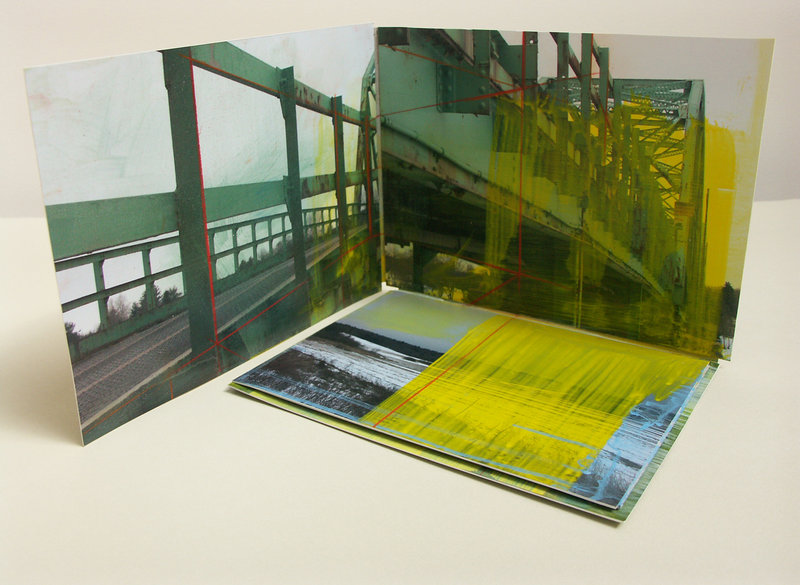
“West Gardiner Road” by Kenneth Deprez touches my taste for book form, photography, altered photographs and whimsy. Through a signature of two pages, Deprez provides mysterious images of the bridges, abutments and detritus along a habitually traveled Maine road. He finds things remarkable in the ordinary.
So does Michael Alpert in his gelatin silver print “Auburn, Maine.” An apparently vacant old-frame shoe plant stares back at the viewer. It is as matter-of-fact and non-judgmental as an image of a water tank by the Bechers.
Case Conover’s “Everything Tree” is memorable. Created by innumerable stamped impressions against a white sheet, it has the quality of a meticulously achieved pen-and-ink drawing. The stampings lose their individual identities in the process, and the effect is of an interweaving, darkening and subsiding as the impressions rise from bottom to top. The result is a landscape that’s animated, restless and not a little mysterious.
“One Mississippi” by Claire Seidl is singular in this event for its introspection. An oil on linen, there is a sense of peering into the work and being met by forms emerging from it. The resulting tension sits just below the surface of the painting — a concept that, by feeling at least, has Asian antecedents.
Susan Cooney’s “Ram Island” and “Bald Island” are tiny wonders in graphite of photoetched-like landscapes. They are irresistible of their kind. Kenny Cole’s typographic drawings elude me in their message, but charm me in the visual employment of their forms, and Scott Reed’s pen-and-ink, dealing with riding the circuits of stars and walks on undescribed spaces, is irresistible in its undefined intent and in the fluency of its execution.
There are 40 or more other artists exhibiting in this fine, wide-ranging event. It warrants two visits.
Philip Isaacson of Lewiston has been writing about the arts for the Maine Sunday Telegram for 45 years. He can be contacted at:
pmisaacson@isaacsonraymond.com
Copy the Story Link
Send questions/comments to the editors.

Success. Please wait for the page to reload. If the page does not reload within 5 seconds, please refresh the page.
Enter your email and password to access comments.
Hi, to comment on stories you must . This profile is in addition to your subscription and website login.
Already have a commenting profile? .
Invalid username/password.
Please check your email to confirm and complete your registration.
Only subscribers are eligible to post comments. Please subscribe or login first for digital access. Here’s why.
Use the form below to reset your password. When you've submitted your account email, we will send an email with a reset code.